The tweet was deleted by the author.
But we saved everything 🙂.

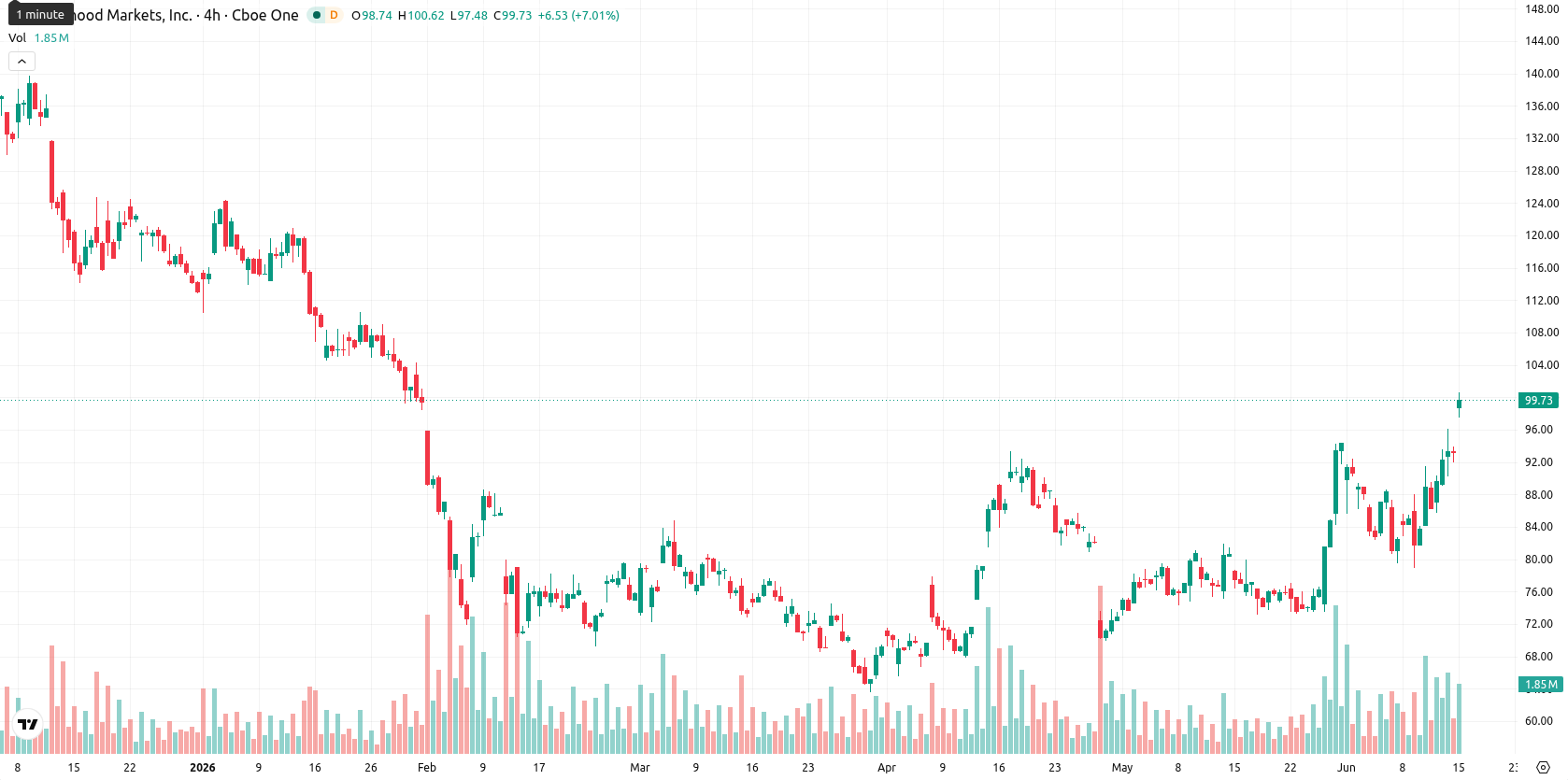
Robinhood Markets Inc (HOOD) is trading at $100.15, up $6.96 or 7.5% from the previous close of $93.19, after a strong intraday rally from the $98.90 open (+$1.25, or +1.3% intraday). The surge is driven by robust technical momentum, a recent bullish gap up, and supportive corporate news, with enhanced sentiment also contributed by the influencer’s announcement of a major new trading feature.
 118.35
118.65
118.35
118.65
Robinhood announced that Agentic Trading is now live for all customers, enabling users to connect any AI agent through the platform for automated trading and research. This statement is significant as it showcases product innovation, potentially boosting user engagement and adoption of HOOD’s ecosystem. The market has responded positively to both this launch and the company’s impressive operating results, including 48% year-over-year asset growth and strong trading volumes. Additional drivers include a major insider buy, new regulatory approval to underwrite IPOs, and the recent class action lawsuit, though positive fundamentals are currently the main focus.
HOOD trades above the MA-20 ($82.82) and MA-50 ($80.24) but remains just below the MA-200 ($102.81), underscoring strong short- and medium-term bullish momentum with key long-term resistance near $102. The nearest support is the Ichimoku Kijun at $84.58, while strong resistance sits at the MA-200 and the $102 area. Momentum signals, especially the MACD, confirm an ongoing uptrend, although several oscillators are in overbought territory. The 5-day outlook sees HOOD consolidating between $96.00 and $104.00, with the tweet’s fundamental signal supporting the technical outlook.
Previously it was reported that Robinhood imposed strict selling restrictions on retail investors participating in high-demand IPOs including potential penalties for selling shares soon after listing. In the current context, ongoing developments in the brokerage landscape warrant careful monitoring of Robinhood’s policy shifts, with any changes likely to impact trading dynamics during the next wave of IPOs.

 Afghanistan
 Albania
 Algeria
 Angola
 Argentina
 Armenia
 Australia
 Austria
 Azerbaijan
 Bahamas
 Bahrain
 Bangladesh
 Belarus
 Belgium
 Bolivia
 Botswana
 Brazil
 Brunei
 Bulgaria
 Cambodia
 Cameroon
 Canada
 Chile
Chile
 China
China
 Colombia
 Congo
Congo
 Costa Rica
 Cote d'Ivoire
 Croatia
 Cuba
Cuba
 Cyprus
 Czechia
 DR Congo
 Denmark
 Dominican Republic
 Ecuador
 Egypt
Egypt
 El Salvador
 Estonia
 Eswatini
 Ethiopia
 Finland
 France
 Georgia
 Germany
 Ghana
Ghana
 Greece
 Haiti
Haiti
 Hong Kong
 Hungary
 India
India
 Indonesia
 Iran, Islamic republic
 Iraq
Iraq
 Ireland
 Israel
 Italy
Italy
 Jamaica
 Japan
Japan
 Jordan
 Kazakhstan
 Kenya
Kenya
 Korea
Korea
 Kuwait
 Kyrgyzstan
 Laos
Laos
 Latvia
 Lebanon
 Lesotho
 Libya
Libya
 Lithuania
 Luxembourg
 Madagascar
 Malaysia
 Malta
Malta
 Mauritius
 Mexico
 Moldova
 Mongolia
 Montenegro
 Morocco
 Mozambique
 Myanmar
 Namibia
 Nepal
Nepal
 Netherlands
 New Zealand
 Nigeria
 North Macedonia
 Norway
 Oman
Oman
 Pakistan
 Palestine
 Panama
 Papua New Guinea
 Paraguay
 Peru
Peru
 Philippines
 Poland
 Portugal
 Puerto Rico
 Qatar
Qatar
 Reunion
 Romania
 Rwanda
 Saudi Arabia
 Serbia
 Singapore
 Slovakia
 Slovenia
 Somalia
 South Africa
 Spain
Spain
 Sri Lanka
 Sweden
 Switzerland
 Syria
Syria
 Taiwan
 Tajikistan
 Tanzania
 Thailand
 Trinidad and Tobago
 Tunisia
 Turkey
 UAE
UAE
 Uganda
 Ukraine
 United Kingdom
United States
United Kingdom
United States
 Uruguay
 Uzbekistan
 Venezuela
 Vietnam
 Yemen
Yemen
 Zambia
 Zimbabwe