
Amazon stock drops 1.9% as wedge pattern warns of pullback

As of May 6, Amazon stock is trading at $186.35, down 1.9% in the past 24 hours. The recent decline comes amid growing technical signs of a potential pullback.
Amazon’s chart reveals the formation of a rising wedge—a pattern typically considered bearish as it indicates a loss of bullish momentum and an increased likelihood of a downside break. This pattern is characterized by upward-sloping support and resistance trendlines that are converging, implying tightening price action and a potential reversal.
From a moving average perspective, Amazon remains above both the 50-day and 200-day simple moving averages, suggesting that the medium- to long-term trend remains intact. However, the narrowing of the wedge and recent bearish candlesticks on the daily chart reflect short-term weakness. The Relative Strength Index (RSI) is hovering near the 60 level, still in bullish territory but pulling back slightly, which may indicate waning buying pressure.
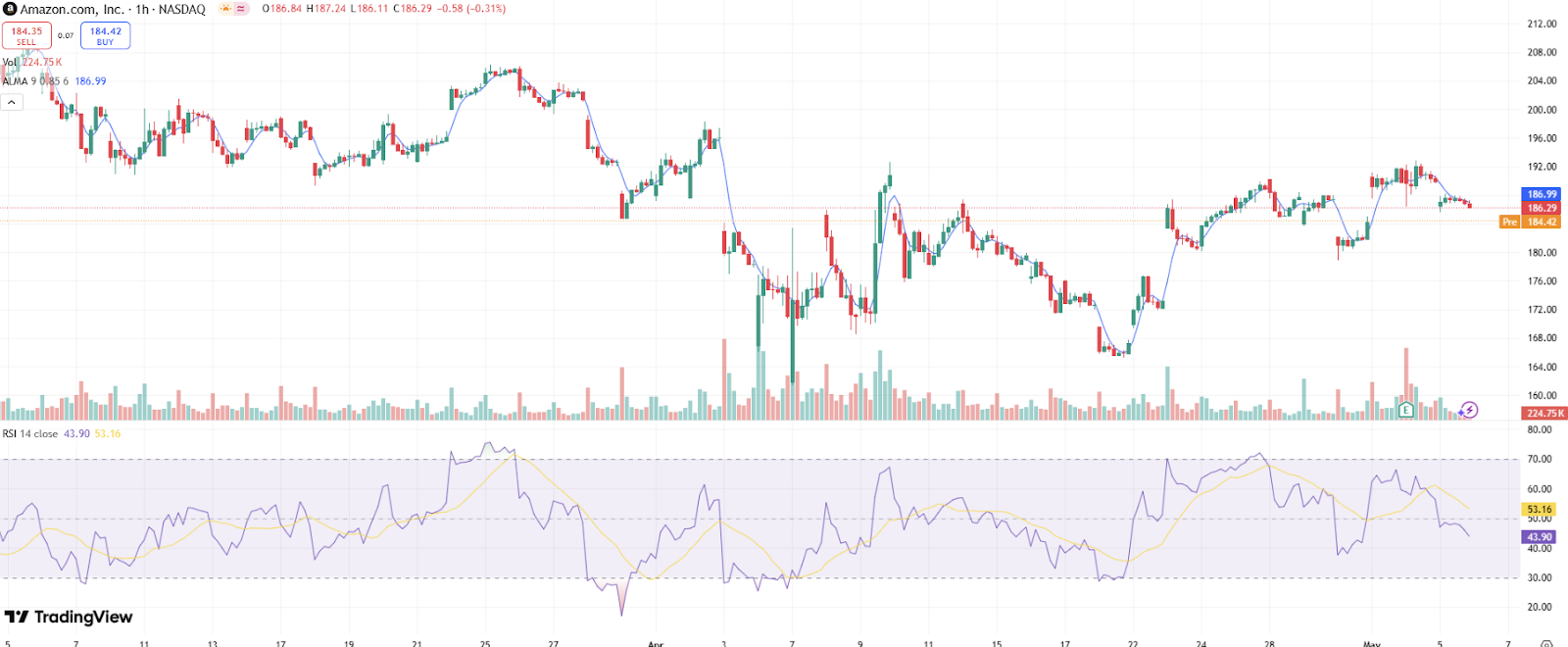
AMZN stock price dynamics (March 2025 - May 2025). Source: TradingView.
Key support levels to monitor include $170, which served as a floor during late April and coincides with the 200-day moving average. A break below this level would likely trigger further selling pressure and open the path toward $152, which marks the August 2024 low and a significant psychological level. On the upside, immediate resistance lies at $199, near the top of the wedge and the early April high. If the stock can break above this level, the next target would be $216, which aligns with the peak observed in November 2024.
Market context: cautious optimism amid macro uncertainty
Despite its strong fundamentals, Amazon faces a mixed macroeconomic environment that could hinder short-term gains. The latest earnings report beat analyst expectations on revenue and cloud growth, but the company offered a cautious outlook, citing possible challenges from slowing consumer spending and global economic headwinds. CEO Andy Jassy acknowledged the risk of tariffs affecting product pricing and margins, although he emphasized that the company has not yet seen a material impact from current trade measures.
The Nasdaq report argues that Amazon’s diversified revenue streams—particularly from AWS, advertising, and subscription services—buffer the company against volatility in its retail segment. Moreover, Amazon’s operating margins have shown improvement over the past few quarters, supported by increased automation, AI-driven logistics, and aggressive cost management initiatives.
On the broader market front, there’s a heightened sensitivity to Federal Reserve policy and interest rate trajectories. As inflation shows signs of stickiness, investors remain cautious about potential rate hikes, which could further compress valuation multiples across growth stocks, including Amazon. While Amazon is not immune to such macro pressures, its dominant market position and operational resilience provide a relative safe haven for long-term investors.
Breakout or breakdown imminent
The confluence of technical and macroeconomic signals suggests that Amazon is nearing a critical inflection point. If the stock fails to hold the $170 support level, a downside move toward $152 could play out swiftly, particularly if accompanied by broader market weakness or disappointing macro data. A break below the wedge would likely attract technical selling and possibly shift sentiment negatively in the near term.
Conversely, a successful breakout above the $199 resistance could trigger renewed bullish momentum. In this scenario, the stock could target the $216 zone, especially if upcoming economic indicators or Fed commentary turn more dovish. Additionally, continued strength in AWS growth or a positive surprise in retail metrics could catalyze upside movement.
Amazon posted strong quarterly results driven by AWS growth and a rebound in advertising revenue. However, management struck a cautious tone with a softer outlook, citing concerns over economic headwinds and slowing consumer demand.


Latest Amazon News







-
 Afghanistan
-
 Albania
-
 Algeria
-
 Angola
-
 Argentina
-
 Armenia
-
 Australia
-
 Austria
-
 Azerbaijan
-
 Bahamas
-
 Bahrain
-
 Bangladesh
-
 Belarus
-
 Belgium
-
 Bolivia
-
 Botswana
-
 Brazil
-
 Brunei
-
 Bulgaria
-
 Cambodia
-
 Cameroon
-
 Canada
-
 Chile
Chile
-
 China
China
-
 Colombia
-
 Congo
Congo
-
 Costa Rica
-
 Cote d'Ivoire
-
 Croatia
-
 Cuba
Cuba
-
 Cyprus
-
 Czechia
-
 DR Congo
-
 Denmark
-
 Dominican Republic
-
 Ecuador
-
 Egypt
Egypt
-
 El Salvador
-
 Estonia
-
 Eswatini
-
 Ethiopia
-
 Finland
-
 France
-
 Georgia
-
 Germany
-
 Ghana
Ghana
-
 Greece
-
 Haiti
Haiti
-
 Hong Kong
-
 Hungary
-
 India
India
-
 Indonesia
-
 Iran, Islamic republic
-
 Iraq
Iraq
-
 Ireland
-
 Israel
-
 Italy
Italy
-
 Jamaica
-
 Japan
Japan
-
 Jordan
-
 Kazakhstan
-
 Kenya
Kenya
-
 Korea
Korea
-
 Kuwait
-
 Kyrgyzstan
-
 Laos
Laos
-
 Latvia
-
 Lebanon
-
 Lesotho
-
 Libya
Libya
-
 Lithuania
-
 Luxembourg
-
 Madagascar
-
 Malaysia
-
 Malta
Malta
-
 Mauritius
-
 Mexico
-
 Moldova
-
 Mongolia
-
 Montenegro
-
 Morocco
-
 Mozambique
-
 Myanmar
-
 Namibia
-
 Nepal
Nepal
-
 Netherlands
-
 New Zealand
-
 Nigeria
-
 North Macedonia
-
 Norway
-
 Oman
Oman
-
 Pakistan
-
 Palestine
-
 Panama
-
 Papua New Guinea
-
 Paraguay
-
 Peru
Peru
-
 Philippines
-
 Poland
-
 Portugal
-
 Puerto Rico
-
 Qatar
Qatar
-
 Reunion
-
 Romania
-
 Rwanda
-
 Saudi Arabia
-
 Serbia
-
 Singapore
-
 Slovakia
-
 Slovenia
-
 Somalia
-
 South Africa
-
 Spain
Spain
-
 Sri Lanka
-
 Sweden
-
 Switzerland
-
 Syria
Syria
-
 Taiwan
-
 Tajikistan
-
 Tanzania
-
 Thailand
-
 Trinidad and Tobago
-
 Tunisia
-
 Turkey
-
 UAE
UAE
-
 Uganda
-
 Ukraine
-
 United Kingdom
-
United States
-
 Uruguay
-
 Uzbekistan
-
 Venezuela
-
 Vietnam
-
 Yemen
Yemen
-
 Zambia
-
 Zimbabwe
- Forex
- Crypto












