
Nvidia stock climbs 3.6% on optimism over China chip sales despite export curbs

As of September 11, Nvidia stock is trading at $177.17, up 3.6% in the past 24 hours. This marks a strong rebound after a brief period of consolidation, where shares dipped toward the $165 level.
Highlights
- Nvidia stock is trading at $177.17 after a 3.6% gain, reclaiming its 50-day moving average and signaling renewed bullish momentum.
- Technical indicators suggest a potential breakout above the $185–$190 resistance range, with upside targets near $210.
- Market optimism is fueled by expected China chip sales despite regulatory challenges.
Intraday trading showed a high of $179.25 and a low of $173.36, suggesting upward momentum with room to test overhead resistance levels. Immediate support is now established in the $170–$172 zone, while stronger historical support lies around $165. On the upside, the stock faces resistance at $185, a level it has tested several times without a clear breakout. A move above $190 would mark a new short-term bullish breakout and could open the path to the $200–$210 zone.
Momentum indicators such as RSI are showing neutral to mildly bullish signals, while moving average convergence-divergence (MACD) lines have started to turn upward again. Volume on up-days is improving, indicating renewed institutional interest. The recent price recovery, after an August pullback, reflects growing optimism around Nvidia’s AI chip dominance and progress in navigating export restrictions.
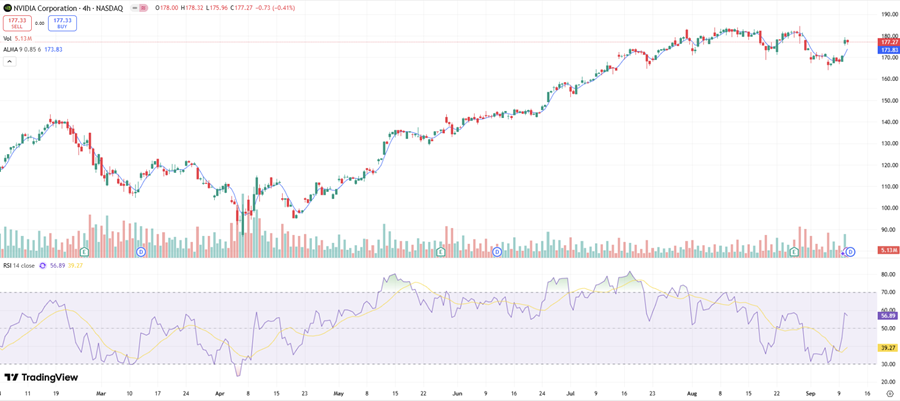
Nvidia stock price dynamics (July 2025 - September 2025). Source: TradingView
The stock continues to trade within a rising channel pattern, with higher lows forming consistently since late July. This structure suggests underlying strength and a gradual accumulation phase. Additionally, the 21-day exponential moving average (EMA) is beginning to curl upward and could soon cross above the 50-day SMA, reinforcing the bullish alignment if the price remains above $175. This confluence of technical signals increases the likelihood of a retest of the $185 resistance in the near term.
China licensing, chip-specific demand, and policy risk define the news cycle
Nvidia’s short-term trajectory remains heavily influenced by the situation in China, where AI chip sales have become both a growth opportunity and a political liability. The company has created specialized chips such as the H20 to comply with U.S. export restrictions, but sales of the H20 in China were effectively zero in the most recent quarter.
However, there is a notable shift: the U.S. government has recently allowed Nvidia to begin delivering the H20 to Chinese firms under a framework that includes a 15% revenue-sharing agreement with the federal government. This compromise opens the door for Nvidia to begin collecting revenue from previously frozen orders by major Chinese cloud players like Alibaba, Tencent, and ByteDance. These companies are still eager to acquire Nvidia hardware, despite local pressure to reduce dependence on U.S. suppliers.
Meanwhile, Nvidia is also preparing the release of a new product—the B30A—based on the upcoming Blackwell architecture. Some Chinese firms have already expressed interest in the B30A, potentially creating a follow-up wave of demand if export licenses are secured. U.S. policy on high-end semiconductor exports remains fluid, and further developments in the U.S.-China tech rivalry could affect future sales forecasts.
$200 upside possible, but policy risk caps breakout potential
Nvidia remains a high-beta stock with sensitivity to both tech sentiment and geopolitical news. In the near term, the most likely scenario is continued trading within a rising channel, bounded by $170 on the downside and $190 on the upside. A confirmed breakout above $190 could push the stock to test $200–$210 levels, particularly if China-related revenue materializes and U.S. licensing eases further.
A bearish scenario, though less likely in the immediate term, would emerge if China orders are delayed or blocked, or if rivals announce major breakthroughs in AI chip design. In that case, NVDA could retrace to test long-term support near $155–$160.
Broadcom’s $10 billion investment in custom AI accelerators signals rising competition for Nvidia’s dominance in the AI GPU market. With XPU sales projected to grow faster than AI GPUs by 2026, Nvidia’s near-total market share faces increasing pressure.







-
 Afghanistan
-
 Albania
-
 Algeria
-
 Angola
-
 Argentina
-
 Armenia
-
 Australia
-
 Austria
-
 Azerbaijan
-
 Bahamas
-
 Bahrain
-
 Bangladesh
-
 Belarus
-
 Belgium
-
 Bolivia
-
 Botswana
-
 Brazil
-
 Brunei
-
 Bulgaria
-
 Cambodia
-
 Cameroon
-
 Canada
-
 Chile
Chile
-
 China
China
-
 Colombia
-
 Congo
Congo
-
 Costa Rica
-
 Cote d'Ivoire
-
 Croatia
-
 Cuba
Cuba
-
 Cyprus
-
 Czechia
-
 DR Congo
-
 Denmark
-
 Dominican Republic
-
 Ecuador
-
 Egypt
Egypt
-
 El Salvador
-
 Estonia
-
 Eswatini
-
 Ethiopia
-
 Finland
-
 France
-
 Georgia
-
 Germany
-
 Ghana
Ghana
-
 Greece
-
 Haiti
Haiti
-
 Hong Kong
-
 Hungary
-
 India
India
-
 Indonesia
-
 Iran, Islamic republic
-
 Iraq
Iraq
-
 Ireland
-
 Israel
-
 Italy
Italy
-
 Jamaica
-
 Japan
Japan
-
 Jordan
-
 Kazakhstan
-
 Kenya
Kenya
-
 Korea
Korea
-
 Kuwait
-
 Kyrgyzstan
-
 Laos
Laos
-
 Latvia
-
 Lebanon
-
 Lesotho
-
 Libya
Libya
-
 Lithuania
-
 Luxembourg
-
 Madagascar
-
 Malaysia
-
 Malta
Malta
-
 Mauritius
-
 Mexico
-
 Moldova
-
 Mongolia
-
 Montenegro
-
 Morocco
-
 Mozambique
-
 Myanmar
-
 Namibia
-
 Nepal
Nepal
-
 Netherlands
-
 New Zealand
-
 Nigeria
-
 North Macedonia
-
 Norway
-
 Oman
Oman
-
 Pakistan
-
 Palestine
-
 Panama
-
 Papua New Guinea
-
 Paraguay
-
 Peru
Peru
-
 Philippines
-
 Poland
-
 Portugal
-
 Puerto Rico
-
 Qatar
Qatar
-
 Reunion
-
 Romania
-
 Rwanda
-
 Saudi Arabia
-
 Serbia
-
 Singapore
-
 Slovakia
-
 Slovenia
-
 Somalia
-
 South Africa
-
 Spain
Spain
-
 Sri Lanka
-
 Sweden
-
 Switzerland
-
 Syria
Syria
-
 Taiwan
-
 Tajikistan
-
 Tanzania
-
 Thailand
-
 Trinidad and Tobago
-
 Tunisia
-
 Turkey
-
 UAE
UAE
-
 Uganda
-
 Ukraine
-
 United Kingdom
-
United States
-
 Uruguay
-
 Uzbekistan
-
 Venezuela
-
 Vietnam
-
 Yemen
Yemen
-
 Zambia
-
 Zimbabwe
- Forex
- Crypto











