
Nvidia stock drops 1.5% amid weak demand for RTX6000D chip in China

As of September 17, Nvidia stock is trading at $175.11, down 1.5% in the past 24 hours. The stock has pulled back from its recent high near $183 after news that the RTX6000D chip, designed to meet U.S. export rules, is struggling in China.
Highlights
- Nvidia shares slipped 1.5% to $175.11 as its China-focused RTX6000D chip failed to gain traction with major buyers.
- Grey market GPUs like the RTX 5090 are being favored due to better performance and pricing.
- Regulatory pressure from a Chinese antitrust probe adds further risk to Nvidia’s China outlook.
Nvidia remains above its 50-day moving average, which is currently acting as a dynamic support level around the $170 mark. The 200-day moving average is still far below the current price near the $130 range, indicating that the broader bullish trend is still in place. However, the price action over the last few sessions reflects consolidation and indecision, with the inability to break above the $183 resistance zone acting as a cap on momentum.
Support levels to watch in the near term are $170 and then $160, where buyers previously stepped in during July and early August. If these levels fail, downside could accelerate toward $150. On the upside, the $183 level is a key barrier. A close above this level on strong volume would open the path toward the $200 psychological threshold.
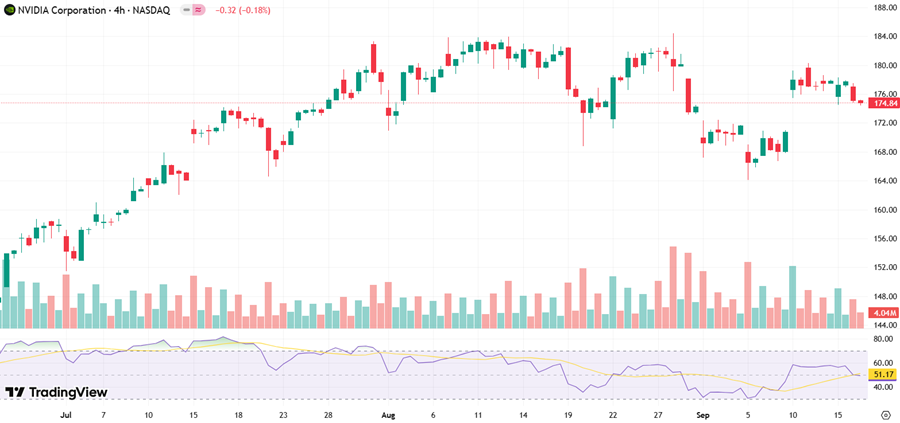
Nvidia stock price dynamics (July 2025 - September 2025). Source: TradingView
Momentum indicators such as the Relative Strength Index (RSI) are currently neutral, hovering in the 50–55 range. This suggests the stock is neither overbought nor oversold, leaving room for movement in either direction. The Moving Average Convergence Divergence (MACD) remains in bullish territory, though the histogram shows waning strength, hinting that upside momentum is slowing.
China sales disappoint as RTX6000D fails to impress major tech buyers
The recent stock weakness is closely tied to Nvidia’s latest attempt to salvage its presence in China — the RTX6000D GPU. This chip was designed to comply with U.S. export controls while offering sufficient performance for Chinese buyers. However, major firms such as Alibaba, Tencent, and ByteDance have so far declined to adopt the RTX6000D. The reasons are clear: the chip is priced near $7,000 but underperforms compared to alternatives that are still entering the market through unofficial channels.
Instead, Chinese firms are reportedly purchasing the RTX 5090, a high-end consumer graphics card, from grey market suppliers. These chips, despite being technically restricted, remain widely available through third-party distributors and are priced more competitively. Many of these cards are repurposed for data center tasks despite being consumer-grade, allowing companies to bypass export controls without sacrificing too much performance. This trend reflects both a growing sophistication in China's AI infrastructure workarounds and a weakening grip of U.S. enforcement on high-performance GPU trade.
Compounding the situation, Chinese regulators have initiated a preliminary finding that Nvidia may have violated antitrust law through its acquisition of Mellanox in 2020. While no formal penalties have yet been announced, the investigation adds another layer of regulatory overhang, just as Nvidia seeks to preserve market share in a region that once accounted for a significant portion of its data center revenue.
Risk of short-term correction, medium-term upside intact
Given the technical setup and the recent negative headlines out of China, Nvidia stock is entering a critical short-term phase. If the $170–175 support band holds, the base case remains a continuation toward the $185–200 range over the next 1–3 months, particularly if broader AI demand supports earnings growth. This would likely require positive catalysts, such as stronger-than-expected global sales or resolution of regulatory concerns in China.
On the downside, failure to hold $170 could trigger a sharper correction, potentially dragging shares toward $160, or in a more bearish scenario, $150. That would likely coincide with further deterioration of Nvidia’s China position or a broader pullback in AI-linked tech stocks. Overall, while the China-related risks are real and immediate, Nvidia continues to benefit from dominant market share in high-end AI computing.
Nvidia’s recent share decline is linked to China’s expanded antitrust probe into its 2020 acquisition of Mellanox Technologies. Regulators claim Nvidia failed to meet anti-monopoly conditions, with preliminary findings indicating possible non-compliance.







-
 Afghanistan
-
 Albania
-
 Algeria
-
 Angola
-
 Argentina
-
 Armenia
-
 Australia
-
 Austria
-
 Azerbaijan
-
 Bahamas
-
 Bahrain
-
 Bangladesh
-
 Belarus
-
 Belgium
-
 Bolivia
-
 Botswana
-
 Brazil
-
 Brunei
-
 Bulgaria
-
 Cambodia
-
 Cameroon
-
 Canada
-
 Chile
Chile
-
 China
China
-
 Colombia
-
 Congo
Congo
-
 Costa Rica
-
 Cote d'Ivoire
-
 Croatia
-
 Cuba
Cuba
-
 Cyprus
-
 Czechia
-
 DR Congo
-
 Denmark
-
 Dominican Republic
-
 Ecuador
-
 Egypt
Egypt
-
 El Salvador
-
 Estonia
-
 Eswatini
-
 Ethiopia
-
 Finland
-
 France
-
 Georgia
-
 Germany
-
 Ghana
Ghana
-
 Greece
-
 Haiti
Haiti
-
 Hong Kong
-
 Hungary
-
 India
India
-
 Indonesia
-
 Iran, Islamic republic
-
 Iraq
Iraq
-
 Ireland
-
 Israel
-
 Italy
Italy
-
 Jamaica
-
 Japan
Japan
-
 Jordan
-
 Kazakhstan
-
 Kenya
Kenya
-
 Korea
Korea
-
 Kuwait
-
 Kyrgyzstan
-
 Laos
Laos
-
 Latvia
-
 Lebanon
-
 Lesotho
-
 Libya
Libya
-
 Lithuania
-
 Luxembourg
-
 Madagascar
-
 Malaysia
-
 Malta
Malta
-
 Mauritius
-
 Mexico
-
 Moldova
-
 Mongolia
-
 Montenegro
-
 Morocco
-
 Mozambique
-
 Myanmar
-
 Namibia
-
 Nepal
Nepal
-
 Netherlands
-
 New Zealand
-
 Nigeria
-
 North Macedonia
-
 Norway
-
 Oman
Oman
-
 Pakistan
-
 Palestine
-
 Panama
-
 Papua New Guinea
-
 Paraguay
-
 Peru
Peru
-
 Philippines
-
 Poland
-
 Portugal
-
 Puerto Rico
-
 Qatar
Qatar
-
 Reunion
-
 Romania
-
 Rwanda
-
 Saudi Arabia
-
 Serbia
-
 Singapore
-
 Slovakia
-
 Slovenia
-
 Somalia
-
 South Africa
-
 Spain
Spain
-
 Sri Lanka
-
 Sweden
-
 Switzerland
-
 Syria
Syria
-
 Taiwan
-
 Tajikistan
-
 Tanzania
-
 Thailand
-
 Trinidad and Tobago
-
 Tunisia
-
 Turkey
-
 UAE
UAE
-
 Uganda
-
 Ukraine
-
 United Kingdom
-
United States
-
 Uruguay
-
 Uzbekistan
-
 Venezuela
-
 Vietnam
-
 Yemen
Yemen
-
 Zambia
-
 Zimbabwe
- Forex
- Crypto











