
WTI crude oil steadies near $61 as OPEC+ output restraint and Russia outage limit downside

WTI crude oil traded around $61.65 on Tuesday, extending its recovery for a third consecutive session after OPEC+ announced a smaller-than-expected production increase for November. The restrained output adjustment, combined with temporary supply disruptions from Russia’s Kirishi refinery, has offered short-term support.
Highlights
- WTI crude trades near $61.65, extending its three-day recovery.
- OPEC+’s smaller output hike and Russia’s refinery outage offer short-term support.
- Broader trend remains fragile amid oversupply concerns and weak demand outlook.
However, the broader structure remains fragile as oversupply and soft demand continue to cap the upside.
Price action and technical setup
WTI has been struggling to regain traction after its late-September decline from the $66–67 zone. The chart highlights a choppy downtrend characterized by lower highs and repeated rejections along a descending trendline. Price is currently testing the 20-day exponential moving average at $61.70, with the 50-day EMA at $62.27 and the 100-day EMA at $62.77 reinforcing a heavy resistance band. The 200-day EMA near $63.31 marks the key level bulls need to reclaim to shift the technical outlook back in their favor.
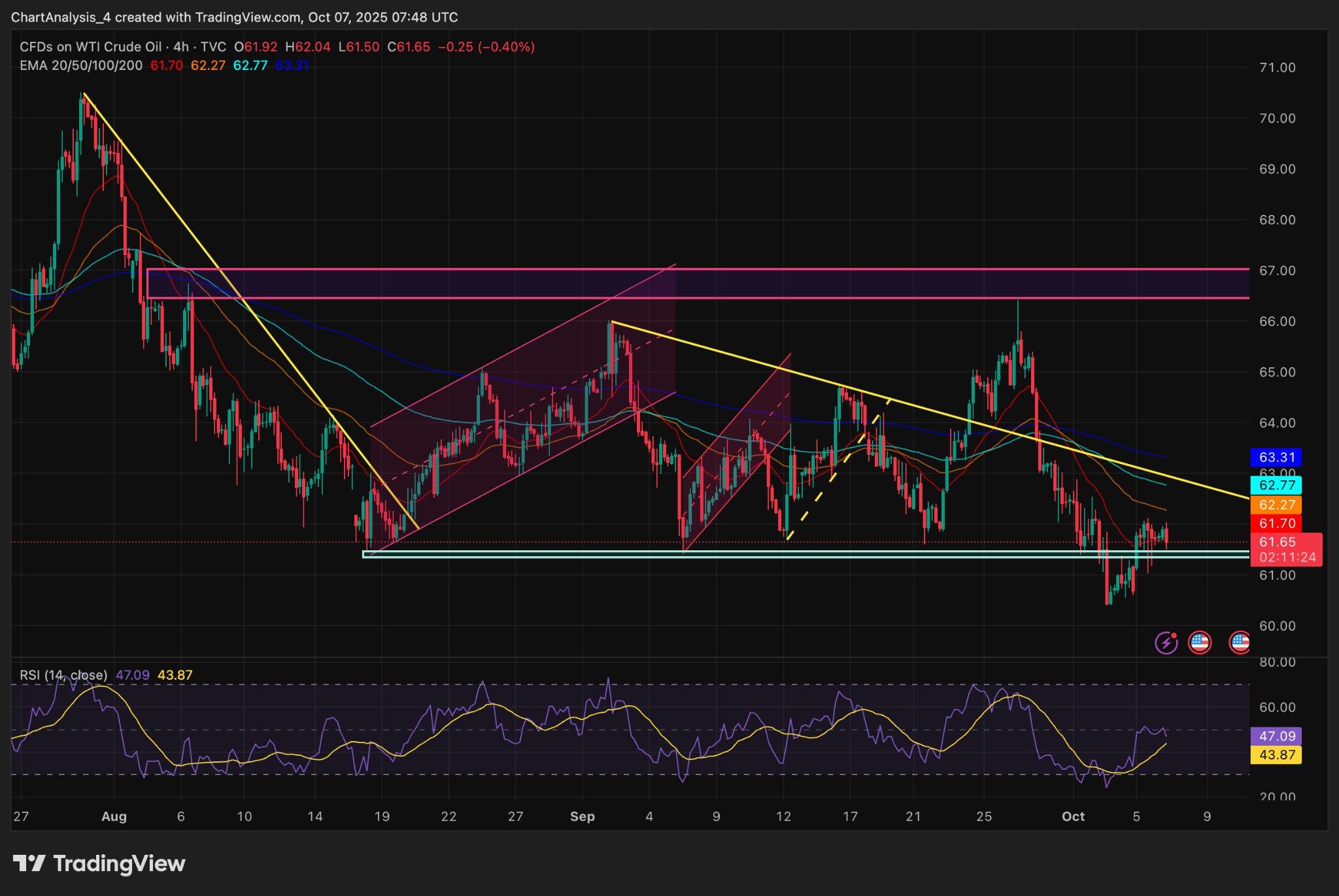
WTI price dynamics (Source: TradingView)
Support remains concentrated around $61.00–$61.20, a zone that has repeatedly attracted buyers in recent weeks. A breakdown below this level would expose $60.50 and potentially extend losses toward $59.50. Conversely, a decisive close above $63.30 would mark a significant technical improvement, opening the path for a retest of $65.50–$66.70.
The relative strength index at 47 signals neutral momentum, consistent with a market in consolidation. While the rebound from oversold territory indicates stabilization, upside momentum remains muted unless price clears the $63 handle.
Market fundamentals and OPEC+ dynamics
OPEC+’s latest decision to raise output by 137,000 barrels per day for November — in line with the previous month — reinforced the group’s cautious stance on supply management. The measured increase soothed fears of an aggressive expansion that could have deepened the ongoing supply imbalance. The move was interpreted by traders as an attempt to stabilize prices near the $60–62 range amid growing pressure from non-OPEC+ production.
Adding to the near-term support, reports indicated that Russia’s Kirishi refinery, one of the country’s largest, suffered operational damage after a drone strike and could remain offline for several weeks. The outage, though temporary, has constrained regional exports and injected short-term tightness into the global market.
Still, concerns over oversupply persist. Rising output from the U.S., Brazil, and Guyana continues to offset OPEC+ restraint, while global demand remains uneven due to economic uncertainty. Analysts note that the extended U.S. government shutdown could delay vital economic data, complicating market assessments of future demand trends.
Outlook
WTI crude oil remains rangebound within a tight band, supported near $61 but facing firm resistance just above current levels. The ongoing geopolitical backdrop and OPEC+ output moderation provide a cushion against deeper losses, yet the absence of strong demand growth limits the potential for a sustained breakout.
In the short term, holding above $61 keeps the market stable within its consolidation phase, while a close above $63–64 would signal renewed bullish control. A drop below $61 would confirm renewed downside pressure, with $59.50 as the next target.
The broader trend remains cautiously neutral until price action confirms a break from the current compression zone. Traders are watching upcoming U.S. inventory data and OPEC commentary for clearer directional cues heading into mid-October.
Earlier analysis identified the $60–67 range as the primary trading corridor, noting that price stability around $61 could precede a rebound attempt if supply disruptions persist. The current structure reinforces that view, showing resilience near key support despite macro headwinds.





Latest WTI News









-
 Afghanistan
-
 Albania
-
 Algeria
-
 Angola
-
 Argentina
-
 Armenia
-
 Australia
-
 Austria
-
 Azerbaijan
-
 Bahamas
-
 Bahrain
-
 Bangladesh
-
 Belarus
-
 Belgium
-
 Bolivia
-
 Botswana
-
 Brazil
-
 Brunei
-
 Bulgaria
-
 Cambodia
-
 Cameroon
-
 Canada
-
 Chile
Chile
-
 China
China
-
 Colombia
-
 Congo
Congo
-
 Costa Rica
-
 Cote d'Ivoire
-
 Croatia
-
 Cuba
Cuba
-
 Cyprus
-
 Czechia
-
 DR Congo
-
 Denmark
-
 Dominican Republic
-
 Ecuador
-
 Egypt
Egypt
-
 El Salvador
-
 Estonia
-
 Eswatini
-
 Ethiopia
-
 Finland
-
 France
-
 Georgia
-
 Germany
-
 Ghana
Ghana
-
 Greece
-
 Haiti
Haiti
-
 Hong Kong
-
 Hungary
-
 India
India
-
 Indonesia
-
 Iran, Islamic republic
-
 Iraq
Iraq
-
 Ireland
-
 Israel
-
 Italy
Italy
-
 Jamaica
-
 Japan
Japan
-
 Jordan
-
 Kazakhstan
-
 Kenya
Kenya
-
 Korea
Korea
-
 Kuwait
-
 Kyrgyzstan
-
 Laos
Laos
-
 Latvia
-
 Lebanon
-
 Lesotho
-
 Libya
Libya
-
 Lithuania
-
 Luxembourg
-
 Madagascar
-
 Malaysia
-
 Malta
Malta
-
 Mauritius
-
 Mexico
-
 Moldova
-
 Mongolia
-
 Montenegro
-
 Morocco
-
 Mozambique
-
 Myanmar
-
 Namibia
-
 Nepal
Nepal
-
 Netherlands
-
 New Zealand
-
 Nigeria
-
 North Macedonia
-
 Norway
-
 Oman
Oman
-
 Pakistan
-
 Palestine
-
 Panama
-
 Papua New Guinea
-
 Paraguay
-
 Peru
Peru
-
 Philippines
-
 Poland
-
 Portugal
-
 Puerto Rico
-
 Qatar
Qatar
-
 Reunion
-
 Romania
-
 Rwanda
-
 Saudi Arabia
-
 Serbia
-
 Singapore
-
 Slovakia
-
 Slovenia
-
 Somalia
-
 South Africa
-
 Spain
Spain
-
 Sri Lanka
-
 Sweden
-
 Switzerland
-
 Syria
Syria
-
 Taiwan
-
 Tajikistan
-
 Tanzania
-
 Thailand
-
 Trinidad and Tobago
-
 Tunisia
-
 Turkey
-
 UAE
UAE
-
 Uganda
-
 Ukraine
-
 United Kingdom
-
United States
-
 Uruguay
-
 Uzbekistan
-
 Venezuela
-
 Vietnam
-
 Yemen
Yemen
-
 Zambia
-
 Zimbabwe
- Forex
- Crypto











