
WTI crude oil steadies at $60 ahead of OPEC+ decision and Russian sanctions fallout

WTI crude oil prices slipped back toward $60 per barrel on Thursday, erasing earlier gains as traders digested the mixed outcome of the Trump–Xi summit. While both leaders agreed on tariff reductions and trade framework progress, energy cooperation was notably absent, leaving the supply outlook uncertain.
Highlights
- WTI crude holds near $60 as traders look ahead to the OPEC+ decision on output.
- Sanctions on Russian oil firms add pressure to the global supply outlook.
- Momentum signals remain weak, with downside risk building below $60.
That void has kept attention fixed on the upcoming OPEC+ meeting on November 2, where the alliance is reportedly considering a modest production hike for December. The move comes amid renewed geopolitical tension after Washington tightened sanctions on major Russian oil firms.
President Trump also urged Beijing to scale back its crude imports from Moscow, a signal that underscores the market’s fragile balance between political maneuvering and physical supply dynamics.
Technical picture shows pressure building
The technical backdrop paints a cautious picture. WTI remains confined within a descending channel drawn from mid-summer highs, with repeated failures near the $63–$65 range reinforcing overhead resistance. The 100- and 200-day EMAs, positioned at $63 and $65.30 respectively, continue to define this ceiling.
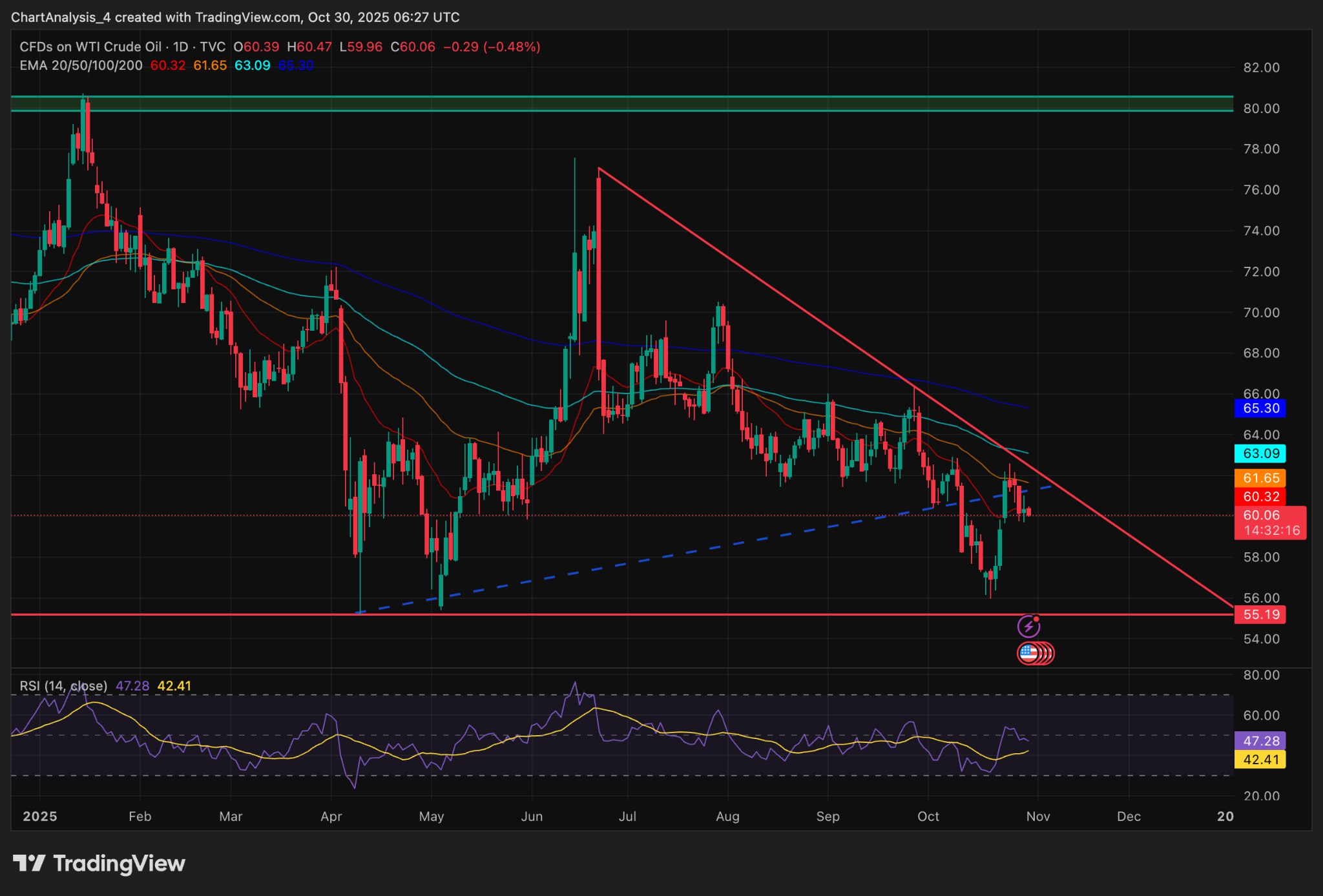
WTI crude oil price dynamics (Source: TradingView)
Short-term levels are equally important. The 20- and 50-day EMAs are tightly clustered between $60.30 and $61.65, creating a near-term pivot zone. A sustained close below $60 would expose the critical $55.20 support — a floor that has repeatedly held since the spring selloff. Reclaiming the 200-day EMA at $65.30 remains the threshold for reversing the broader bearish trend.
Momentum indicators echo this weakness. The RSI sits near 47, a level that signals fading bullish conviction but not full capitulation. Without a clear catalyst from the OPEC+ meeting, the risk of another downward leg remains high.
Macro backdrop weighs on sentiment
Beyond the charts, market sentiment is struggling under mixed signals. WTI crude oil is set to close its third consecutive month of losses — the longest losing streak since mid-2023 — as oversupply fears persist despite escalating sanctions and geopolitical disruptions. While the U.S. sanctions on Russia’s energy giants tighten the long-term outlook, short-term balances remain loose, particularly with OPEC+ members quietly raising production levels.
If the cartel proceeds with an output increase in December, analysts warn that prices could face additional headwinds. On the demand side, the outlook is also uneven. Progress in U.S.–China trade negotiations offers some support, but the absence of specific energy cooperation tempers optimism. At the same time, the Federal Reserve’s recent 25-basis-point rate cut underscores concerns over slowing growth — another weight on oil demand expectations.
Outlook: Pressure builds ahead of OPEC+ meeting
WTI crude oil sits at a critical juncture. A sustained defense of the $60 handle could spark a short-term recovery toward the $63–$65 zone, but sellers remain firmly in control for now. A break below $60 would likely accelerate losses toward $55.20, where a decisive breach could invite a slide toward the low $50s.'
As previously discussed, the technical landscape aligns with a broader macro theme — one where fragile demand collides with policy uncertainty. With sanctions tightening, OPEC+ divided, and trade optimism fading, oil markets are entering a volatile stretch where sentiment may shift rapidly based on production headlines and global growth data.


Latest WTI News









-
 Afghanistan
-
 Albania
-
 Algeria
-
 Angola
-
 Argentina
-
 Armenia
-
 Australia
-
 Austria
-
 Azerbaijan
-
 Bahamas
-
 Bahrain
-
 Bangladesh
-
 Belarus
-
 Belgium
-
 Bolivia
-
 Botswana
-
 Brazil
-
 Brunei
-
 Bulgaria
-
 Cambodia
-
 Cameroon
-
 Canada
-
 Chile
Chile
-
 China
China
-
 Colombia
-
 Congo
Congo
-
 Costa Rica
-
 Cote d'Ivoire
-
 Croatia
-
 Cuba
Cuba
-
 Cyprus
-
 Czechia
-
 DR Congo
-
 Denmark
-
 Dominican Republic
-
 Ecuador
-
 Egypt
Egypt
-
 El Salvador
-
 Estonia
-
 Eswatini
-
 Ethiopia
-
 Finland
-
 France
-
 Georgia
-
 Germany
-
 Ghana
Ghana
-
 Greece
-
 Haiti
Haiti
-
 Hong Kong
-
 Hungary
-
 India
India
-
 Indonesia
-
 Iran, Islamic republic
-
 Iraq
Iraq
-
 Ireland
-
 Israel
-
 Italy
Italy
-
 Jamaica
-
 Japan
Japan
-
 Jordan
-
 Kazakhstan
-
 Kenya
Kenya
-
 Korea
Korea
-
 Kuwait
-
 Kyrgyzstan
-
 Laos
Laos
-
 Latvia
-
 Lebanon
-
 Lesotho
-
 Libya
Libya
-
 Lithuania
-
 Luxembourg
-
 Madagascar
-
 Malaysia
-
 Malta
Malta
-
 Mauritius
-
 Mexico
-
 Moldova
-
 Mongolia
-
 Montenegro
-
 Morocco
-
 Mozambique
-
 Myanmar
-
 Namibia
-
 Nepal
Nepal
-
 Netherlands
-
 New Zealand
-
 Nigeria
-
 North Macedonia
-
 Norway
-
 Oman
Oman
-
 Pakistan
-
 Palestine
-
 Panama
-
 Papua New Guinea
-
 Paraguay
-
 Peru
Peru
-
 Philippines
-
 Poland
-
 Portugal
-
 Puerto Rico
-
 Qatar
Qatar
-
 Reunion
-
 Romania
-
 Rwanda
-
 Saudi Arabia
-
 Serbia
-
 Singapore
-
 Slovakia
-
 Slovenia
-
 Somalia
-
 South Africa
-
 Spain
Spain
-
 Sri Lanka
-
 Sweden
-
 Switzerland
-
 Syria
Syria
-
 Taiwan
-
 Tajikistan
-
 Tanzania
-
 Thailand
-
 Trinidad and Tobago
-
 Tunisia
-
 Turkey
-
 UAE
UAE
-
 Uganda
-
 Ukraine
-
 United Kingdom
-
United States
-
 Uruguay
-
 Uzbekistan
-
 Venezuela
-
 Vietnam
-
 Yemen
Yemen
-
 Zambia
-
 Zimbabwe
- Forex
- Crypto












