
Microsoft stock drops as rising AI costs weigh on outlook despite strong cloud growth

Microsoft Corp. (NASDAQ: MSFT) fell nearly 3% to $525.76 on Thursday, extending its retreat from record highs earlier in the week. The decline followed the company’s strong fiscal Q1 results, where Azure once again outperformed expectations, but investor focus shifted sharply toward surging AI-related spending and a cautious margin outlook.
Highlights
- Microsoft slides nearly 3% to $525.76 as AI costs overshadow record earnings.
- Azure revenue surges 40% but capital spending climbs to $34.9 billion.
- Support holds near $515–$520 as long-term trend remains bullish.
Microsoft’s daily chart shows a decisive pullback after testing resistance near $554, where the 1.0 Fibonacci extension aligns with the upper channel limit. The stock is now holding key support at $525–$528, an area reinforced by the 0.5 Fibonacci retracement and 20-day EMA at $522.87. A drop below $515 would expose deeper support near the 50-day EMA at $515.54 and the 100-day EMA at $500.97. Despite the correction, the longer-term structure remains bullish, with the 200-day EMA rising from $475.70 and maintaining the broader uptrend.
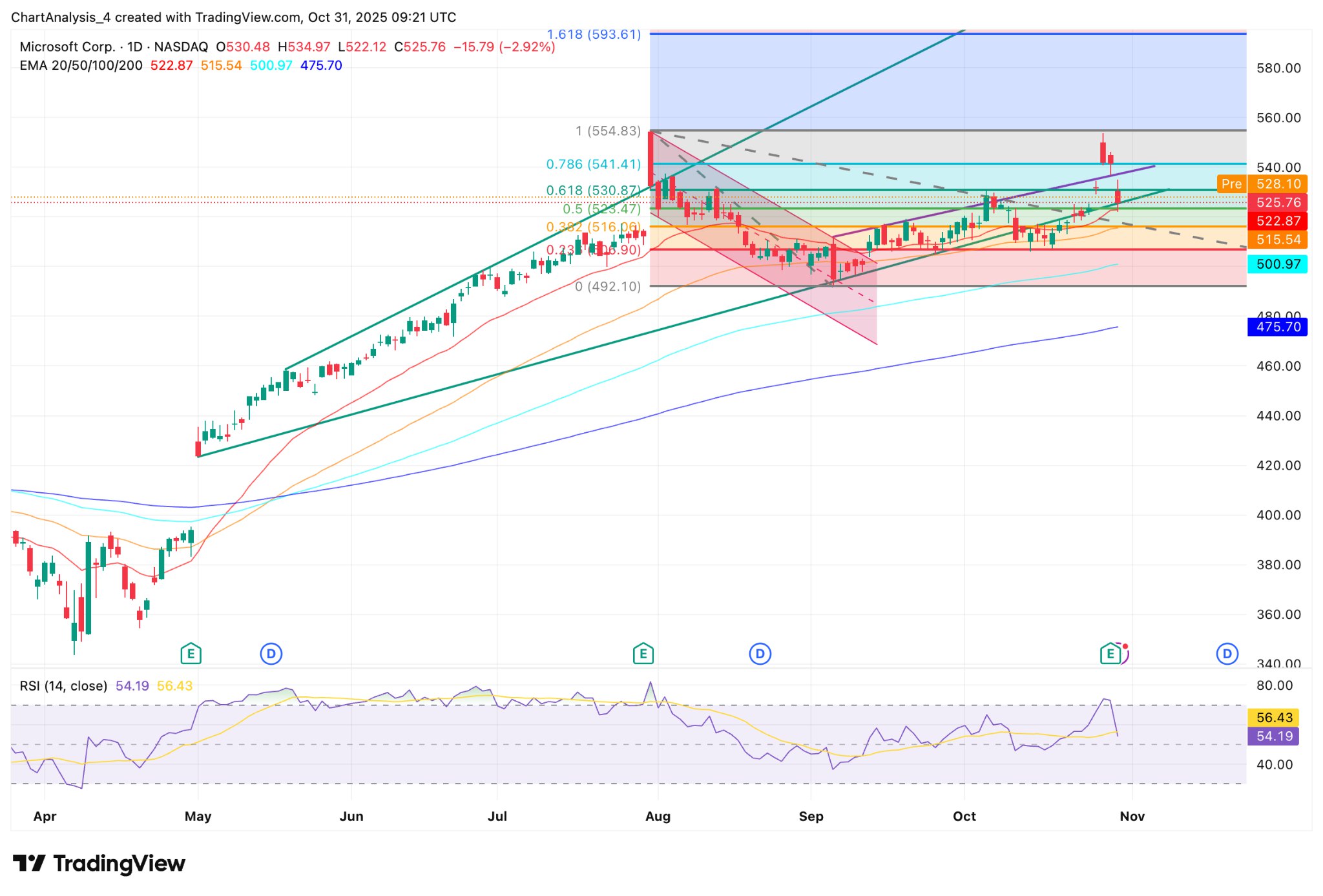
MSFT price dynamics (Source: TradingView)
Momentum indicators have cooled but remain constructive. The RSI sits near 54, reflecting a reset from earlier overbought conditions, while the MACD histogram continues to narrow without signaling a full reversal. The Fibonacci confluence between $516 and $530 now forms the key demand zone, with a rebound above $540–$554 required to restore momentum toward fresh highs.
Earnings reaction and market sentiment
Microsoft’s quarterly results reaffirmed its leadership in cloud computing. The company posted revenue of $77.67 billion, up 18% year over year, and earnings per share of $3.72—both exceeding Wall Street expectations. Azure’s 40% growth was particularly notable, underscoring continued expansion across enterprise AI workloads.
However, the optimism faded as the company revealed escalating capital expenditures. CFO Amy Hood said spending reached $34.9 billion during the quarter, exceeding the $30 billion consensus, and signaled that fiscal 2026 investment growth would surpass 2025 levels. The outlook raised concerns about near-term margin pressure, triggering a rotation out of AI-heavy stocks that had led the market for months.
Investors were quick to draw parallels to Meta’s recent selloff, where large-scale AI infrastructure costs rattled sentiment despite strong revenue gains. In Microsoft’s case, analysts described the current adjustment as a valuation recalibration rather than a deterioration in fundamentals, noting that its cash flow and market share remain robust.
Strategic outlook and key levels
Microsoft remains structurally positioned to dominate the next phase of AI commercialization. Its 27% stake in OpenAI—valued near $135 billion—cements a long-term pipeline of innovation feeding directly into Azure and Copilot products. The recent restructuring of OpenAI’s ownership clarified Microsoft’s influence as both an investor and infrastructure provider, ensuring continued alignment across research and deployment.
From a trading perspective, the $515–$520 zone serves as a crucial pivot. Sustained support above this range would keep the uptrend intact and potentially invite buying interest toward $540–$554. A breakout above $555 could extend the rally toward the $593 Fibonacci extension. Conversely, a daily close below $515 could deepen the correction toward $500 or even $475, where the 200-day EMA sits as the long-term floor.
Outlook
The recent pullback appears to be a technical reset following months of rapid gains driven by AI enthusiasm. While rising capital expenditures have clouded short-term sentiment, Microsoft’s position as a market leader in AI infrastructure and cloud services remains unshaken.
As long as prices hold within the $515–$530 support corridor, the broader bullish trend stays intact. The stock’s next move will likely hinge on whether investor confidence in its long-term AI monetization story outweighs short-term margin concerns.





Latest Microsoft News









-
 Afghanistan
-
 Albania
-
 Algeria
-
 Angola
-
 Argentina
-
 Armenia
-
 Australia
-
 Austria
-
 Azerbaijan
-
 Bahamas
-
 Bahrain
-
 Bangladesh
-
 Belarus
-
 Belgium
-
 Bolivia
-
 Botswana
-
 Brazil
-
 Brunei
-
 Bulgaria
-
 Cambodia
-
 Cameroon
-
 Canada
-
 Chile
Chile
-
 China
China
-
 Colombia
-
 Congo
Congo
-
 Costa Rica
-
 Cote d'Ivoire
-
 Croatia
-
 Cuba
Cuba
-
 Cyprus
-
 Czechia
-
 DR Congo
-
 Denmark
-
 Dominican Republic
-
 Ecuador
-
 Egypt
Egypt
-
 El Salvador
-
 Estonia
-
 Eswatini
-
 Ethiopia
-
 Finland
-
 France
-
 Georgia
-
 Germany
-
 Ghana
Ghana
-
 Greece
-
 Haiti
Haiti
-
 Hong Kong
-
 Hungary
-
 India
India
-
 Indonesia
-
 Iran, Islamic republic
-
 Iraq
Iraq
-
 Ireland
-
 Israel
-
 Italy
Italy
-
 Jamaica
-
 Japan
Japan
-
 Jordan
-
 Kazakhstan
-
 Kenya
Kenya
-
 Korea
Korea
-
 Kuwait
-
 Kyrgyzstan
-
 Laos
Laos
-
 Latvia
-
 Lebanon
-
 Lesotho
-
 Libya
Libya
-
 Lithuania
-
 Luxembourg
-
 Madagascar
-
 Malaysia
-
 Malta
Malta
-
 Mauritius
-
 Mexico
-
 Moldova
-
 Mongolia
-
 Montenegro
-
 Morocco
-
 Mozambique
-
 Myanmar
-
 Namibia
-
 Nepal
Nepal
-
 Netherlands
-
 New Zealand
-
 Nigeria
-
 North Macedonia
-
 Norway
-
 Oman
Oman
-
 Pakistan
-
 Palestine
-
 Panama
-
 Papua New Guinea
-
 Paraguay
-
 Peru
Peru
-
 Philippines
-
 Poland
-
 Portugal
-
 Puerto Rico
-
 Qatar
Qatar
-
 Reunion
-
 Romania
-
 Rwanda
-
 Saudi Arabia
-
 Serbia
-
 Singapore
-
 Slovakia
-
 Slovenia
-
 Somalia
-
 South Africa
-
 Spain
Spain
-
 Sri Lanka
-
 Sweden
-
 Switzerland
-
 Syria
Syria
-
 Taiwan
-
 Tajikistan
-
 Tanzania
-
 Thailand
-
 Trinidad and Tobago
-
 Tunisia
-
 Turkey
-
 UAE
UAE
-
 Uganda
-
 Ukraine
-
 United Kingdom
-
United States
-
 Uruguay
-
 Uzbekistan
-
 Venezuela
-
 Vietnam
-
 Yemen
Yemen
-
 Zambia
-
 Zimbabwe
- Forex
- Crypto












