
Nvidia stock falls 2.6% amid concerns over GPU competition

As of December 1, Nvidia stock is trading at $178.97, down 2.6% over the past 24 hours. The recent pullback places the stock near its lowest level in over a month, reflecting renewed pressure on AI-related equities.
Highlights
- Nvidia shares dropped 2.6%, extending a nearly 15% decline from their 52-week high amid profit-taking and concerns over AI chip valuations.
- The company reported record Q3 revenue of $57 billion, driven by strong data center demand and robust gross margins above 73%.
- Technical support near the 200-day moving average could offer a rebound point if sentiment stabilizes.
Nvidia has now dropped nearly 15% from its 52-week high of $212, breaking below several key moving averages, including the 50-day and 100-day lines, with the 200-day moving average now looming near the $173–175 range. This technical breakdown has increased short-term bearish pressure, with momentum indicators like RSI trending toward oversold levels. However, the area around the 200-day average has historically acted as a strong demand zone, potentially setting the stage for a technical rebound if buying interest resumes.
Technically, the $175 area is acting as a near-term support, with some minor consolidation seen between $176–178 during the last few trading sessions. Below this, stronger structural support lies around the $165–167 zone, which coincides with price action from mid-October and April. Resistance on the upside remains near $185, followed by $195 and the psychological $200 threshold.
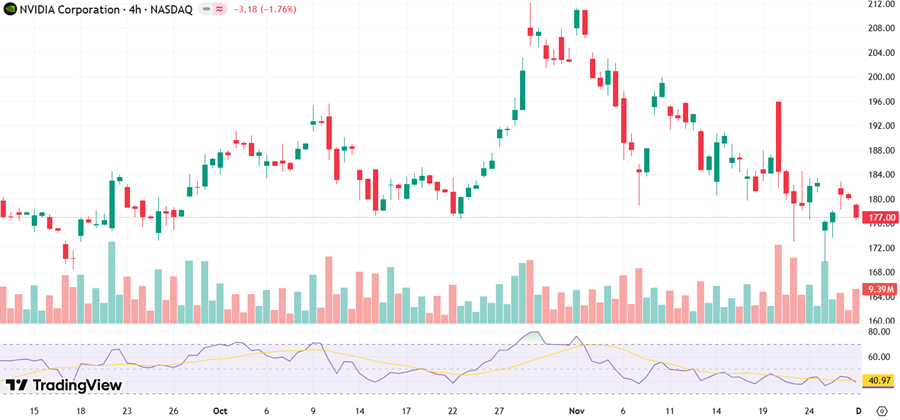
Nvidia stock price dynamics (October 2025 - December 2025). Source: TradingView
Volume has remained elevated, with Friday’s session seeing over 121 million shares traded, signaling institutional repositioning rather than low-volume drift. The RSI has dipped below 40, indicating the stock is entering mildly oversold territory. MACD has crossed into bearish territory but has not yet diverged dramatically, suggesting potential for near-term reversal if buyers step in.
AI bubble concerns weigh on sentiment despite solid fundamentals
The latest decline in Nvidia stock was fueled by a mix of sector-specific and broader macroeconomic concerns. A key catalyst was the growing narrative of an "AI bubble" — an idea gaining traction after several large-cap tech names, including Nvidia, experienced steep run-ups through the first half of 2025. Traders locked in gains following signs of fatigue in AI chip momentum and as Google unveiled its new AI model and supporting TPU architecture, potentially threatening Nvidia’s dominance in the cloud-GPU market.
However, this concern may be overstated. Despite the Google development, there are no concrete signs that major cloud providers like Microsoft Azure or Amazon Web Services are moving away from Nvidia's platform. On the contrary, multiple reports confirm continued long-term procurement contracts for Nvidia’s Hopper and upcoming Blackwell GPUs, with orders reportedly booked well into mid-2026.
Nvidia’s latest earnings report showed record Q3 revenue of $57.0 billion, up 62% year-on-year and 22% sequentially, driven by continued strength in its data center business. Gross margins remained high at 73.4% GAAP and 73.6% non-GAAP, reflecting strong pricing and scale benefits from Hopper and Blackwell GPUs. The company issued a positive Q4 outlook, citing steady AI infrastructure demand from hyperscalers and enterprises across the U.S. and Asia-Pacific.
$165 downside risk vs $210 rebound potential
In the base case, assuming AI demand remains stable and no large clients shift away from Nvidia, the stock could rebound toward the $200–210 zone by Q1 2026. This scenario reflects a reversion to its previous support-turn-resistance range and assumes stable institutional demand.
A bullish scenario — involving further expansion of AI data center infrastructure, robust earnings in early 2026, and improved macro sentiment — could drive NVDA toward $230 or even $240 by late Q2. This would likely require another wave of capital rotation into high-growth tech and confirmation that Nvidia's dominance in AI GPUs remains unchallenged.
Nvidia addressed valuation concerns in an internal memo defending its $4.5 trillion market cap while acknowledging that its new Blackwell chips would carry lower margins and higher warranty costs. Although the company framed these pressures as typical for early product cycles, the disclosure reignited debate over the sustainability of its profit model amid rising AI competition.















-
 Afghanistan
-
 Albania
-
 Algeria
-
 Angola
-
 Argentina
-
 Armenia
-
 Australia
-
 Austria
-
 Azerbaijan
-
 Bahamas
-
 Bahrain
-
 Bangladesh
-
 Belarus
-
 Belgium
-
 Bolivia
-
 Botswana
-
 Brazil
-
 Brunei
-
 Bulgaria
-
 Cambodia
-
 Cameroon
-
 Canada
-
 Chile
Chile
-
 China
China
-
 Colombia
-
 Congo
Congo
-
 Costa Rica
-
 Cote d'Ivoire
-
 Croatia
-
 Cuba
Cuba
-
 Cyprus
-
 Czechia
-
 DR Congo
-
 Denmark
-
 Dominican Republic
-
 Ecuador
-
 Egypt
Egypt
-
 El Salvador
-
 Estonia
-
 Eswatini
-
 Ethiopia
-
 Finland
-
 France
-
 Georgia
-
 Germany
-
 Ghana
Ghana
-
 Greece
-
 Haiti
Haiti
-
 Hong Kong
-
 Hungary
-
 India
India
-
 Indonesia
-
 Iran, Islamic republic
-
 Iraq
Iraq
-
 Ireland
-
 Israel
-
 Italy
Italy
-
 Jamaica
-
 Japan
Japan
-
 Jordan
-
 Kazakhstan
-
 Kenya
Kenya
-
 Korea
Korea
-
 Kuwait
-
 Kyrgyzstan
-
 Laos
Laos
-
 Latvia
-
 Lebanon
-
 Lesotho
-
 Libya
Libya
-
 Lithuania
-
 Luxembourg
-
 Madagascar
-
 Malaysia
-
 Malta
Malta
-
 Mauritius
-
 Mexico
-
 Moldova
-
 Mongolia
-
 Montenegro
-
 Morocco
-
 Mozambique
-
 Myanmar
-
 Namibia
-
 Nepal
Nepal
-
 Netherlands
-
 New Zealand
-
 Nigeria
-
 North Macedonia
-
 Norway
-
 Oman
Oman
-
 Pakistan
-
 Palestine
-
 Panama
-
 Papua New Guinea
-
 Paraguay
-
 Peru
Peru
-
 Philippines
-
 Poland
-
 Portugal
-
 Puerto Rico
-
 Qatar
Qatar
-
 Reunion
-
 Romania
-
 Rwanda
-
 Saudi Arabia
-
 Serbia
-
 Singapore
-
 Slovakia
-
 Slovenia
-
 Somalia
-
 South Africa
-
 Spain
Spain
-
 Sri Lanka
-
 Sweden
-
 Switzerland
-
 Syria
Syria
-
 Taiwan
-
 Tajikistan
-
 Tanzania
-
 Thailand
-
 Trinidad and Tobago
-
 Tunisia
-
 Turkey
-
 UAE
UAE
-
 Uganda
-
 Ukraine
-
 United Kingdom
-
United States
-
 Uruguay
-
 Uzbekistan
-
 Venezuela
-
 Vietnam
-
 Yemen
Yemen
-
 Zambia
-
 Zimbabwe
- Forex
- Crypto












