
Gold price forecast: Pullback to $4,200 tests support as traders await key U.S. data

Gold eased to roughly $4,200 per ounce on Tuesday, falling about 1 percent after a rally that pushed the metal to its highest level in six weeks. The decline comes as traders trim exposure ahead of a Federal Reserve meeting widely expected to deliver a rate cut next week.
Highlights
- Gold pulls back 1 percent after hitting a six-week high.
- Markets price an 88 percent chance of a Fed rate cut next week.
- Trend support remains firm above the $4,090 zone.
Futures markets now assign an 88 percent probability to a 25-basis-point reduction, supported by nine consecutive months of manufacturing contraction and consistently dovish communication from Fed officials. The retracement is viewed as routine position-management rather than a shift in sentiment, with macro expectations and structural demand still aligned in gold’s favor.
Market Cools as Traders Hedge Ahead of Fed Decision
Gold’s latest move reflects a consolidation phase inside a broader bullish trend. After peaking near $4,381, the metal eased into the 61.8 percent Fibonacci retracement at $4,191, a level that has served as the primary pivot for the recent upswing. Monday’s advance briefly pushed gold back through the $4,200 to $4,275 resistance pocket, but Tuesday’s reversal shows hesitation as investors prepare for a series of data releases that could influence the Fed’s tone.
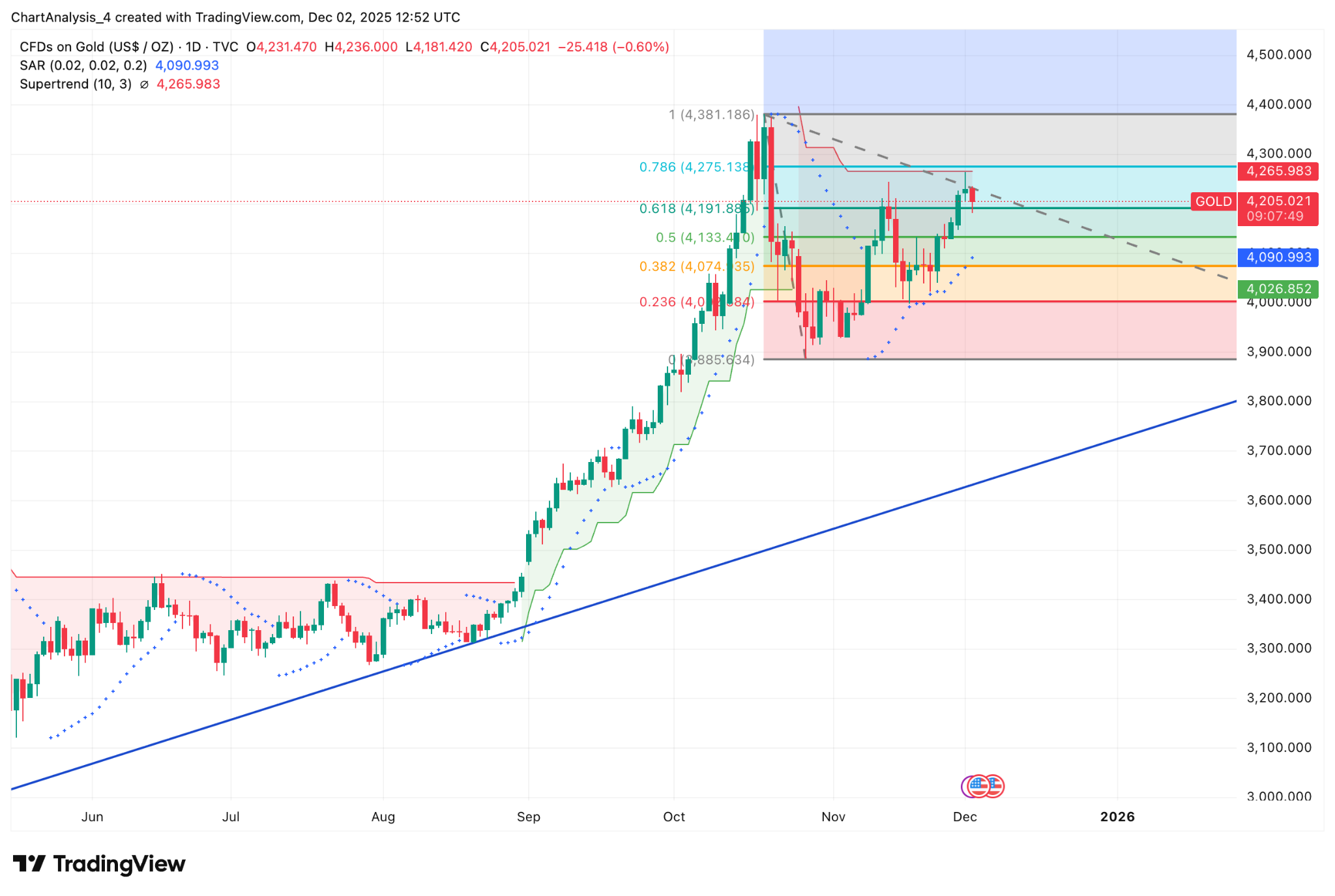
Gold price forecast (Source: TradingView)
The short-term descending trendline drawn from the October high continues to act as a ceiling, and gold has now rejected that line twice. This behavior suggests that traders remain unwilling to chase a breakout before confirmation of policy easing.
Despite the pause, the broader uptrend remains intact. The supertrend support at $4,266 has flipped bullish, and the parabolic SAR continues to sit beneath price, indicating that the market has not entered a reversal phase. Gold also remains comfortably above the medium-term support zone near $4,090, where prior demand converges with the 38.2 percent retracement. Even a deeper pullback into the $4,000 to $4,030 region would represent normal volatility rather than a structural break. Only a close below $3,885 would challenge the macro trend that has guided gold since the summer breakout.
Macro Signals Still Point Toward Easing
The policy backdrop remains supportive. The Fed is under increasing pressure to pivot as economic momentum softens, with manufacturing output weakening, job creation moderating, and consumer activity showing signs of fatigue. Traders will watch this week’s ADP report and long-delayed PCE data for confirmation, but the market’s reaction function remains asymmetric. Weak numbers reinforce the expectation of easing. Strong data may delay but likely will not derail the Fed’s trajectory after months of dovish communication.
The metal also benefits from cross-asset positioning. U.S. equities remain stretched, bond markets continue to experience rate-driven swings, and the dollar has lost part of its yield premium. In that environment, gold stands out as a liquid defensive asset with well-understood macro correlations. Recent inflows into gold-backed vehicles reflect that rotation, with asset managers favoring gold as a stabilizer during a late-cycle slowdown.
Price action over the past six weeks—sharp rally, orderly correction, and quick recovery—underscores that underlying demand remains steady rather than speculative. Strategic flows, not short-term trading, continue to shape the trend.
What to Watch From Here
Gold remains in bullish formation as long as it stays above $4,090. A sustained breakout through $4,275 would open a move toward retesting the recent highs near $4,380, with the potential for new price discovery if the Fed confirms a dovish path. Failure to hold the mid-range support, however, could invite a deeper pullback into areas where long-term buyers have previously stepped in.
The narrative remains clear: monetary conditions are easing, inflation data is softening, and gold continues to behave like a late-cycle refuge. Tuesday’s decline reflects caution ahead of major catalysts, not a shift in the underlying trend.
Our earlier coverage emphasized gold’s strong alignment with macro forces, including rate-cut expectations, falling yields, and rising defensive demand. The latest movement supports that framework, as the metal continues to consolidate near the upper end of its range ahead of the Fed decision.


Latest Gold News










-
 Afghanistan
-
 Albania
-
 Algeria
-
 Angola
-
 Argentina
-
 Armenia
-
 Australia
-
 Austria
-
 Azerbaijan
-
 Bahamas
-
 Bahrain
-
 Bangladesh
-
 Belarus
-
 Belgium
-
 Bolivia
-
 Botswana
-
 Brazil
-
 Brunei
-
 Bulgaria
-
 Cambodia
-
 Cameroon
-
 Canada
-
 Chile
Chile
-
 China
China
-
 Colombia
-
 Congo
Congo
-
 Costa Rica
-
 Cote d'Ivoire
-
 Croatia
-
 Cuba
Cuba
-
 Cyprus
-
 Czechia
-
 DR Congo
-
 Denmark
-
 Dominican Republic
-
 Ecuador
-
 Egypt
Egypt
-
 El Salvador
-
 Estonia
-
 Eswatini
-
 Ethiopia
-
 Finland
-
 France
-
 Georgia
-
 Germany
-
 Ghana
Ghana
-
 Greece
-
 Haiti
Haiti
-
 Hong Kong
-
 Hungary
-
 India
India
-
 Indonesia
-
 Iran, Islamic republic
-
 Iraq
Iraq
-
 Ireland
-
 Israel
-
 Italy
Italy
-
 Jamaica
-
 Japan
Japan
-
 Jordan
-
 Kazakhstan
-
 Kenya
Kenya
-
 Korea
Korea
-
 Kuwait
-
 Kyrgyzstan
-
 Laos
Laos
-
 Latvia
-
 Lebanon
-
 Lesotho
-
 Libya
Libya
-
 Lithuania
-
 Luxembourg
-
 Madagascar
-
 Malaysia
-
 Malta
Malta
-
 Mauritius
-
 Mexico
-
 Moldova
-
 Mongolia
-
 Montenegro
-
 Morocco
-
 Mozambique
-
 Myanmar
-
 Namibia
-
 Nepal
Nepal
-
 Netherlands
-
 New Zealand
-
 Nigeria
-
 North Macedonia
-
 Norway
-
 Oman
Oman
-
 Pakistan
-
 Palestine
-
 Panama
-
 Papua New Guinea
-
 Paraguay
-
 Peru
Peru
-
 Philippines
-
 Poland
-
 Portugal
-
 Puerto Rico
-
 Qatar
Qatar
-
 Reunion
-
 Romania
-
 Rwanda
-
 Saudi Arabia
-
 Serbia
-
 Singapore
-
 Slovakia
-
 Slovenia
-
 Somalia
-
 South Africa
-
 Spain
Spain
-
 Sri Lanka
-
 Sweden
-
 Switzerland
-
 Syria
Syria
-
 Taiwan
-
 Tajikistan
-
 Tanzania
-
 Thailand
-
 Trinidad and Tobago
-
 Tunisia
-
 Turkey
-
 UAE
UAE
-
 Uganda
-
 Ukraine
-
 United Kingdom
-
United States
-
 Uruguay
-
 Uzbekistan
-
 Venezuela
-
 Vietnam
-
 Yemen
Yemen
-
 Zambia
-
 Zimbabwe
- Forex
- Crypto












