

Quantum Computing stock forecast: Weak momentum persists near $8.25 resistance

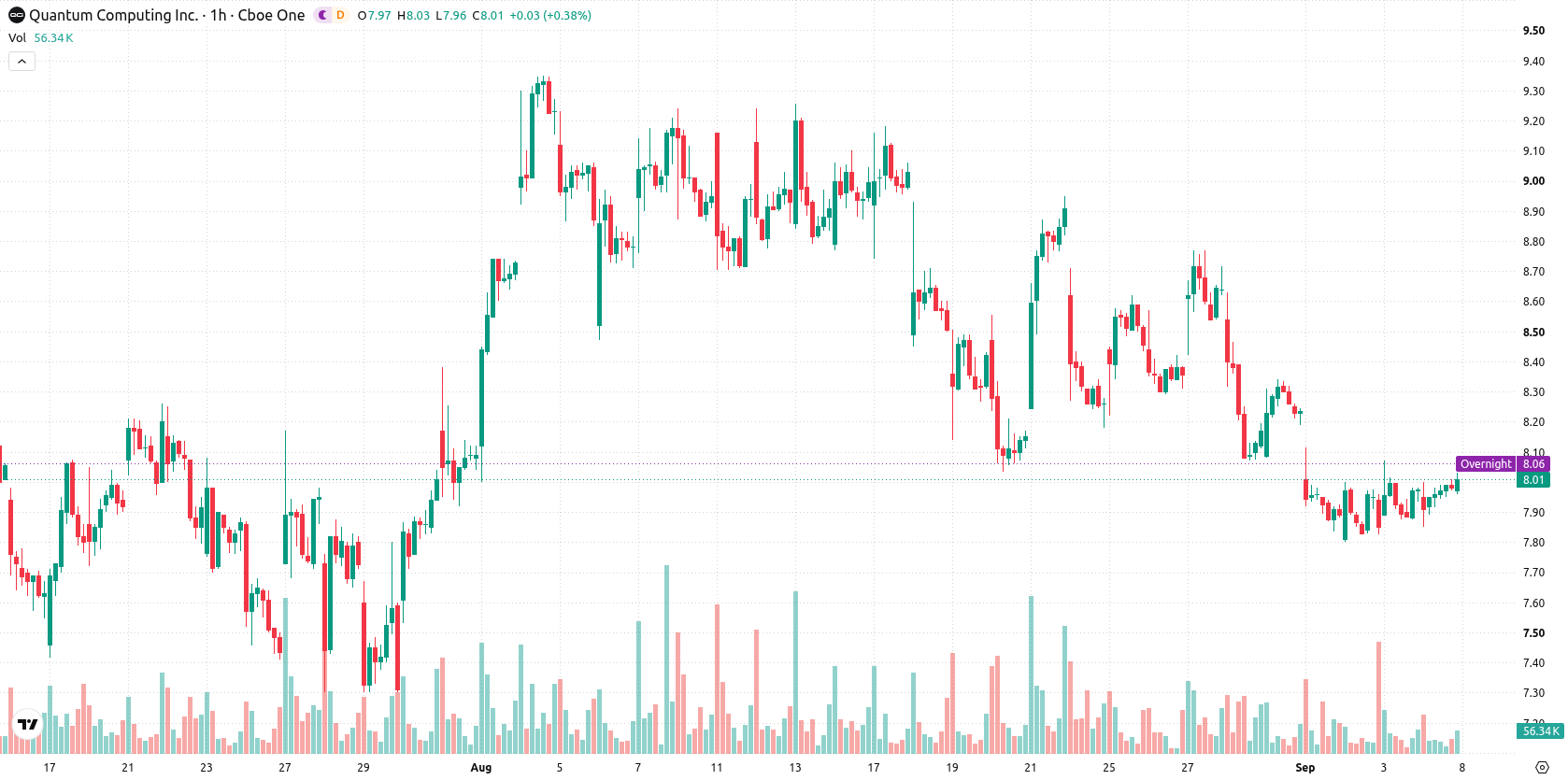
Quantum Computing (QUBT) stock is trading at $8.01 today, posting a modest gain and ending near the session's high. The price currently stands between short- and longer-term moving averages.
 6.43
6.66
Highlights
- QUBT stock remains above short-term moving averages but continues to trade below key medium- and long-term averages, showing ongoing resistance.
- Momentum signals are mixed, with strong intraday buying and overbought readings, while broader momentum indicators lean bearish.
- QUBT is expected to remain between $7.77 and $8.25 in the coming days, with a 55% probability of a decline.
Buy signals compete with bearish momentum across technical indicators
On the hourly chart, QUBT remains above its MA-20 but is still below the MA-50, while on the daily timeframe the price sits beneath the MA-200. The Ichimoku Kijun at $7.94 acts as immediate support. Momentum indicators present mixed signals: the MACD shows strong sell, the ADX points to continued selling momentum, and the Awesome Oscillator reads neutral. RSI is just above neutral at 51.13 and classified as Buy, whereas both Stoch RSI and CCI are in overbought territory, indicating a potential pullback. Bull/Bear Power is classified as strong buy, suggesting buyers are dominant intraday, even as some momentum readings remain bearish.
Sideways bias favored as downside risk edges higher
For the next few days, QUBT is expected to trade within the $7.77 to $8.25 volatility band relative to current levels. Downside movement appears slightly more likely, with a 55% probability of decline versus 45% for upward movement. The most probable scenario is continued sideways action, barring a break of either immediate support at the Kijun or overhead resistance.
Earlier, analysts noted that the Ethereum Foundation is prioritizing the development of quantum-resistant technologies to secure blockchain networks against potential future threats. The current technical outlook for QUBT adds a trading dimension, with sideways price action likely in the near term and the $7.77–$8.25 band serving as a key volatility range to monitor for potential breakouts.






Latest Quantum Computing News





-
 Afghanistan
-
 Albania
-
 Algeria
-
 Angola
-
 Argentina
-
 Armenia
-
 Australia
-
 Austria
-
 Azerbaijan
-
 Bahamas
-
 Bahrain
-
 Bangladesh
-
 Belarus
-
 Belgium
-
 Bolivia
-
 Botswana
-
 Brazil
-
 Brunei
-
 Bulgaria
-
 Cambodia
-
 Cameroon
-
 Canada
-
 Chile
-
 China
-
 Colombia
-
 Congo
-
 Costa Rica
-
 Cote d'Ivoire
-
 Croatia
-
 Cuba
-
 Cyprus
-
 Czechia
-
 DR Congo
-
 Denmark
-
 Dominican Republic
-
 Ecuador
-
 Egypt
-
 El Salvador
-
 Estonia
-
 Eswatini
-
 Ethiopia
-
 Finland
-
 France
-
 Georgia
-
 Germany
-
 Ghana
-
 Greece
-
 Haiti
-
 Hong Kong
-
 Hungary
-
 India
-
 Indonesia
-
 Iran, Islamic republic
-
 Iraq
-
 Ireland
-
 Israel
-
 Italy
-
 Jamaica
-
 Japan
-
 Jordan
-
 Kazakhstan
-
 Kenya
-
 Korea
-
 Kuwait
-
 Kyrgyzstan
-
 Laos
-
 Latvia
-
 Lebanon
-
 Lesotho
-
 Libya
-
 Lithuania
-
 Luxembourg
-
 Madagascar
-
 Malaysia
-
 Malta
-
 Mauritius
-
 Mexico
-
 Moldova
-
 Mongolia
-
 Montenegro
-
 Morocco
-
 Mozambique
-
 Myanmar
-
 Namibia
-
 Nepal
-
 Netherlands
-
 New Zealand
-
 Nigeria
-
 North Macedonia
-
 Norway
-
 Oman
-
 Pakistan
-
 Palestine
-
 Panama
-
 Papua New Guinea
-
 Paraguay
-
 Peru
-
 Philippines
-
 Poland
-
 Portugal
-
 Puerto Rico
-
 Qatar
-
 Reunion
-
 Romania
-
 Rwanda
-
 Saudi Arabia
-
 Serbia
-
 Singapore
-
 Slovakia
-
 Slovenia
-
 Somalia
-
 South Africa
-
 Spain
-
 Sri Lanka
-
 Sweden
-
 Switzerland
-
 Syria
-
 Taiwan
-
 Tajikistan
-
 Tanzania
-
 Thailand
-
 Trinidad and Tobago
-
 Tunisia
-
 Turkey
-
 UAE
-
 Uganda
-
 Ukraine
-
 United Kingdom
-
United States
-
 Uruguay
-
 Uzbekistan
-
 Venezuela
-
 Vietnam
-
 Yemen
-
 Zambia
-
 Zimbabwe
- Forex
- Crypto












