

Nano Dimension shares technical analysis: Upward price move capped by $1.47 resistance

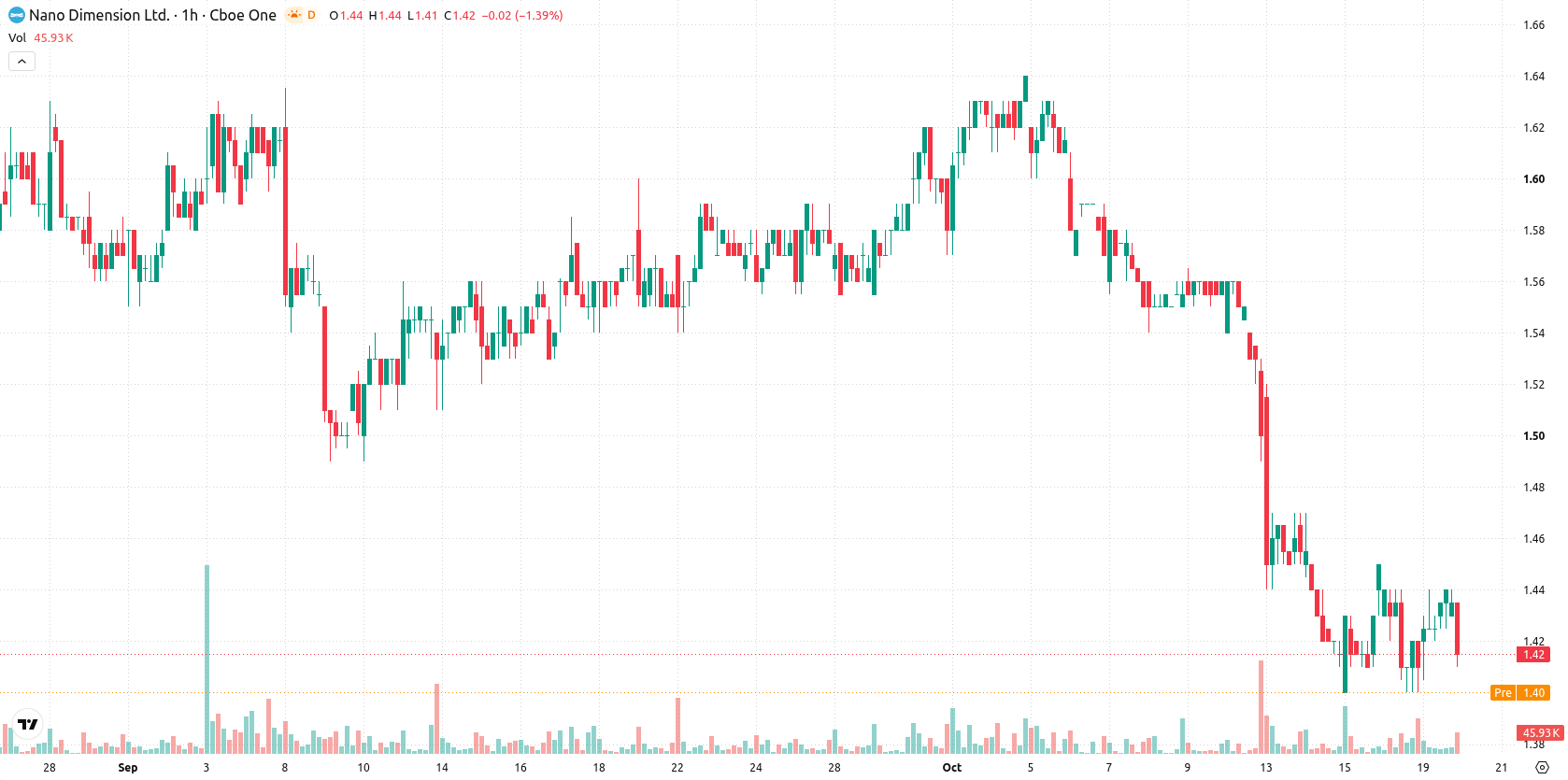
Nano Dimension (NNDM) stock is trading at $1.42, up 1.07% on the day. The price currently sits above its short-term averages but remains capped by medium- and long-term moving averages, reflecting moderate intraday strength within a broader consolidating trend.
 1.39
1.45
Highlights
- Shares of Nano Dimension closed at $1.42, gaining 1.07%, but the stock remains below key medium- and long-term moving averages.
- Momentum indicators such as MACD and ADX confirm strong selling pressure, with RSI and other oscillators indicating limited bullish potential.
- The expected price range for the upcoming sessions is $1.37 to $1.47, with a high probability of further downside below current support levels.
Negative momentum persists as buyer strength diverges from technical signals
On the technical front, NNDM finished the session at $1.42, holding just above its MA-20 while remaining below the MA-50 on the hourly chart and the MA-200 on the daily chart. The Ichimoku Kijun at $1.42 offers immediate support. Momentum indicators point to continued negative pressure, as both MACD and ADX display strong selling signals. RSI is weak at 43.73, signaling a sell condition. However, both Stoch RSI and CCI are neutral, suggesting a lack of clear overbought or oversold conditions. Intraday Bull/Bear Power indicates buyer dominance, creating a divergence with the broader negative momentum backdrop.
Rangebound trading likely as downside risk grows on renewed selling
Looking ahead, NNDM is expected to remain volatile within a short-term range of $1.37 to $1.47 over the next several sessions. A breakout above resistance appears unlikely, while the likelihood of a move below immediate support increases if selling pressure resumes. The most probable outcome is a continuation of rangebound, sideways trading with a bias toward renewed weakness.
Earlier, analysts noted that Nano Dimension was experiencing persistent technical weakness and an ongoing bearish outlook. The current analysis reaffirms this negative bias, emphasizing that if sellers regain control, downside risk remains elevated and renewed weakness could develop below current support levels.










-
 Afghanistan
-
 Albania
-
 Algeria
-
 Angola
-
 Argentina
-
 Armenia
-
 Australia
-
 Austria
-
 Azerbaijan
-
 Bahamas
-
 Bahrain
-
 Bangladesh
-
 Belarus
-
 Belgium
-
 Bolivia
-
 Botswana
-
 Brazil
-
 Brunei
-
 Bulgaria
-
 Cambodia
-
 Cameroon
-
 Canada
-
 Chile
-
 China
-
 Colombia
-
 Congo
-
 Costa Rica
-
 Cote d'Ivoire
-
 Croatia
-
 Cuba
-
 Cyprus
-
 Czechia
-
 DR Congo
-
 Denmark
-
 Dominican Republic
-
 Ecuador
-
 Egypt
-
 El Salvador
-
 Estonia
-
 Eswatini
-
 Ethiopia
-
 Finland
-
 France
-
 Georgia
-
 Germany
-
 Ghana
-
 Greece
-
 Haiti
-
 Hong Kong
-
 Hungary
-
 India
-
 Indonesia
-
 Iran, Islamic republic
-
 Iraq
-
 Ireland
-
 Israel
-
 Italy
-
 Jamaica
-
 Japan
-
 Jordan
-
 Kazakhstan
-
 Kenya
-
 Korea
-
 Kuwait
-
 Kyrgyzstan
-
 Laos
-
 Latvia
-
 Lebanon
-
 Lesotho
-
 Libya
-
 Lithuania
-
 Luxembourg
-
 Madagascar
-
 Malaysia
-
 Malta
-
 Mauritius
-
 Mexico
-
 Moldova
-
 Mongolia
-
 Montenegro
-
 Morocco
-
 Mozambique
-
 Myanmar
-
 Namibia
-
 Nepal
-
 Netherlands
-
 New Zealand
-
 Nigeria
-
 North Macedonia
-
 Norway
-
 Oman
-
 Pakistan
-
 Palestine
-
 Panama
-
 Papua New Guinea
-
 Paraguay
-
 Peru
-
 Philippines
-
 Poland
-
 Portugal
-
 Puerto Rico
-
 Qatar
-
 Reunion
-
 Romania
-
 Rwanda
-
 Saudi Arabia
-
 Serbia
-
 Singapore
-
 Slovakia
-
 Slovenia
-
 Somalia
-
 South Africa
-
 Spain
-
 Sri Lanka
-
 Sweden
-
 Switzerland
-
 Syria
-
 Taiwan
-
 Tajikistan
-
 Tanzania
-
 Thailand
-
 Trinidad and Tobago
-
 Tunisia
-
 Turkey
-
 UAE
-
 Uganda
-
 Ukraine
-
 United Kingdom
-
United States
-
 Uruguay
-
 Uzbekistan
-
 Venezuela
-
 Vietnam
-
 Yemen
-
 Zambia
-
 Zimbabwe
- Forex
- Crypto












