

SEALSQ stock outlook: Downward trend persists as sellers maintain control below key averages

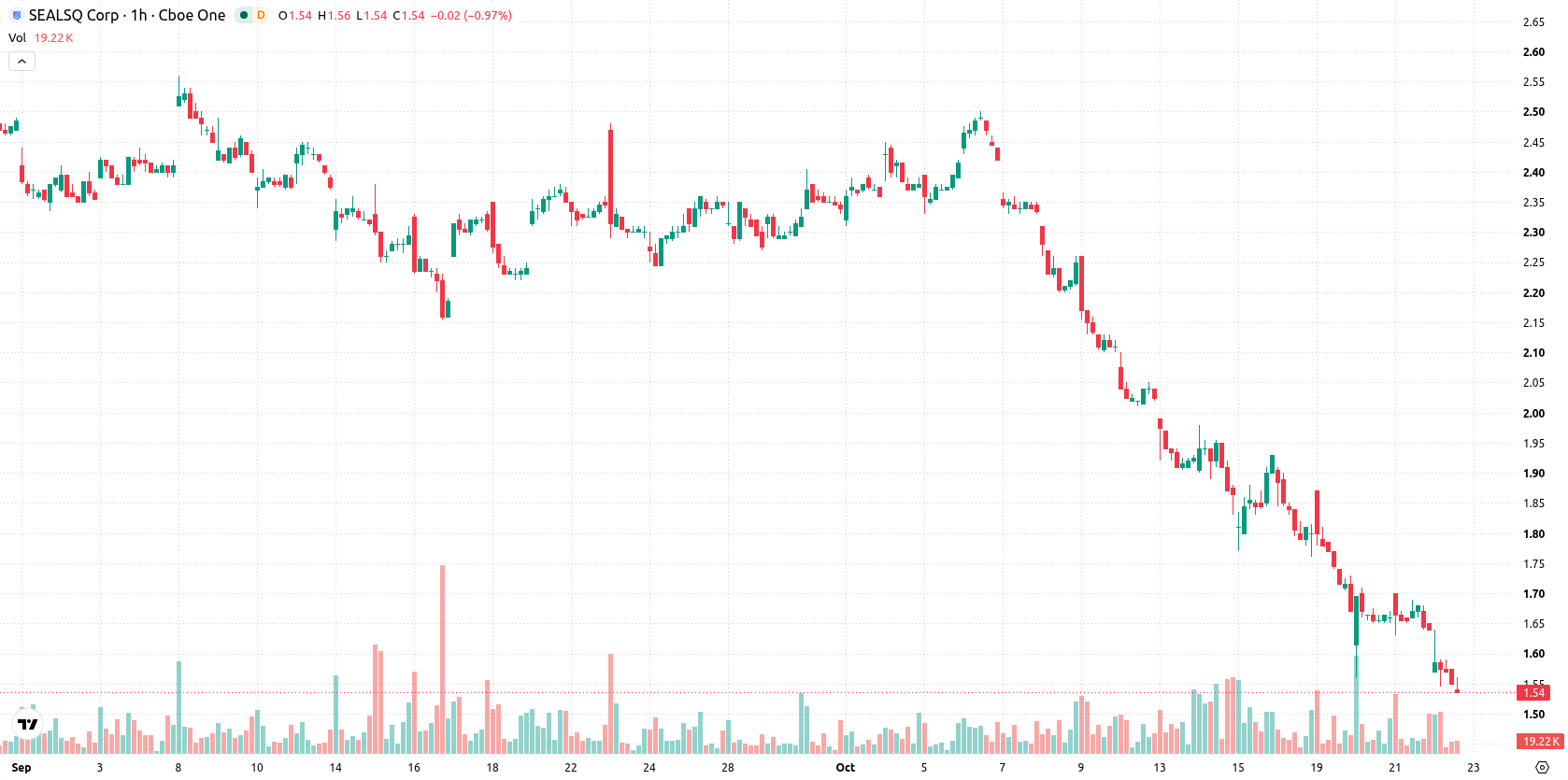
SEALSQ (LAES) stock is trading at $1.64 after slipping 1.2% today. The price remains below its main moving averages, reflecting continued downward movement in the short and long term.
 1.49
1.65
Highlights
- LAES/USD trades below all key moving averages, confirming sustained downward pressure across both short-term and long-term trends.
- Multiple technical indicators including MACD, ADX, and CCI flash strong sell signals, indicating seller dominance and limited signs of immediate recovery.
- Price dropped 1.2% to $1.64 with the anticipated range for the next sessions at $1.48 to $1.8; a break below $1.48 could accelerate further downside.
Seller control sustained as indicators reinforce resistance pressure
On the technical front, LAES/USD trades below its MA-20 at $1.69, MA-50 at $1.81, and MA-200 at $3.04 on the hourly timeframe, while the Ichimoku Kijun sits at $1.72 and acts as immediate resistance. Momentum signals remain negative: MACD registers a Strong Sell, ADX shows a Sell bias, and RSI is oversold at 29.62. While Stoch RSI is Neutral, both CCI and Bull/Bear Power support continued seller dominance; the Awesome Oscillator is Neutral and does not reinforce the primary trend.
Downside risk elevated as volatility traps range-bound outlook
Looking ahead, LAES is expected to remain in a volatile corridor between $1.48 and $1.8 over the next several sessions. The probability of a downward move is assessed as very high, while a significant rebound is unlikely without a breakout above $1.72 resistance. If support at $1.48 fails, a bearish scenario could intensify; otherwise, the baseline scenario is for the price to consolidate sideways within this range.
Earlier, analysts noted that SEALSQ stock was exhibiting persistent technical weakness and sustained downward pressure. The latest price action and momentum signals confirm this bearish bias, with the immediate focus on whether the $1.48 support can withstand coming sessions or if a decisive breach will trigger further downside risk.






Latest SEALSQ News




-
 Afghanistan
-
 Albania
-
 Algeria
-
 Angola
-
 Argentina
-
 Armenia
-
 Australia
-
 Austria
-
 Azerbaijan
-
 Bahamas
-
 Bahrain
-
 Bangladesh
-
 Belarus
-
 Belgium
-
 Bolivia
-
 Botswana
-
 Brazil
-
 Brunei
-
 Bulgaria
-
 Cambodia
-
 Cameroon
-
 Canada
-
 Chile
-
 China
-
 Colombia
-
 Congo
-
 Costa Rica
-
 Cote d'Ivoire
-
 Croatia
-
 Cuba
-
 Cyprus
-
 Czechia
-
 DR Congo
-
 Denmark
-
 Dominican Republic
-
 Ecuador
-
 Egypt
-
 El Salvador
-
 Estonia
-
 Eswatini
-
 Ethiopia
-
 Finland
-
 France
-
 Georgia
-
 Germany
-
 Ghana
-
 Greece
-
 Haiti
-
 Hong Kong
-
 Hungary
-
 India
-
 Indonesia
-
 Iran, Islamic republic
-
 Iraq
-
 Ireland
-
 Israel
-
 Italy
-
 Jamaica
-
 Japan
-
 Jordan
-
 Kazakhstan
-
 Kenya
-
 Korea
-
 Kuwait
-
 Kyrgyzstan
-
 Laos
-
 Latvia
-
 Lebanon
-
 Lesotho
-
 Libya
-
 Lithuania
-
 Luxembourg
-
 Madagascar
-
 Malaysia
-
 Malta
-
 Mauritius
-
 Mexico
-
 Moldova
-
 Mongolia
-
 Montenegro
-
 Morocco
-
 Mozambique
-
 Myanmar
-
 Namibia
-
 Nepal
-
 Netherlands
-
 New Zealand
-
 Nigeria
-
 North Macedonia
-
 Norway
-
 Oman
-
 Pakistan
-
 Palestine
-
 Panama
-
 Papua New Guinea
-
 Paraguay
-
 Peru
-
 Philippines
-
 Poland
-
 Portugal
-
 Puerto Rico
-
 Qatar
-
 Reunion
-
 Romania
-
 Rwanda
-
 Saudi Arabia
-
 Serbia
-
 Singapore
-
 Slovakia
-
 Slovenia
-
 Somalia
-
 South Africa
-
 Spain
-
 Sri Lanka
-
 Sweden
-
 Switzerland
-
 Syria
-
 Taiwan
-
 Tajikistan
-
 Tanzania
-
 Thailand
-
 Trinidad and Tobago
-
 Tunisia
-
 Turkey
-
 UAE
-
 Uganda
-
 Ukraine
-
 United Kingdom
-
United States
-
 Uruguay
-
 Uzbekistan
-
 Venezuela
-
 Vietnam
-
 Yemen
-
 Zambia
-
 Zimbabwe
- Forex
- Crypto












