Best Online Brokers With Low Deposit Requirements


Editorial Note: While we adhere to strict Editorial Integrity, this post may contain references to products from our partners. Here's an explanation for How We Make Money. None of the data and information on this webpage constitutes investment advice according to our Disclaimer.
Best stock brokers with low deposit requirements:
- Saxo Bank - Over 23,500 stocks from 26 countries, commissions from USD 1
- CapTrader - German broker offering over 1.2 mln. securities on over 150 exchanges
- ChoiceTrade - Professional platforms, $100 min. balance, fees from $12 per trade
- SogoTrade - Broker with $0 commission, traders get paid for qualified limit orders
- Cobra Trading - Broker with primary focus on day-trading, min. account $30,000
- eToro USA - A broker for U.S. investors licensed by the SEC and FINRA, offering access to trading stocks, ETFs, options, and cryptocurrencies, including CopyTrader.
Choosing a broker with a low minimum deposit is a practical solution for those who want to start investing without large investments. This allows you to quickly test the platform, evaluate trading conditions and understand how convenient the service is. For beginners, this is a way to gain real experience without the risk of losing a large amount. And for experienced traders, it is an opportunity to flexibly manage capital and diversify accounts.
Best brokers with low minimum deposit
We’ve handpicked a list of trusted stock brokers that allow you to start trading with a low minimum deposit, making them perfect for beginners and budget-conscious traders.
| Account min. | Interest rate | Demo | Min. stock/ETF fee | Deposit Fee | Withdrawal fee | Regulation level | TU overall score | Open an account | |
|---|---|---|---|---|---|---|---|---|---|
| 2,500 | 3.56% | Yes | $2 | No | $1 (ACH), $4 (check), $10 (domestic wire) | Tier-1 | 7.59 | Go to broker Your capital is at risk. |
|
| 2,500 | No | Yes | $0 | $0 | $30/$75 | Tier-1 | 9.2 | Go to broker |
|
| 50 | 3,75 | Yes | No | No | No | Tier-1 | 9.3 | Go to broker Your capital is at risk. |
|
| 500 | 9% | Yes | $0.99 | $0 | ACH - $0-5, Wire - $15-50 | Tier-1 | 7.51 | Go to broker Your capital is at risk. |
|
| 500 | No | Yes | Not specified | No | Not specified | Tier-1 | 7.86 | Study review | |
| 500 | No | Yes | Not specified | No | No | Tier-1 | 7.7 | Go to broker 81% of retail CFD accounts lose money. |






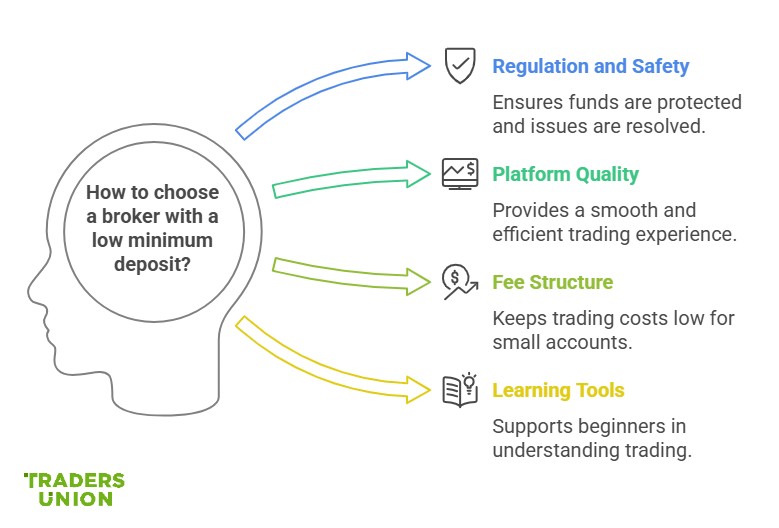
How to choose a broker with a low minimum deposit
Regulation and safety come first
Always begin by checking whether the broker is licensed by a recognized authority such as the FCA (UK), ASIC (Australia), or CySEC (Cyprus). These regulators enforce strict rules to protect your funds, including keeping client money in separate accounts and offering complaint resolution if issues arise. A low deposit should never come at the cost of safety.
A solid platform makes a big difference
Even if you’re trading small amounts, you need a platform that’s smooth, stable, and fast. Look for user-friendly platforms with clear charting tools, mobile support, and real-time execution. Poorly built systems with delays or bugs can lead to frustration and missed opportunities.
Low fees help small accounts grow
Don’t be fooled by “zero commission” marketing — pay close attention to spreads, overnight fees, and hidden charges. Some brokers offer very tight spreads and simple fee structures, making them better for smaller traders who need to keep costs low.
Learning tools help you avoid costly mistakes
For beginners, access to trading lessons, demo accounts, and tutorials is a must. Some brokers offer a complete library of resources that help you understand how markets move and how to build a solid trading plan — even with a small balance.
Good support means fewer headaches
If something goes wrong or you have a question, you’ll want quick and clear help. Look for brokers that offer live chat or fast responses through email or phone, especially during busy market hours. A broker that listens and responds is one you can stick with for the long haul.
Pros and cons of trading with a low minimum deposit
- Pros
- Cons
Start with less pressure. Trading with a low deposit lets you enter the market without needing to risk too much money. It’s a simple way to get hands-on experience and understand how things work without putting your savings on the line.
Learn with real stakes. Even with a small amount, you learn how real money behaves in the market. This builds discipline — traders tend to think more carefully, use proper risk limits, and avoid careless decisions when their capital is limited.
Test brokers without big commitments. Low deposits give you the freedom to try different platforms. You can check how quickly trades are executed, whether withdrawals go through smoothly, and how responsive customer service is — all without making a large commitment.
Room to grow gradually. Instead of throwing in a large sum, you can add to your trading account bit by bit as your confidence and skill improve. It’s a more measured way to grow your capital.
Temptation to overuse leverage. One of the biggest dangers of small accounts is overleveraging. To chase bigger profits, many traders increase their lot sizes too early — one quick price move against them and the account can be wiped out.
Emotional trading. Trading small amounts can sometimes lead to bigger stress. When your capital is limited, even a small loss feels huge. This can push traders into bad habits like chasing losses or jumping into trades without a plan.
Costs eat into profits. With a smaller balance, fixed costs like spreads and commissions take up a bigger chunk of your trades. You could be right about the direction — but still lose money because your account can’t absorb the fees.
Can’t spread out risk easily. Having only one or two trades running at a time increases your exposure. If one trade goes wrong, you don’t have other positions to balance the impact, which makes your account more vulnerable to swings.
Execution quality and margin rules can make or break small trading accounts

When starting with a small deposit, skip the hype around commission-free brokers. Instead, check where your orders actually go. Some platforms send trades to third parties that profit off how your order is filled, which can quietly eat into your profits — especially in fast-moving markets. If you're only trading with $100–$200, even a few cents lost on each trade adds up. Look for brokers that clearly explain their execution policy, even if they charge a small fee. You’re better off with a fair fill than a “free” one that misses the mark.
Most new traders ignore how brokers handle margin calls until it’s too late. Some platforms cut your trades early to protect you, others wait until your losses pile up. If you’re trading with limited capital, this can be the difference between staying in the game and blowing your account. Before funding your account, open a demo and test how close you can go to a loss before your positions close. It’ll show you how the broker handles risk — and how much control you really have in a tight spot.
Methodology for compiling our ratings of stock brokers
Traders Union applies a rigorous methodology to evaluate brokers using over 100 quantitative and qualitative criteria. Multiple parameters are given individual scores that feed into an overall rating.
Key aspects of the assessment include:
-
Regulation and safety. Brokers are evaluated based on the level/reputation of licenses and regulations they operate under.
-
User reviews. Client reviews and feedback are analyzed to determine customer satisfaction levels. Reviews are fact-checked and verified.
-
Trading instruments. Brokers are evaluated on the range of assets offered, as well as the breadth and depth of available markets.
-
Fees and commissions. All trading fees and commissions are analyzed comprehensively to determine overall costs for clients.
-
Trading platforms. Brokers are assessed based on the variety, quality, and features of platforms offered to clients.
-
Other factors like brand popularity, client support, and educational resources are also evaluated.
Conclusion
Low minimum deposit brokers provide access to live trading with minimal financial commitment, but they require careful evaluation. It’s not just the deposit amount that matters — execution quality, fee structure, platform functionality, and regulatory status are equally critical. Beginners should prioritize regulated brokers that offer educational support and allow for small position sizing without hidden restrictions.
For those testing strategies or comparing platforms, flexible account conditions and transparent withdrawal policies are essential. There’s no one-size-fits-all solution — the right broker depends on your trading goals, risk tolerance, and preferred approach. A deliberate choice helps make small capital work with maximum efficiency.
FAQs
Can I trade international markets with a low deposit?
Yes, but make sure the broker offers access to global exchanges and relevant asset classes. Also check for currency conversion fees and additional charges for trading on foreign markets.
What account types are usually offered with low deposits?
Typically, brokers offer cent or simplified standard accounts. These accounts often have limited features, wider spreads, and fewer instruments, but they’re suitable for learning or testing.
Is it practical to use automated trading systems with a small deposit?
Only if risk parameters are carefully adjusted. Most algorithms are designed for larger balances, and on small accounts, performance may be unstable or inconsistent.
What should I do if a broker blocks withdrawals from a low-balance account?
Always review withdrawal conditions before funding. If issues arise, document all communication, request a formal explanation, and escalate the case to the broker’s listed regulator.
Editors' Top Picks and Insights






Related Articles
Team that worked on the article
Maxim Nechiporenko has been a contributor to Traders Union since 2023. He started his professional career in the media in 2006.
Chinmay Soni is a financial analyst with more than 5 years of experience in working with stocks, Forex, derivatives, and other assets. As a founder of a boutique research firm and an active researcher, he covers various industries and fields, providing insights backed by statistical data.
Mirjan Hipolito is a journalist and news editor at Traders Union. She is an expert crypto writer with five years of experience in the financial markets.
Cryptocurrency is a type of digital or virtual currency that relies on cryptography for security. Unlike traditional currencies issued by governments (fiat currencies), cryptocurrencies operate on decentralized networks, typically based on blockchain technology.
A trading system is a set of rules and algorithms that a trader uses to make trading decisions. It can be based on fundamental analysis, technical analysis, or a combination of both.
Forex leverage is a tool enabling traders to control larger positions with a relatively small amount of capital, amplifying potential profits and losses based on the chosen leverage ratio.
Index in trading is the measure of the performance of a group of stocks, which can include the assets and securities in it.
Bitcoin is a decentralized digital cryptocurrency that was created in 2009 by an anonymous individual or group using the pseudonym Satoshi Nakamoto. It operates on a technology called blockchain, which is a distributed ledger that records all transactions across a network of computers.

-
 Afghanistan
-
 Albania
-
 Algeria
-
 Angola
-
 Argentina
-
 Armenia
-
 Australia
-
 Austria
-
 Azerbaijan
-
 Bahamas
-
 Bahrain
-
 Bangladesh
-
 Belarus
-
 Belgium
-
 Bolivia
-
 Botswana
-
 Brazil
-
 Brunei
-
 Bulgaria
-
 Cambodia
-
 Cameroon
-
 Canada
-
 Chile
Chile
-
 China
China
-
 Colombia
-
 Congo
Congo
-
 Costa Rica
-
 Cote d'Ivoire
-
 Croatia
-
 Cuba
Cuba
-
 Cyprus
-
 Czechia
-
 DR Congo
-
 Denmark
-
 Dominican Republic
-
 Ecuador
-
 Egypt
Egypt
-
 El Salvador
-
 Estonia
-
 Eswatini
-
 Ethiopia
-
 Finland
-
 France
-
 Georgia
-
 Germany
-
 Ghana
Ghana
-
 Greece
-
 Haiti
Haiti
-
 Hong Kong
-
 Hungary
-
 India
India
-
 Indonesia
-
 Iran, Islamic republic
-
 Iraq
Iraq
-
 Ireland
-
 Israel
-
 Italy
Italy
-
 Jamaica
-
 Japan
Japan
-
 Jordan
-
 Kazakhstan
-
 Kenya
Kenya
-
 Korea
Korea
-
 Kuwait
-
 Kyrgyzstan
-
 Laos
Laos
-
 Latvia
-
 Lebanon
-
 Lesotho
-
 Libya
Libya
-
 Lithuania
-
 Luxembourg
-
 Madagascar
-
 Malaysia
-
 Malta
Malta
-
 Mauritius
-
 Mexico
-
 Moldova
-
 Mongolia
-
 Montenegro
-
 Morocco
-
 Mozambique
-
 Myanmar
-
 Namibia
-
 Nepal
Nepal
-
 Netherlands
-
 New Zealand
-
 Nigeria
-
 North Macedonia
-
 Norway
-
 Oman
Oman
-
 Pakistan
-
 Palestine
-
 Panama
-
 Papua New Guinea
-
 Paraguay
-
 Peru
Peru
-
 Philippines
-
 Poland
-
 Portugal
-
 Puerto Rico
-
 Qatar
Qatar
-
 Reunion
-
 Romania
-
 Rwanda
-
 Saudi Arabia
-
 Serbia
-
 Singapore
-
 Slovakia
-
 Slovenia
-
 Somalia
-
 South Africa
-
 Spain
Spain
-
 Sri Lanka
-
 Sweden
-
 Switzerland
-
 Syria
Syria
-
 Taiwan
-
 Tajikistan
-
 Tanzania
-
 Thailand
-
 Trinidad and Tobago
-
 Tunisia
-
 Turkey
-
 UAE
UAE
-
 Uganda
-
 Ukraine
-
 United Kingdom
-
United States
-
 Uruguay
-
 Uzbekistan
-
 Venezuela
-
 Vietnam
-
 Yemen
Yemen
-
 Zambia
-
 Zimbabwe
- Forex
- Crypto