
Sam Bankman-Fried Cryptocurrency Portfolio



Editorial Note: While we adhere to strict Editorial Integrity, this post may contain references to products from our partners. Here's an explanation for How We Make Money. None of the data and information on this webpage constitutes investment advice according to our Disclaimer.
Sam Bankman-Fried (SBF) held large Bitcoin reserves through FTX and Alameda Research, ensuring platform liquidity. His key investments included FTT, Solana, and Serum, all of which collapsed with FTX. He also backed Ethereum, Aptos, and Robinhood shares. The FTT crash led to massive losses, forcing asset sales to repay creditors. Facing fraud charges, SBF’s downfall highlights the need for transparency, diversification, and risk management when investing in crypto and trusting industry leaders.
Sam Bankman-Fried (SBF), the founder of FTX and Alameda Research, was once a driving force in the crypto world, making bold bets on major digital assets, up-and-coming blockchain projects, and high-profile acquisitions. But after the dramatic collapse of FTX, everything changed. His portfolio, once a symbol of influence, has been shaken, leaving many wondering what’s left and what it all means for the market. This article takes a deep dive into Sam Bankman-Fried’s crypto portfolio, how it evolved, and what could come next.
Key insights:
Bitcoin holdings. Sam Bankman-Fried (SBF), through his companies FTX and Alameda Research, held large amounts of Bitcoin (BTC), which were crucial for the liquidity of these platforms.
FTX crypto investments. SBF's key investments included FTX Token (FTT), Serum (SRM), and Solana (SOL). The collapse of FTX had a major effect on these assets.
Other cryptocurrency investments. In addition to BTC and SOL, SBF invested in Ethereum (ETH) and Aptos (APT). He also bought a 7.6% share in Robinhood Markets through his company, Emergent Fidelity Technologies Ltd.
Market impact. The crash of FTT resulted in massive financial losses, leading to the sale of assets to repay creditors.
Regulatory actions. U.S. authorities have charged SBF with defrauding investors and misusing customer funds, increasing the legal challenges in recovering assets.
Lessons learned. SBF's downfall is a warning to others. Traders should focus on transparency, diversify their investments, and manage risks carefully when dealing with prominent figures in the crypto industry.
Risk warning: Cryptocurrency markets are highly volatile, with sharp price swings and regulatory uncertainties. Research indicates that 75-90% of traders face losses. Only invest discretionary funds and consult an experienced financial advisor.
Breakdown of Sam Bankman-Fried cryptocurrency holdings

Before FTX's collapse in November 2022, Sam Bankman-Fried (SBF) and his companies, FTX and Alameda Research, were deeply involved in several key cryptocurrencies:
Bitcoin (BTC). They held substantial amounts of Bitcoin, which they used as a reserve asset, significantly influencing market liquidity.
Ethereum (ETH). Ethereum was actively traded on FTX and frequently utilized for decentralized finance (DeFi) investments and lending activities.
Solana (SOL). SBF was notably invested in Solana, with Alameda Research playing a pivotal role in developing its ecosystem. In 2021, FTX and Alameda were among the largest investors in Solana, collectively raising over $300 million from various parties.
FTX Token (FTT). FTX's native token, FTT, was central to the exchange's operations. The company held a significant amount of FTT on its balance sheet.
Serum (SRM). Backed by SBF, Serum was a decentralized exchange project deeply integrated into the Solana network. It was established by the Serum Foundation, comprising partners like FTX, Alameda Research, and the Solana Foundation.
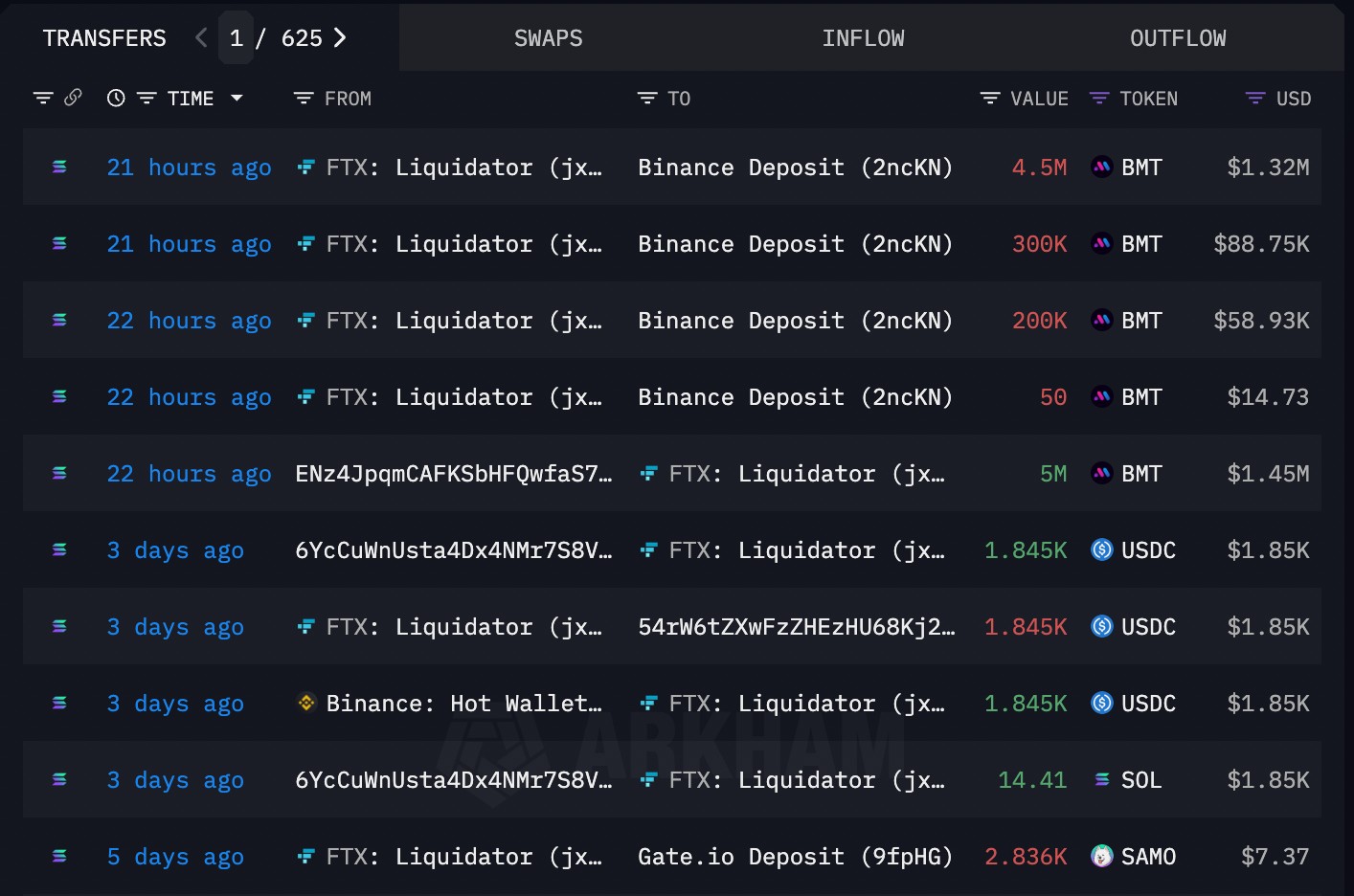
Currently, according to ARKHAM, the FTX crypto holdings are:

Sam Bankman-Fried crypto ventures
Through FTX and Alameda Research, Sam Bankman-Fried (SBF) was a significant investor in various blockchain and crypto startups, including:
BlockFi. A cryptocurrency lending platform that declared bankruptcy on November 28, 2022, citing significant exposure to FTX as a primary cause.
Voyager Digital. A digital asset brokerage firm that filed for bankruptcy in July 2022 due to extreme market conditions, with FTX later winning a bid to acquire its assets in September 2022.
Anthropic AI. A non-crypto artificial intelligence company that received funding from SBF, reflecting his broader investment interests.
Robinhood (HOOD). SBF acquired a 7.6% stake in the trading platform in May 2022, indicating his interest in integrating traditional finance with cryptocurrency.
Financial impact and market reactions
SBF’s portfolio had a profound impact on the cryptocurrency market:
Solana’s surge and collapse. Sam Bankman-Fried's support for Solana (SOL) played a significant role in its swift ascent. However, when FTX collapsed, Solana's value plummeted, leaving traders who followed his investments facing extreme volatility.
FTT token crash. When FTX's financial troubles came to light, investors rushed to sell off FTT tokens. This rush led to liquidity problems and a broader downturn in the crypto market.
Regulatory shockwaves. FTX's downfall drew increased attention from regulators, impacting other crypto companies linked to Bankman-Fried.
Trust deficit in centralized platforms. The FTX scandal made people more wary of centralized exchanges, boosting interest in decentralized options. In 2025 FTX started its repayment process, allocating $18 billion for creditors. Small claims under $50,000 may receive up to 90% of their funds by February 2025, while larger creditors will have their distributions phased over time.
SBF cryptocurrency strategy

SBF followed some unconventional strategies, including the following:
Look for low-liquidity assets. SBF thrived on trading assets with lower liquidity because they tend to have bigger price inefficiencies, creating high-profit opportunities.
Exploit time zone arbitrage. Market activity varies across global time zones. He often traded assets when volume was lower in certain regions, allowing for strategic entries and exits.
Leverage transaction fees to your advantage. Many exchanges offer rebates for market-making. Instead of paying fees, he structured trades to earn from these rebates while profiting from price movements.
Find mispriced options in derivatives. Instead of spot trading alone, he focused on crypto derivatives where minor mispricings in futures and options contracts could lead to high returns.
Trade against emotional retail investors. He identified when retail traders overreacted to news and used this as a chance to take the opposite position before the market corrected.
If you feel you’re ready to test the waters with crypto investing, we have presented the top crypto exchange for beginners in the table below. You may compare their key features and choose the one most suitable to you:
| Crypto | Foundation year | Min. Deposit, $ | Coins Supported | Spot Taker fee, % | Spot Maker Fee, % | Alerts | Copy trading | Tier-1 regulation | TU overall score | Open an account | |
|---|---|---|---|---|---|---|---|---|---|---|---|
| Yes | 2012 | 10 | 249 | 0.5 | 0.5 | Yes | No | Yes | 8.6 | Go to broker Your capital is at risk. |
|
| Yes | 2017 | 10 | 329 | 0.1 | 0.08 | Yes | Yes | No | 8.48 | Go to broker Your capital is at risk. |
|
| Yes | 2016 | 1 | 250 | 0.5 | 0.25 | Yes | No | Yes | 8.44 | Go to broker Your capital is at risk. |
|
| Yes | 2011 | 10 | 278 | 0.4 | 0.25 | Yes | Yes | Yes | 8.32 | Go to broker Your capital is at risk. |
|
| Yes | 2018 | No | 1000 | 0 | 0 | Yes | Yes | No | 7.85 | Go to broker Your capital is at risk. |
Why trust us
15+ years of independent market analysis
140+ evaluation criteria, reviewed by 50+ experts
Data-driven reviews of 200+ platforms, updated regularly
20+ industry awards & a wide network of global media partners
Learn more about our methodology and editorial policies.


Future outlook: What’s next for SBF’s crypto holdings?
Sam Bankman-Fried's cryptocurrency holdings have been significantly impacted by legal proceedings and the collapse of FTX. Following his conviction on multiple counts of fraud and money laundering, Bankman-Fried was sentenced to 25 years in prison and ordered to forfeit $11 billion. This forfeiture has effectively stripped him of his assets, including his cryptocurrency holdings. Consequently, any future outlook on his crypto assets is overshadowed by these legal outcomes, leaving little to no room for personal financial maneuvering.
In the broader context, the FTX collapse has prompted increased regulatory scrutiny across the cryptocurrency industry. This heightened oversight aims to prevent similar incidents, potentially leading to more robust investor protections and a shift towards decentralized platforms. While Bankman-Fried's personal crypto journey has come to a halt, the ripple effects of FTX's downfall continue to influence the market's evolution and regulatory landscape.
Risks and warnings
Investors should be aware of the risks associated with cryptocurrencies linked to SBF:
High volatility. Tokens like SOL and FTT experienced extreme price swings due to their ties with FTX.
Regulatory uncertainty. The legal battles surrounding SBF could lead to further actions affecting his previous investments.
Creditor claims. Some assets in SBF’s portfolio are being liquidated to repay FTX customers, impacting market supply and demand.
Market sentiment shifts. Negative perceptions surrounding FTX and Alameda Research continue to affect related projects.
Sam Bankman-Fried profited from liquidity flow and transaction speed
With everything good and bad, there are still things to learn from SBF’s rise in the crypto world. Most traders look at portfolios in terms of individual coins, but Sam Bankman-Fried’s crypto approach was all about capital flow. He didn’t just hold assets — he positioned himself where money was moving before it got there. Instead of focusing on blue-chip cryptos, he leveraged high-volume stablecoin pairs and liquidity pools to act as a tollbooth for other traders.
Beginners often ignore the power of sitting between transactions rather than chasing volatile assets. If you want to think like SBF, start analyzing where liquidity is flowing across chains and find ways to insert yourself into that flow profitably.
Another overlooked tactic was his ability to weaponize transaction speed. He optimized everything — from exchange APIs to server proximity — so his trades were executed milliseconds before retail traders even saw price shifts. This isn’t just for high-frequency traders; even beginners can apply a simplified version of this. Choosing an exchange with the lowest latency, using limit orders instead of market orders, and automating parts of your trades through simple scripts can give you an edge over 90% of traders who rely on manual execution. The real game isn’t just buying low and selling high — it’s making sure you’re first in line when prices move.
Conclusion
The extent of Sam Bankman-Fried's Bitcoin holdings was once a major discussion point, but in light of the legal cases, much of his remaining assets are now tied up in court proceedings. FTX crypto investments in Solana, Serum, and other projects have faced a turbulent period, leaving investors questioning their future viability. What cryptocurrency Sam Bankman-Fried owns today is mostly determined by ongoing liquidation efforts and asset forfeitures.
FAQs
What cryptocurrencies were in Sam Bankman-Fried’s portfolio?
His portfolio included Bitcoin (BTC), Ethereum (ETH), Solana (SOL), FTX Token (FTT), and Serum (SRM), among others.
How much was Sam Bankman-Fried’s crypto portfolio worth?
Before the FTX collapse, estimates placed SBF’s holdings at over $15 billion, but most of this value was tied to illiquid assets.
What happened to SBF’s crypto holdings?
Many of his assets were liquidated or seized to compensate FTX creditors. Some holdings remain under legal scrutiny.
Is Solana still a good investment after SBF’s collapse?
Solana continues to operate independently, with strong developer activity. However, investors should assess ongoing risks and market conditions before investing.
Editors' Top Picks and Insights

Worldcoin on Wall Street: From iris scans to ETF

Mark Cuban's wealth philosophy: Why stocks matter more than salary or crypto

Dangerous but indispensable: Why the crypto market needs bridges

Markus Levin: DePIN could power the AI agent economy

Pokémon cards for $2,500: How collectibles became a new form of gambling

The privacy paradox: How the crypto mixer market has changed
Related Articles
Team that worked on the article
Parshwa is a content expert and finance professional possessing deep knowledge of stock and options trading, technical and fundamental analysis, and equity research. As a Chartered Accountant Finalist, Parshwa also has expertise in Forex, crypto trading, and personal taxation.
Chinmay Soni is a financial analyst with more than 5 years of experience in working with stocks, Forex, derivatives, and other assets. As a founder of a boutique research firm and an active researcher, he covers various industries and fields, providing insights backed by statistical data.
Mirjan Hipolito is a journalist and news editor at Traders Union. She is an expert crypto writer with five years of experience in the financial markets.
Copy trading is an investing tactic where traders replicate the trading strategies of more experienced traders, automatically mirroring their trades in their own accounts to potentially achieve similar results.
Crypto trading involves the buying and selling of cryptocurrencies, such as Bitcoin, Ethereum, or other digital assets, with the aim of making a profit from price fluctuations.
Diversification is an investment strategy that involves spreading investments across different asset classes, industries, and geographic regions to reduce overall risk.
Index in trading is the measure of the performance of a group of stocks, which can include the assets and securities in it.
Fundamental analysis is a method or tool that investors use that seeks to determine the intrinsic value of a security by examining economic and financial factors. It considers macroeconomic factors such as the state of the economy and industry conditions.

-
 Afghanistan
-
 Albania
-
 Algeria
-
 Angola
-
 Argentina
-
 Armenia
-
 Australia
-
 Austria
-
 Azerbaijan
-
 Bahamas
-
 Bahrain
-
 Bangladesh
-
 Belarus
-
 Belgium
-
 Bolivia
-
 Botswana
-
 Brazil
-
 Brunei
-
 Bulgaria
-
 Cambodia
-
 Cameroon
-
 Canada
-
 Chile
Chile
-
 China
China
-
 Colombia
-
 Congo
Congo
-
 Costa Rica
-
 Cote d'Ivoire
-
 Croatia
-
 Cuba
Cuba
-
 Cyprus
-
 Czechia
-
 DR Congo
-
 Denmark
-
 Dominican Republic
-
 Ecuador
-
 Egypt
Egypt
-
 El Salvador
-
 Estonia
-
 Eswatini
-
 Ethiopia
-
 Finland
-
 France
-
 Georgia
-
 Germany
-
 Ghana
Ghana
-
 Greece
-
 Haiti
Haiti
-
 Hong Kong
-
 Hungary
-
 India
India
-
 Indonesia
-
 Iran, Islamic republic
-
 Iraq
Iraq
-
 Ireland
-
 Israel
-
 Italy
Italy
-
 Jamaica
-
 Japan
Japan
-
 Jordan
-
 Kazakhstan
-
 Kenya
Kenya
-
 Korea
Korea
-
 Kuwait
-
 Kyrgyzstan
-
 Laos
Laos
-
 Latvia
-
 Lebanon
-
 Lesotho
-
 Libya
Libya
-
 Lithuania
-
 Luxembourg
-
 Madagascar
-
 Malaysia
-
 Malta
Malta
-
 Mauritius
-
 Mexico
-
 Moldova
-
 Mongolia
-
 Montenegro
-
 Morocco
-
 Mozambique
-
 Myanmar
-
 Namibia
-
 Nepal
Nepal
-
 Netherlands
-
 New Zealand
-
 Nigeria
-
 North Macedonia
-
 Norway
-
 Oman
Oman
-
 Pakistan
-
 Palestine
-
 Panama
-
 Papua New Guinea
-
 Paraguay
-
 Peru
Peru
-
 Philippines
-
 Poland
-
 Portugal
-
 Puerto Rico
-
 Qatar
Qatar
-
 Reunion
-
 Romania
-
 Rwanda
-
 Saudi Arabia
-
 Serbia
-
 Singapore
-
 Slovakia
-
 Slovenia
-
 Somalia
-
 South Africa
-
 Spain
Spain
-
 Sri Lanka
-
 Sweden
-
 Switzerland
-
 Syria
Syria
-
 Taiwan
-
 Tajikistan
-
 Tanzania
-
 Thailand
-
 Trinidad and Tobago
-
 Tunisia
-
 Turkey
-
 UAE
UAE
-
 Uganda
-
 Ukraine
-
 United Kingdom
-
United States
-
 Uruguay
-
 Uzbekistan
-
 Venezuela
-
 Vietnam
-
 Yemen
Yemen
-
 Zambia
-
 Zimbabwe
- Forex
- Crypto












