

Ethereum drops as Federal Reserve holds rates steady amid Middle East tensions

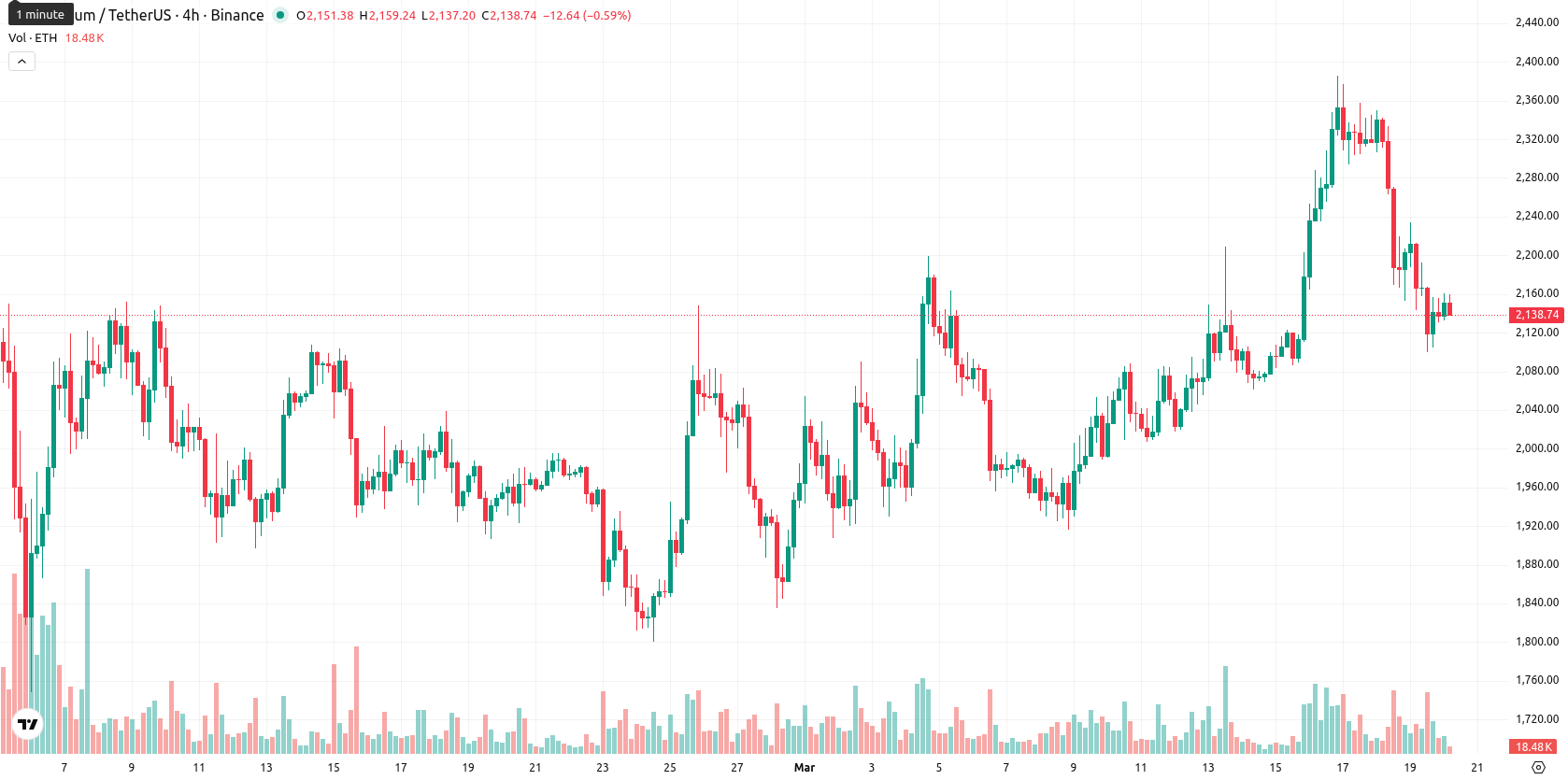
Ethereum (ETH) is trading at $2,138.04, slightly above the SMA-20 ($2,076.97) and SMA-50 ($2,084.49), while remaining far below the SMA-200 ($3,193.53), which points to short-term and medium-term support but a bearish long-term outlook. The Ichimoku Kijun (D1) sits at $2,093.01, just under the current price, marking immediate support.
 2538.52
2587.28
2538.52
2587.28
Highlights
- Escalating Middle East conflict and disruptions at the Strait of Hormuz have driven global oil prices higher, intensifying inflation risk and market instability.
- US regulators have unified SEC and CFTC oversight of cryptocurrencies, reducing regulatory overlap and potentially increasing onshore crypto market participation.
- ETH is consolidating in a $2,040–$2,160 range with technical signals showing waning bullish momentum and increased likelihood of further declines.
Tighter global liquidity as Middle East turmoil and Fed amplify risks
Major military escalation in the Middle East has disrupted global oil flows, driving energy prices sharply higher and increasing inflationary pressure. Concurrent conflicts in Iran and Ukraine have further reduced European oil supplies, heightening instability in energy markets and straining economic liquidity abroad. The U.S. Federal Reserve has maintained a hawkish stance, refraining from interest rate cuts until inflation trends lower, intensifying tight financial conditions across risk assets including Ethereum. Coordinated regulatory oversight by the SEC and CFTC in the United States has resolved agency conflicts over cryptocurrency supervision, ending duplicative rules that previously drove market participants offshore. The Strait of Hormuz faces heightened risk of trade disruption, compounding global economic uncertainty.
Intraday weakness emerges as mixed technicals signal waning buyer momentum
Momentum signals are mixed: the D1 MACD and ADX indicate moderate bullish momentum, while RSI and CCI read as mildly constructive (both above 50). However, Stoch RSI remains neutral, and BBP signals are overbought, suggesting buyer dominance may be waning. The Awesome Oscillator is in buy territory, consistent with the short-term uptrend. ETH opened lower with no pricing gap and currently hovers near the intraday low, after sliding 2.30% from the previous close, which demonstrates increased intraday volatility and steady selling pressure since the open. The divergence among oscillators and momentum tools highlights near-term uncertainty and possible profit-taking, with daily price action favoring sellers as intraday momentum signals and BBP both point to waning bullish interest.
Sideways consolidation likely as bearish bias limits breakout odds
For the next five trading days, the expected range for ETH is $2,040 to $2,160, keeping the price action within a volatility band relative to current levels. Weekly indicators (RSI, ADX, MACD, MA-50) all lean bearish or neutral, resulting in a very low probability (less than 20%) of a sustained upward move. The baseline scenario is for consolidation sideways within the $2,040 – $2,160 corridor. If ETH clears resistance above $2,160, a run toward $2,200 is possible, while a break below $2,040 may spark a test of $2,000 or further declines.
Earlier, analysts noted that Ethereum’s recovery was constrained by a cautious macroeconomic backdrop, with institution-driven staking and monetary policy both shaping its price floor. Heightened geopolitical risks and persistent regulatory uncertainty now reinforce the likelihood of continued rangebound consolidation, making decisive moves above $2,160 or below $2,040 key triggers for a shift in near-term direction.





Latest Ethereum News






-
 Afghanistan
-
 Albania
-
 Algeria
-
 Angola
-
 Argentina
-
 Armenia
-
 Australia
-
 Austria
-
 Azerbaijan
-
 Bahamas
-
 Bahrain
-
 Bangladesh
-
 Belarus
-
 Belgium
-
 Bolivia
-
 Botswana
-
 Brazil
-
 Brunei
-
 Bulgaria
-
 Cambodia
-
 Cameroon
-
 Canada
-
 Chile
Chile
-
 China
China
-
 Colombia
-
 Congo
Congo
-
 Costa Rica
-
 Cote d'Ivoire
-
 Croatia
-
 Cuba
Cuba
-
 Cyprus
-
 Czechia
-
 DR Congo
-
 Denmark
-
 Dominican Republic
-
 Ecuador
-
 Egypt
Egypt
-
 El Salvador
-
 Estonia
-
 Eswatini
-
 Ethiopia
-
 Finland
-
 France
-
 Georgia
-
 Germany
-
 Ghana
Ghana
-
 Greece
-
 Haiti
Haiti
-
 Hong Kong
-
 Hungary
-
 India
India
-
 Indonesia
-
 Iran, Islamic republic
-
 Iraq
Iraq
-
 Ireland
-
 Israel
-
 Italy
Italy
-
 Jamaica
-
 Japan
Japan
-
 Jordan
-
 Kazakhstan
-
 Kenya
Kenya
-
 Korea
Korea
-
 Kuwait
-
 Kyrgyzstan
-
 Laos
Laos
-
 Latvia
-
 Lebanon
-
 Lesotho
-
 Libya
Libya
-
 Lithuania
-
 Luxembourg
-
 Madagascar
-
 Malaysia
-
 Malta
Malta
-
 Mauritius
-
 Mexico
-
 Moldova
-
 Mongolia
-
 Montenegro
-
 Morocco
-
 Mozambique
-
 Myanmar
-
 Namibia
-
 Nepal
Nepal
-
 Netherlands
-
 New Zealand
-
 Nigeria
-
 North Macedonia
-
 Norway
-
 Oman
Oman
-
 Pakistan
-
 Palestine
-
 Panama
-
 Papua New Guinea
-
 Paraguay
-
 Peru
Peru
-
 Philippines
-
 Poland
-
 Portugal
-
 Puerto Rico
-
 Qatar
Qatar
-
 Reunion
-
 Romania
-
 Rwanda
-
 Saudi Arabia
-
 Serbia
-
 Singapore
-
 Slovakia
-
 Slovenia
-
 Somalia
-
 South Africa
-
 Spain
Spain
-
 Sri Lanka
-
 Sweden
-
 Switzerland
-
 Syria
Syria
-
 Taiwan
-
 Tajikistan
-
 Tanzania
-
 Thailand
-
 Trinidad and Tobago
-
 Tunisia
-
 Turkey
-
 UAE
UAE
-
 Uganda
-
 Ukraine
-
 United Kingdom
-
United States
-
 Uruguay
-
 Uzbekistan
-
 Venezuela
-
 Vietnam
-
 Yemen
Yemen
-
 Zambia
-
 Zimbabwe
- Forex
- Crypto












