The tweet was deleted by the author.
But we saved everything 🙂.


Avalanche (AVAX) is currently trading at $10.21, up $0.13 (+1.23%) versus the previous close of $10.08. Intraday, AVAX has moved in a moderate range between $10.01 and $10.50, showing a measured recovery from early selling pressure and holding a mid-range position within the day's band. The daily gain reflects a blend of strong short-term momentum, moderate volatility, and ongoing ecosystem developments — with Emin Sirer's positive remarks on Avalanche’s account system alignment adding to broader optimism about institutional adoption and network growth.
 8.74
9.16
Emin Sirer highlighted Avalanche’s support for both the UTXO and EVM account models, emphasizing that the network design provides security and potential tax efficiency advantages for users. This statement matters for AVAX as it reinforces confidence in the platform's technical flexibility and security, fueling positive sentiment and supporting adoption among institutional users. The overall news backdrop underscores significant growth in Avalanche’s ecosystem, with tokenized US Treasuries reaching $545 million and onchain credit loans hitting records in 2026, alongside partnerships with Centrifuge, Securitize, and Neuberger Berman. These partnerships, new lending protocol integrations, and the NYSE's interest in Avalanche technology all point toward expanding real-world asset tokenization on AVAX.
View post on X Loading...
AVAX trades just below its MA-20 ($10.89), but above the MA-50 ($8.87) and MA-200 ($8.12), indicating sustained medium- and long-term support with short-term selling pressure still present. The closest support rests at $9.59, while resistance is near $10.89. The MACD gives a strong buy signal, but oscillator readings are still bearish, supporting a rangebound outlook with some uncertainty. For the next five days, AVAX is likely to trade between $9.80 and $10.50; with the fundamental signal from the tweet supporting the technical outlook.
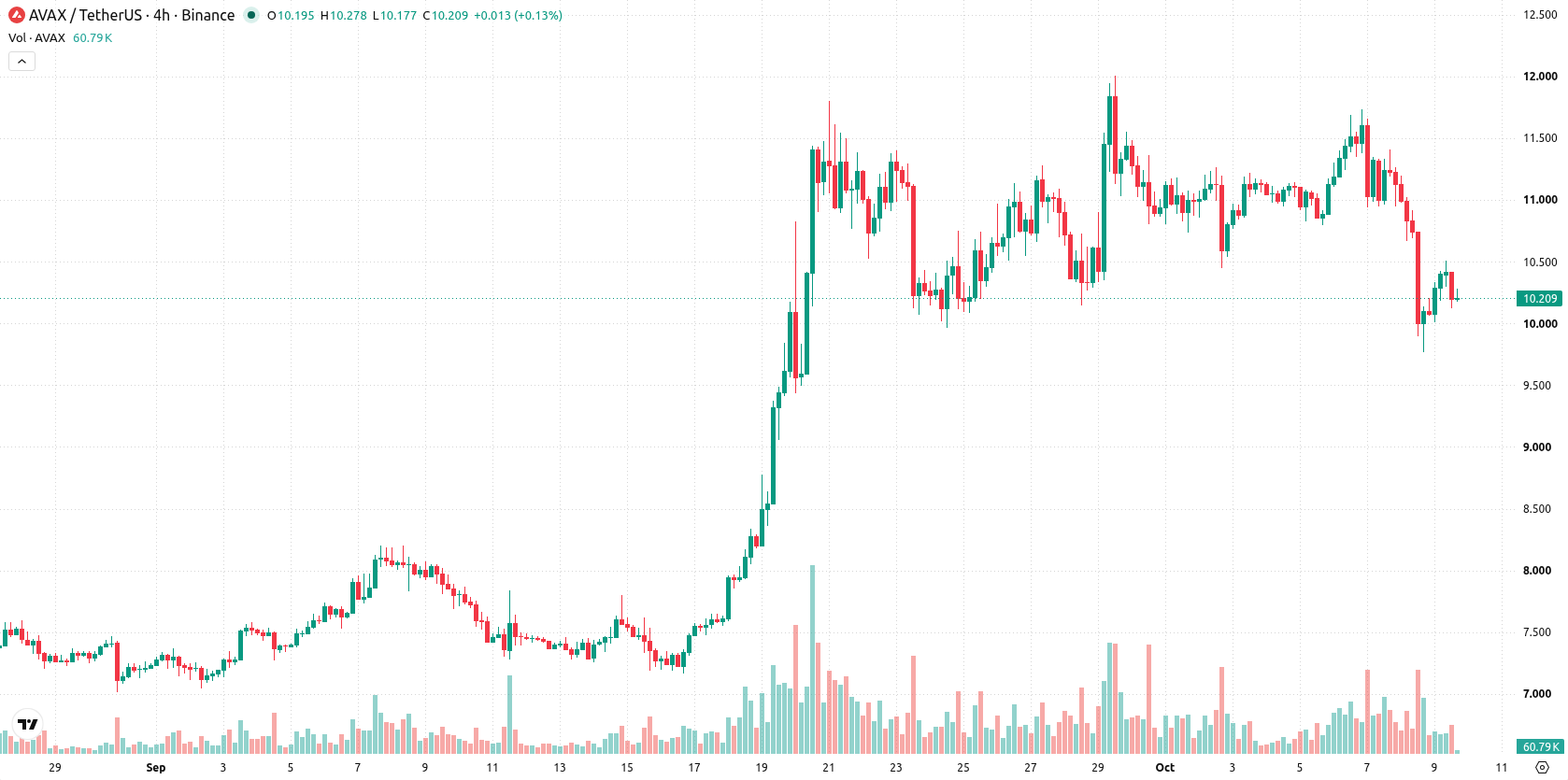
Earlier, analysts noted that Avalanche’s price action was dominated by institutional flows and technical pressures, with rangebound movement likely as support and resistance levels converged. The current analysis builds on this by highlighting fresh developments in the network or market, making it important for traders to monitor any emerging shifts as they could signal a change in the prevailing scenario.



 Afghanistan
 Albania
 Algeria
 Angola
 Argentina
 Armenia
 Australia
 Austria
 Azerbaijan
 Bahamas
 Bahrain
 Bangladesh
 Belarus
 Belgium
 Bolivia
 Botswana
 Brazil
 Brunei
 Bulgaria
 Cambodia
 Cameroon
 Canada
 Chile
 China
 Colombia
 Congo
 Costa Rica
 Cote d'Ivoire
 Croatia
 Cuba
 Cyprus
 Czechia
 DR Congo
 Denmark
 Dominican Republic
 Ecuador
 Egypt
 El Salvador
 Estonia
 Eswatini
 Ethiopia
 Finland
 France
 Georgia
 Germany
 Ghana
 Greece
 Haiti
 Hong Kong
 Hungary
 India
 Indonesia
 Iran, Islamic republic
 Iraq
 Ireland
 Israel
 Italy
 Jamaica
 Japan
 Jordan
 Kazakhstan
 Kenya
 Korea
 Kuwait
 Kyrgyzstan
 Laos
 Latvia
 Lebanon
 Lesotho
 Libya
 Lithuania
 Luxembourg
 Madagascar
 Malaysia
 Malta
 Mauritius
 Mexico
 Moldova
 Mongolia
 Montenegro
 Morocco
 Mozambique
 Myanmar
 Namibia
 Nepal
 Netherlands
 New Zealand
 Nigeria
 North Macedonia
 Norway
 Oman
 Pakistan
 Palestine
 Panama
 Papua New Guinea
 Paraguay
 Peru
 Philippines
 Poland
 Portugal
 Puerto Rico
 Qatar
 Reunion
 Romania
 Rwanda
 Saudi Arabia
 Serbia
 Singapore
 Slovakia
 Slovenia
 Somalia
 South Africa
 Spain
 Sri Lanka
 Sweden
 Switzerland
 Syria
 Taiwan
 Tajikistan
 Tanzania
 Thailand
 Trinidad and Tobago
 Tunisia
 Turkey
 UAE
 Uganda
 Ukraine
 United Kingdom
United States
 Uruguay
 Uzbekistan
 Venezuela
 Vietnam
 Yemen
 Zambia
 Zimbabwe