
WTI crude slips under $56 with downtrend firmly in place

WTI crude oil prices remain under heavy pressure on Friday, with WTI futures trading just below $56 per barrel as the market struggles to arrest a prolonged and damaging selloff. Despite intermittent intraday rebounds, price action continues to signal distribution rather than the formation of a durable base, leaving crude pinned near levels last seen almost five years ago.
Highlights
- WTI trades below $56 as the broader downtrend remains firmly intact.
- Rallies continue to fail beneath key moving averages and resistance zones.
- Oversupply concerns outweigh geopolitical risk and inventory draws.
The recent weakness reflects a market that has shifted decisively from tightness narratives toward surplus concerns, with technical and fundamental signals reinforcing one another rather than diverging.
Bearish structure dominates daily charts
From a technical perspective, the damage to WTI’s structure is both clear and persistent. On the daily chart, crude remains decisively below all major moving averages. The 20-day EMA is hovering near $57.8, followed by the 50-day around $59.2, the 100-day near $60.8, and the 200-day EMA sitting above $63. This descending EMA configuration has consistently capped every recovery attempt since late summer.
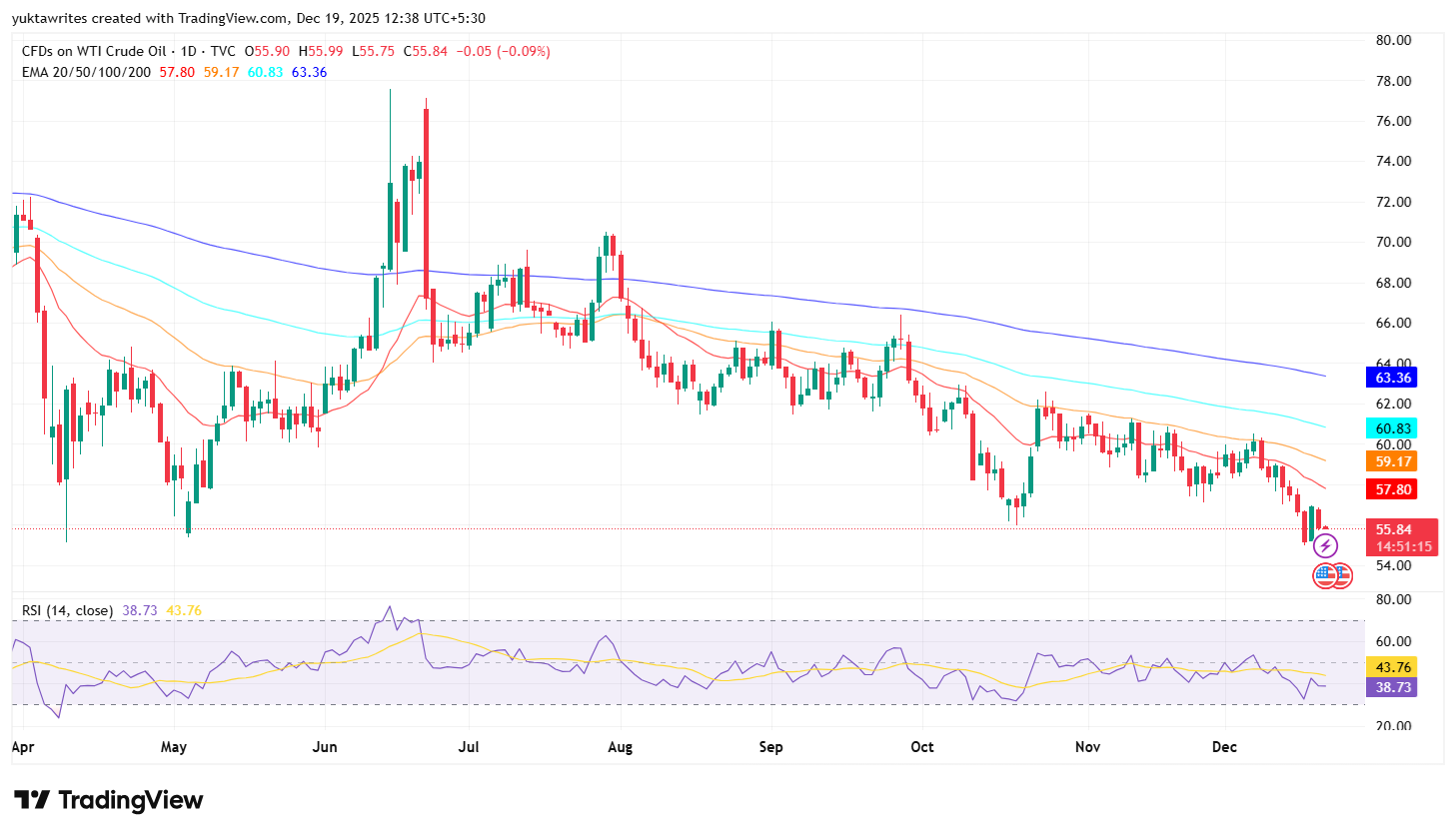
WTI crude oil price dynamics (Source: TradingView)
The trend has been defined by a steady sequence of lower highs and lower lows, confirming that rebounds remain corrective rather than the start of a reversal. The recent failure to reclaim the $56 handle on a closing basis has further reinforced downside dominance, leaving WTI trading near the lower boundary of its multi-year range.
Momentum indicators support this bearish assessment. Daily RSI is holding in the high-30s, signaling persistent selling pressure without reaching extreme oversold levels. Importantly, prior RSI rebounds over the past quarter stalled near the mid-40s, suggesting that momentum resets have repeatedly been sold into. This pattern highlights a market still controlled by sellers rather than one approaching capitulation.
Short-term stabilization lacks conviction
Intraday price action has offered only limited relief. On the 30-minute chart, WTI attempted to stabilize following a sharp drop earlier in the week, but rebounds have remained shallow and short-lived. Supertrend resistance continues to press lower near $56.2, while Parabolic SAR remains positioned above price, indicating that short-term control has not shifted back to buyers.
Each push toward the $56.5 to $57 zone has attracted renewed selling, underscoring the presence of active supply overhead. The absence of impulsive upside moves suggests that recent bounces are driven more by short covering than by fresh demand. Until price can reclaim and hold above near-term resistance, intraday stabilization should be viewed as fragile rather than constructive.
Fundamentals reinforce downside bias
The fundamental backdrop continues to align with the bearish technical picture. Oversupply concerns dominate sentiment as OPEC+ moves forward with plans to gradually restore previously curtailed production. At the same time, non-OPEC output, particularly from the U.S., remains elevated, adding to global supply at a time when demand signals are softening.
Early indicators from key consuming regions have weighed on confidence. Slower growth expectations in China and signs of moderation in U.S. fuel demand have undermined hopes for a near-term rebalancing of the market. With crude down roughly 20% on the year, the narrative has shifted decisively from scarcity toward surplus.
Geopolitical developments have injected bouts of volatility but have failed to alter the broader trajectory. Recent U.S. actions to suspend maritime activity involving sanctioned Venezuelan tankers, alongside tightening measures targeting parts of Russia’s energy sector, have introduced temporary price support. However, these moves have so far only slowed declines rather than reversed them, highlighting how heavily fundamentals are tilted toward excess supply.
Inventory data has provided mixed signals. While occasional draws have emerged, they have not been large or consistent enough to offset concerns about rising production and weakening demand. As a result, inventory surprises have generated only fleeting reactions in price.
Market outlook
Technically, WTI remains vulnerable as long as price stays below the $57.5 to $58 zone on a closing basis. A sustained move back above the 20-day EMA would be required to signal any meaningful shift in short-term momentum. On the downside, a decisive break below $55 would expose the market to another leg lower, with limited structural support beneath current levels.
Previously, we highlighted the risk that repeated failures near the $60 area would leave crude exposed to deeper losses if demand failed to recover. That scenario has now materialized, with prices continuing to grind lower rather than stabilize convincingly. For now, WTI is trading like a market still searching for a floor, where stabilization remains tentative and conviction among buyers is notably absent.





Latest WTI News









-
 Afghanistan
-
 Albania
-
 Algeria
-
 Angola
-
 Argentina
-
 Armenia
-
 Australia
-
 Austria
-
 Azerbaijan
-
 Bahamas
-
 Bahrain
-
 Bangladesh
-
 Belarus
-
 Belgium
-
 Bolivia
-
 Botswana
-
 Brazil
-
 Brunei
-
 Bulgaria
-
 Cambodia
-
 Cameroon
-
 Canada
-
 Chile
Chile
-
 China
China
-
 Colombia
-
 Congo
Congo
-
 Costa Rica
-
 Cote d'Ivoire
-
 Croatia
-
 Cuba
Cuba
-
 Cyprus
-
 Czechia
-
 DR Congo
-
 Denmark
-
 Dominican Republic
-
 Ecuador
-
 Egypt
Egypt
-
 El Salvador
-
 Estonia
-
 Eswatini
-
 Ethiopia
-
 Finland
-
 France
-
 Georgia
-
 Germany
-
 Ghana
Ghana
-
 Greece
-
 Haiti
Haiti
-
 Hong Kong
-
 Hungary
-
 India
India
-
 Indonesia
-
 Iran, Islamic republic
-
 Iraq
Iraq
-
 Ireland
-
 Israel
-
 Italy
Italy
-
 Jamaica
-
 Japan
Japan
-
 Jordan
-
 Kazakhstan
-
 Kenya
Kenya
-
 Korea
Korea
-
 Kuwait
-
 Kyrgyzstan
-
 Laos
Laos
-
 Latvia
-
 Lebanon
-
 Lesotho
-
 Libya
Libya
-
 Lithuania
-
 Luxembourg
-
 Madagascar
-
 Malaysia
-
 Malta
Malta
-
 Mauritius
-
 Mexico
-
 Moldova
-
 Mongolia
-
 Montenegro
-
 Morocco
-
 Mozambique
-
 Myanmar
-
 Namibia
-
 Nepal
Nepal
-
 Netherlands
-
 New Zealand
-
 Nigeria
-
 North Macedonia
-
 Norway
-
 Oman
Oman
-
 Pakistan
-
 Palestine
-
 Panama
-
 Papua New Guinea
-
 Paraguay
-
 Peru
Peru
-
 Philippines
-
 Poland
-
 Portugal
-
 Puerto Rico
-
 Qatar
Qatar
-
 Reunion
-
 Romania
-
 Rwanda
-
 Saudi Arabia
-
 Serbia
-
 Singapore
-
 Slovakia
-
 Slovenia
-
 Somalia
-
 South Africa
-
 Spain
Spain
-
 Sri Lanka
-
 Sweden
-
 Switzerland
-
 Syria
Syria
-
 Taiwan
-
 Tajikistan
-
 Tanzania
-
 Thailand
-
 Trinidad and Tobago
-
 Tunisia
-
 Turkey
-
 UAE
UAE
-
 Uganda
-
 Ukraine
-
 United Kingdom
-
United States
-
 Uruguay
-
 Uzbekistan
-
 Venezuela
-
 Vietnam
-
 Yemen
Yemen
-
 Zambia
-
 Zimbabwe
- Forex
- Crypto












