
WTI crude steadies above $57 as geopolitics offer support

WTI crude oil is attempting to stabilize on Monday after months of persistent weakness, with prices climbing back above the $57 per barrel mark as geopolitical risk re-enters the market narrative. The rebound follows repeated defenses of the mid-$56 area and reflects growing sensitivity to supply-side headlines.
Highlights
- WTI rebounds above $57 as geopolitical risk supports near-term prices.
- Crude remains below key EMAs, keeping the broader trend bearish.
- $59–$60 resistance is critical for any meaningful shift in outlook.
The latest price action shows buyers becoming more active at depressed levels, but the market has yet to demonstrate the conviction typically associated with a trend reversal. Instead, WTI appears to be pausing within a broader downtrend, with short-term stabilization colliding with unresolved oversupply concerns.The broader technical picture suggests the move remains corrective rather than the start of a sustained recovery.
Downtrend remains intact despite rebound
On the daily chart, the dominant structure continues to favor sellers. WTI is still trading below its full EMA stack, with the 20-day EMA near $57.8 acting as the first layer of resistance. Above that, the 50-day EMA around $59.1 and the 100-day near $60.8 reinforce a descending resistance zone that has capped every rally since late summer. The downward slope of these averages confirms that the broader trend remains defined by lower highs rather than accumulation.
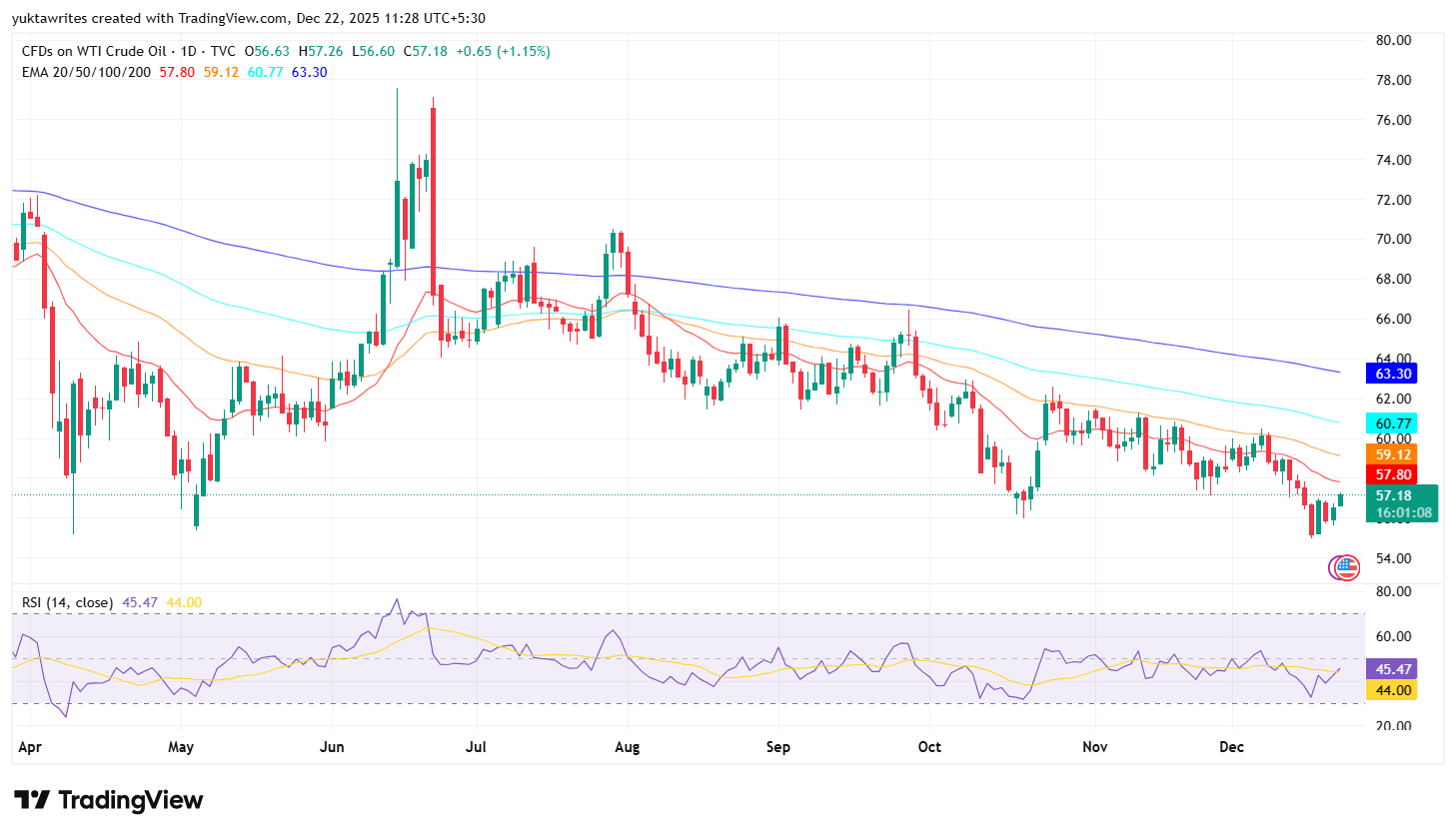
WTI crude oil price dynamics (Source: TradingView)
From a structural perspective, the recent lift is best viewed as a corrective recovery within a declining channel. The $55.5 to $56 region has repeatedly attracted demand, forming a short-term base. However, each rebound has stalled beneath declining moving averages, preventing price from transitioning into a higher high. The failure to reclaim the $59–$60 band on a closing basis has kept medium-term control firmly with sellers.
Momentum indicators reinforce this cautious view. Daily RSI is hovering in the mid-40s, a level consistent with stabilization but not strength. This suggests downside momentum has eased, yet there is no clear bullish divergence to indicate a broader trend shift. Historically, sustainable recoveries in crude have required RSI to reclaim and hold above the mid-50s, a condition that remains unmet.
Intraday structure shows tentative improvement
While higher timeframes remain bearish, the lower timeframe offers a more constructive signal. On the 30-minute chart, WTI has formed a sequence of higher lows since late last week, with Supertrend flipping to support near $56.7 and Parabolic SAR trailing beneath price. This shift confirms that short-term control has tilted back toward buyers, allowing price to grind higher rather than spike and fade.
Importantly, pullbacks have been shallow, suggesting improved bid-side discipline around current levels. The $56.5 to $56.7 zone now represents immediate intraday support, while a break below $55.8 would undermine the current recovery attempt and reopen downside risk. On the upside, $57.8 remains the first technical barrier, aligned with the 20-day EMA.
Beyond that, the $59–$60 region is pivotal. This zone combines moving-average resistance with prior breakdown territory, making it the level that would need to be reclaimed to materially improve the medium-term outlook. Until then, rallies are likely to be sold rather than extended.
Geopolitics support prices, oversupply caps upside
Geopolitical developments are providing the primary catalyst for the recent bounce. Rising tensions between the U.S. and Venezuela, alongside disruptions linked to Russian shipping and energy infrastructure, have reintroduced a supply-risk premium. These factors help explain why prices are finding support despite weak underlying structure.
However, the market’s response has been measured. The absence of impulsive upside follow-through suggests that traders are pricing geopolitical risk cautiously rather than aggressively chasing higher prices. This restraint reflects the larger backdrop of expected oversupply.
Longer-term headwinds remain firmly in place. OPEC+ plans to gradually restore production, while non-OPEC supply continues to grow. At the same time, demand forecasts for next year remain muted, reinforcing skepticism that temporary disruptions will be sufficient to rebalance the market. This tension between headline-driven support and structural surplus is visible in price behavior, with volatility contained and rallies capped.
Market outlook
Previously, we noted that WTI’s repeated defenses of the mid-$56 area were slowing downside momentum but failing to change the broader trend. That assessment remains valid. The current rebound shows early signs of stabilization, supported by improving intraday structure and geopolitical risk, but the market has not yet escaped its bearish framework.
Looking ahead, the focus remains on the $59–$60 resistance band. A sustained move above this zone would signal a meaningful improvement in structure and open the door to a broader consolidation phase. Until then, WTI continues to trade as a market searching for a durable floor, with near-term gains vulnerable as long as key moving averages remain overhead.





Latest WTI News








-
 Afghanistan
-
 Albania
-
 Algeria
-
 Angola
-
 Argentina
-
 Armenia
-
 Australia
-
 Austria
-
 Azerbaijan
-
 Bahamas
-
 Bahrain
-
 Bangladesh
-
 Belarus
-
 Belgium
-
 Bolivia
-
 Botswana
-
 Brazil
-
 Brunei
-
 Bulgaria
-
 Cambodia
-
 Cameroon
-
 Canada
-
 Chile
Chile
-
 China
China
-
 Colombia
-
 Congo
Congo
-
 Costa Rica
-
 Cote d'Ivoire
-
 Croatia
-
 Cuba
Cuba
-
 Cyprus
-
 Czechia
-
 DR Congo
-
 Denmark
-
 Dominican Republic
-
 Ecuador
-
 Egypt
Egypt
-
 El Salvador
-
 Estonia
-
 Eswatini
-
 Ethiopia
-
 Finland
-
 France
-
 Georgia
-
 Germany
-
 Ghana
Ghana
-
 Greece
-
 Haiti
Haiti
-
 Hong Kong
-
 Hungary
-
 India
India
-
 Indonesia
-
 Iran, Islamic republic
-
 Iraq
Iraq
-
 Ireland
-
 Israel
-
 Italy
Italy
-
 Jamaica
-
 Japan
Japan
-
 Jordan
-
 Kazakhstan
-
 Kenya
Kenya
-
 Korea
Korea
-
 Kuwait
-
 Kyrgyzstan
-
 Laos
Laos
-
 Latvia
-
 Lebanon
-
 Lesotho
-
 Libya
Libya
-
 Lithuania
-
 Luxembourg
-
 Madagascar
-
 Malaysia
-
 Malta
Malta
-
 Mauritius
-
 Mexico
-
 Moldova
-
 Mongolia
-
 Montenegro
-
 Morocco
-
 Mozambique
-
 Myanmar
-
 Namibia
-
 Nepal
Nepal
-
 Netherlands
-
 New Zealand
-
 Nigeria
-
 North Macedonia
-
 Norway
-
 Oman
Oman
-
 Pakistan
-
 Palestine
-
 Panama
-
 Papua New Guinea
-
 Paraguay
-
 Peru
Peru
-
 Philippines
-
 Poland
-
 Portugal
-
 Puerto Rico
-
 Qatar
Qatar
-
 Reunion
-
 Romania
-
 Rwanda
-
 Saudi Arabia
-
 Serbia
-
 Singapore
-
 Slovakia
-
 Slovenia
-
 Somalia
-
 South Africa
-
 Spain
Spain
-
 Sri Lanka
-
 Sweden
-
 Switzerland
-
 Syria
Syria
-
 Taiwan
-
 Tajikistan
-
 Tanzania
-
 Thailand
-
 Trinidad and Tobago
-
 Tunisia
-
 Turkey
-
 UAE
UAE
-
 Uganda
-
 Ukraine
-
 United Kingdom
-
United States
-
 Uruguay
-
 Uzbekistan
-
 Venezuela
-
 Vietnam
-
 Yemen
Yemen
-
 Zambia
-
 Zimbabwe
- Forex
- Crypto












