

Nvidia stock slips 4.9% as Bernstein flags extreme undervaluation with strong upside

As of December 22, Nvidia stock is trading at $182.70, up 4.9% in the last 24 hours. This rally comes amid renewed bullish commentary from analysts who point to a rare valuation compression and historical return trends that favor buyers at these levels.
Highlights
- Nvidia is trading at a rare valuation of 25x forward earnings, placing it in the 11th percentile of its 10-year historical range.
- Despite strong earnings upgrades, the stock has underperformed the SOX index by 13% year-to-date.
- Bernstein notes that similar valuation setups in the past delivered average 1-year returns of over 150% with zero historical drawdowns.
Technically, Nvidia is at a decisive level, with its current price sitting just above the 200-day simple moving average (SMA), which stands near $182.20. Holding above this level typically signals continued participation from long-term trend-followers and institutions. A clean reclaim of this SMA with follow-through could restore short-term bullish momentum.Recent price action shows Nvidia correcting from a 52-week high of $212.19, with intermediate support now layered at $176.00, then deeper at $172.00 and $164.00. These represent Fibonacci retracements from the mid-year rally and are now watched closely by momentum traders and algorithmic models.
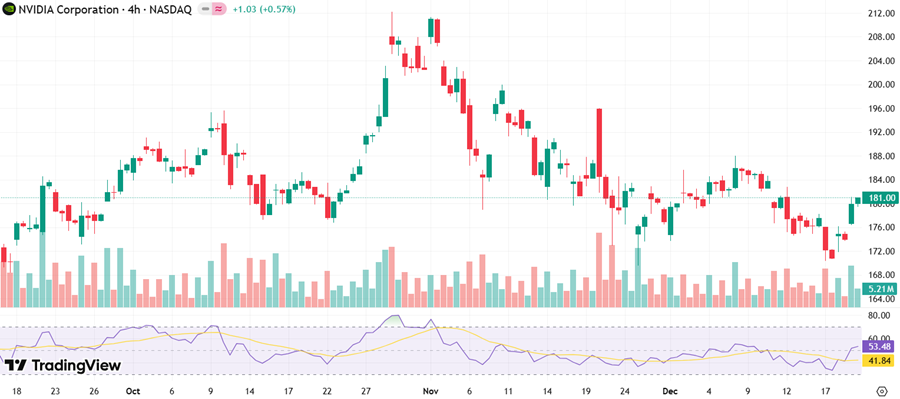
Nvidia stock price dynamics (October 2025 - December 2025). Source: TradingView
Volume has picked up in recent sessions, and while the Relative Strength Index (RSI) remains near neutral at ~49, this gives the stock room to push higher without entering overbought territory. The 20-day moving average sits at $189.45, and a close above that could trigger short-term technical buying. Resistance zones to the upside lie between $188.00 and $190.00, followed by the major psychological level of $200.00. Breaking that would open the path back to retesting the yearly highs near $212.
Earnings rising as shares lag SOX
Bernstein highlights a growing disconnect between Nvidia’s fundamentals and its share price performance. While the stock is up around 30% year to date, it has substantially underperformed the SOX semiconductor index, even as earnings estimates have continued to move higher. According to analyst Stacy Rasgon, this divergence is unusual for Nvidia, which has historically tracked or outperformed the sector during periods of strong earnings momentum. The key takeaway is that the recent weakness has not been driven by deteriorating fundamentals, but by multiple compression as investors rotated away from high‑growth technology names.
That underperformance has led to a sharp reset in valuation. Bernstein notes that Nvidia’s forward price-to-earnings multiple has fallen by 27% over the course of the year and is now sitting just under 25x forward earnings. In absolute terms, this level may not look cheap for a megacap technology stock, but Rasgon stresses that context is critical. For Nvidia specifically, a 25x forward multiple places the shares in the 11th percentile of their valuation range over the past decade, underscoring how rare such pricing has been during periods of strong earnings growth.
Relative valuation paints an even more compelling picture. Bernstein estimates that Nvidia is now trading at roughly a 13% discount to the SOX index, placing it in the first percentile on a relative basis. Over the past ten years, there have been only thirteen trading days when Nvidia was cheaper versus the SOX than it is now. Importantly, historical performance at similar valuation levels has been exceptional. Bernstein points out that buying Nvidia below 25x forward earnings over the last decade resulted in average one‑year returns exceeding 150%, with zero instances of negative drawdowns. This combination of rising earnings expectations, extreme relative undervaluation, and strong historical outcomes reinforces the view that current levels represent a statistically attractive long‑term entry point despite near‑term volatility.
Bullish bias with $220 target if $190 breaks
In the short term, the base case scenario is continued sideways consolidation between $176 and $190 as markets weigh end-of-year macro data and Q4 earnings guidance. This range could persist unless macro news or tech earnings provide a catalyst.
If Nvidia breaks above $190 with momentum, a rally toward $200–$212 is likely, with potential to test $220 in Q1 2026. This aligns with analyst targets in the $250–$275 zone, particularly if Nvidia delivers strong Q4 earnings and guidance in January. Conversely, a drop below $176 would put pressure on short-term sentiment, with $164 as next support. However, barring broad tech sector weakness, downside appears limited.
Tigress Financial raised its Nvidia price target to $350, maintaining a Strong Buy rating based on the company’s leadership in full-stack AI infrastructure and accelerated computing. The firm sees continued upside in data center and networking segments as enterprise AI adoption grows across industries.





Latest NVIDIA News






-
 Afghanistan
-
 Albania
-
 Algeria
-
 Angola
-
 Argentina
-
 Armenia
-
 Australia
-
 Austria
-
 Azerbaijan
-
 Bahamas
-
 Bahrain
-
 Bangladesh
-
 Belarus
-
 Belgium
-
 Bolivia
-
 Botswana
-
 Brazil
-
 Brunei
-
 Bulgaria
-
 Cambodia
-
 Cameroon
-
 Canada
-
 Chile
Chile
-
 China
China
-
 Colombia
-
 Congo
Congo
-
 Costa Rica
-
 Cote d'Ivoire
-
 Croatia
-
 Cuba
Cuba
-
 Cyprus
-
 Czechia
-
 DR Congo
-
 Denmark
-
 Dominican Republic
-
 Ecuador
-
 Egypt
Egypt
-
 El Salvador
-
 Estonia
-
 Eswatini
-
 Ethiopia
-
 Finland
-
 France
-
 Georgia
-
 Germany
-
 Ghana
Ghana
-
 Greece
-
 Haiti
Haiti
-
 Hong Kong
-
 Hungary
-
 India
India
-
 Indonesia
-
 Iran, Islamic republic
-
 Iraq
Iraq
-
 Ireland
-
 Israel
-
 Italy
Italy
-
 Jamaica
-
 Japan
Japan
-
 Jordan
-
 Kazakhstan
-
 Kenya
Kenya
-
 Korea
Korea
-
 Kuwait
-
 Kyrgyzstan
-
 Laos
Laos
-
 Latvia
-
 Lebanon
-
 Lesotho
-
 Libya
Libya
-
 Lithuania
-
 Luxembourg
-
 Madagascar
-
 Malaysia
-
 Malta
Malta
-
 Mauritius
-
 Mexico
-
 Moldova
-
 Mongolia
-
 Montenegro
-
 Morocco
-
 Mozambique
-
 Myanmar
-
 Namibia
-
 Nepal
Nepal
-
 Netherlands
-
 New Zealand
-
 Nigeria
-
 North Macedonia
-
 Norway
-
 Oman
Oman
-
 Pakistan
-
 Palestine
-
 Panama
-
 Papua New Guinea
-
 Paraguay
-
 Peru
Peru
-
 Philippines
-
 Poland
-
 Portugal
-
 Puerto Rico
-
 Qatar
Qatar
-
 Reunion
-
 Romania
-
 Rwanda
-
 Saudi Arabia
-
 Serbia
-
 Singapore
-
 Slovakia
-
 Slovenia
-
 Somalia
-
 South Africa
-
 Spain
Spain
-
 Sri Lanka
-
 Sweden
-
 Switzerland
-
 Syria
Syria
-
 Taiwan
-
 Tajikistan
-
 Tanzania
-
 Thailand
-
 Trinidad and Tobago
-
 Tunisia
-
 Turkey
-
 UAE
UAE
-
 Uganda
-
 Ukraine
-
 United Kingdom
-
United States
-
 Uruguay
-
 Uzbekistan
-
 Venezuela
-
 Vietnam
-
 Yemen
Yemen
-
 Zambia
-
 Zimbabwe
- Forex
- Crypto












