
WTI crude oil closes 2025 near $57.9 with downtrend still intact
WTI crude oil is ending 2025 near $57.9 a barrel on Wednesday, stuck in a sideways grind after another failed attempt to reclaim higher ground. The market is not unraveling, but it is clearly heavy.
Highlights
- WTI holds near $57.9 after repeated failures to clear the $59 to $60 zone.
- U.S. inventory builds keep surplus fears front and center, with API pegging a 1.7M barrel rise.
- OPEC+ policy and geopolitical risks continue to cushion selloffs into early 2026.
The tension heading into 2026 is straightforward. The market has enough supply to keep rallies honest, but it also has enough risk premium to stop a clean breakdown. Until one side wins, crude is likely to keep trading like a negotiation, with every push higher sold and every dip bought selectively rather than aggressively. Traders have spent the final stretch of the year weighing inventory builds and surplus expectations against the reality that OPEC+ restraint and geopolitical risk still put a floor under dips. The result is an uneasy balance, with prices pinned in a tight range and conviction thin as the calendar flips.
Downtrend still defines the tape, even as selling pressure cools
The bigger picture explains why rallies have struggled for most of the year. On the daily chart, WTI remains locked in a downtrend that has been in place since early 2025. Price is trading below the 20, 50, 100, and 200-day EMAs, with those averages stacked bearishly from roughly $57.9 up through $63. That structure has repeatedly rejected upside attempts, including several sharp but short-lived spikes during the summer. Each rebound has been met by supply, reinforcing the idea that the dominant flow remains defensive rather than accumulative.
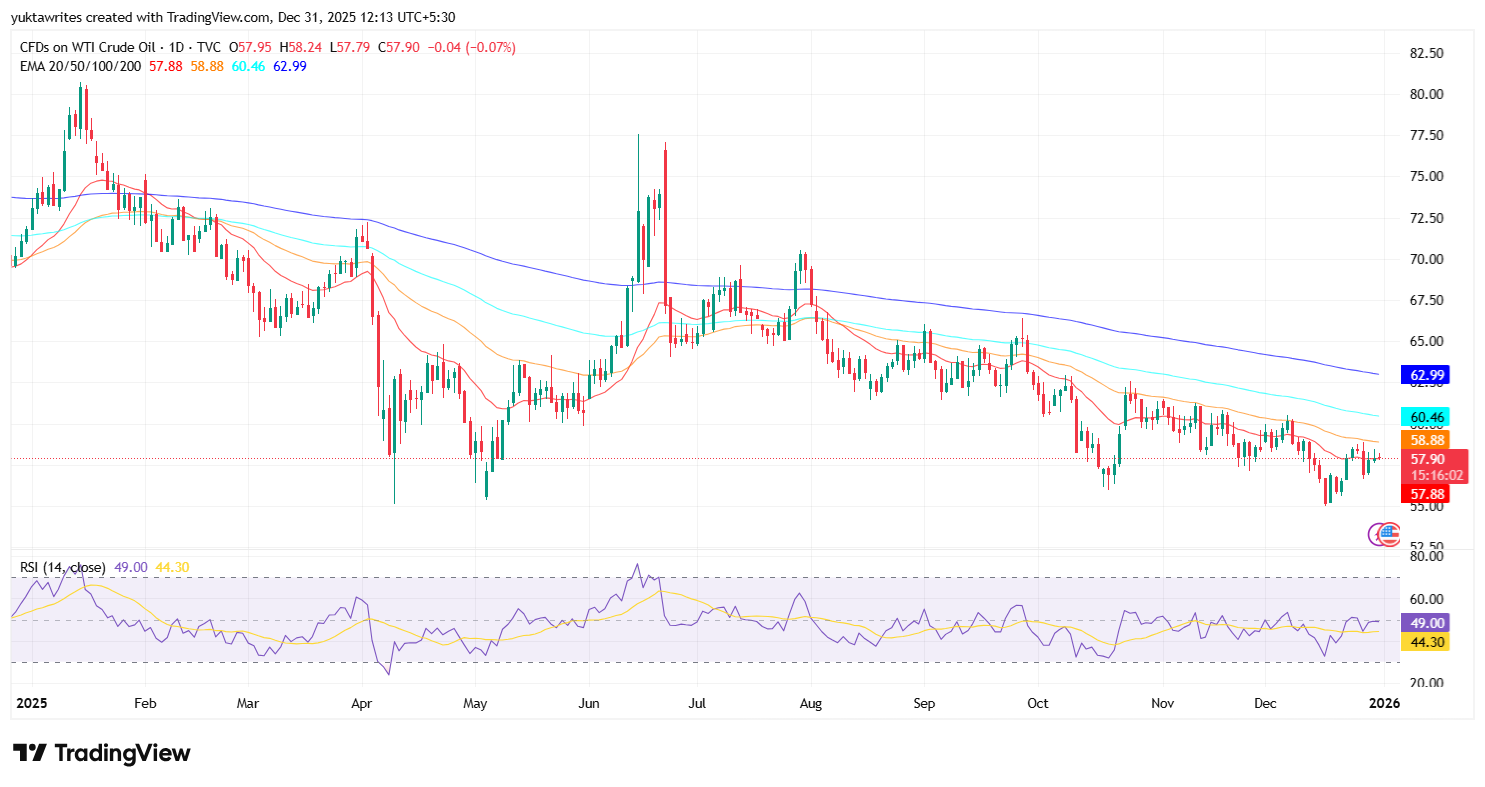
WTI crude oil (Source: TradingView)
Momentum backs that up. Daily RSI is hovering near 49, reflecting balance rather than stress. That matters because durable bottoms in crude often coincide with momentum extremes, and this market has not produced that kind of capitulation signature. Instead, momentum has stabilized at a low level, suggesting sellers are no longer pressing aggressively, but buyers are not willing to commit either. Volume has also faded into year-end, typical of a market waiting for a catalyst, but it also increases the risk of false moves in either direction.
Short-term price action shows how tactical the trade has become. On the 30-minute chart, WTI slid toward $56.7 earlier in the week before snapping back toward $58.0. Since then, price has churned between roughly $57.7 and $58.3. Supertrend has flipped frequently and SAR dots have clustered tightly around price, classic range behavior rather than trend. The $58.2 area has acted as near-term resistance, while dips toward $57.5 have continued to attract buyers, suggesting that flows are driving execution while conviction remains limited.
Inventory builds reinforce the surplus narrative, but supply risk keeps a floor in place
Fundamentals have done little to break the stalemate. WTI is on track for its steepest annual decline since 2020, down nearly 20% for the year, as the prospect of a supply glut has weighed on sentiment. Higher output from OPEC+ and non-OPEC producers, combined with muted demand growth, has kept pressure on prices and made rallies difficult to sustain.
The latest inventory signals have reinforced that story. The American Petroleum Institute estimated a 1.7M barrel build in U.S. crude inventories, which would be the largest since mid-November if confirmed by official figures. Inventory builds at current levels tend to cap enthusiasm because they validate the core bearish argument that supply remains ample and demand is not accelerating fast enough to absorb it.
Still, prices have not collapsed, and the reasons are consistent. OPEC+ is widely expected to maintain a pause on supply increases into the first quarter of 2026 when it meets this weekend. That expectation has repeatedly shown up as dip support, even when the macro tone turns cautious. Geopolitical risk has also kept a risk premium embedded in the curve. U.S. actions affecting Venezuelan oil shipments, ongoing instability in the Middle East, and the unresolved nature of a Russia–Ukraine peace framework have all contributed to the pattern of buyers stepping in on weakness rather than chasing highs.
What traders will watch in early 2026
From here, the bullish path requires both technical confirmation and a fundamental shift. WTI needs to defend $57.5 and reclaim the $59 to $60 zone on a daily closing basis. A sustained move through $60 would signal that supply risk is starting to overpower surplus fears, opening a path toward $62 and potentially the 200-day EMA near $63 if momentum builds and inventories begin to tighten. That outcome likely depends on a combination of firm OPEC+ discipline, continued geopolitical friction, and evidence that U.S. inventories are peaking rather than building.
The bearish scenario is simpler. If $57.5 fails, attention shifts quickly to the $56.5 to $56 support band. A daily close below $56 would likely invite a move toward $54, particularly if inventory builds persist and early-2026 demand data disappoints. In that case, the downtrend that defined 2025 would remain intact, and rallies would continue to be treated as opportunities to sell rather than the start of a new cycle.
Previously, we highlighted that WTI’s late-December bounce was largely headline-driven and struggled to change the broader trend while prices remained trapped under heavy moving-average resistance. This year-end close near $58 reinforces that theme. The market can react sharply, but it has not proven it can sustain upside without help from tighter inventories or a clearer shift in supply expectations.




Latest WTI News






-
 Afghanistan
-
 Albania
-
 Algeria
-
 Angola
-
 Argentina
-
 Armenia
-
 Australia
-
 Austria
-
 Azerbaijan
-
 Bahamas
-
 Bahrain
-
 Bangladesh
-
 Belarus
-
 Belgium
-
 Bolivia
-
 Botswana
-
 Brazil
-
 Brunei
-
 Bulgaria
-
 Cambodia
-
 Cameroon
-
 Canada
-
 Chile
Chile
-
 China
China
-
 Colombia
-
 Congo
Congo
-
 Costa Rica
-
 Cote d'Ivoire
-
 Croatia
-
 Cuba
Cuba
-
 Cyprus
-
 Czechia
-
 DR Congo
-
 Denmark
-
 Dominican Republic
-
 Ecuador
-
 Egypt
Egypt
-
 El Salvador
-
 Estonia
-
 Eswatini
-
 Ethiopia
-
 Finland
-
 France
-
 Georgia
-
 Germany
-
 Ghana
Ghana
-
 Greece
-
 Haiti
Haiti
-
 Hong Kong
-
 Hungary
-
 India
India
-
 Indonesia
-
 Iran, Islamic republic
-
 Iraq
Iraq
-
 Ireland
-
 Israel
-
 Italy
Italy
-
 Jamaica
-
 Japan
Japan
-
 Jordan
-
 Kazakhstan
-
 Kenya
Kenya
-
 Korea
Korea
-
 Kuwait
-
 Kyrgyzstan
-
 Laos
Laos
-
 Latvia
-
 Lebanon
-
 Lesotho
-
 Libya
Libya
-
 Lithuania
-
 Luxembourg
-
 Madagascar
-
 Malaysia
-
 Malta
Malta
-
 Mauritius
-
 Mexico
-
 Moldova
-
 Mongolia
-
 Montenegro
-
 Morocco
-
 Mozambique
-
 Myanmar
-
 Namibia
-
 Nepal
Nepal
-
 Netherlands
-
 New Zealand
-
 Nigeria
-
 North Macedonia
-
 Norway
-
 Oman
Oman
-
 Pakistan
-
 Palestine
-
 Panama
-
 Papua New Guinea
-
 Paraguay
-
 Peru
Peru
-
 Philippines
-
 Poland
-
 Portugal
-
 Puerto Rico
-
 Qatar
Qatar
-
 Reunion
-
 Romania
-
 Rwanda
-
 Saudi Arabia
-
 Serbia
-
 Singapore
-
 Slovakia
-
 Slovenia
-
 Somalia
-
 South Africa
-
 Spain
Spain
-
 Sri Lanka
-
 Sweden
-
 Switzerland
-
 Syria
Syria
-
 Taiwan
-
 Tajikistan
-
 Tanzania
-
 Thailand
-
 Trinidad and Tobago
-
 Tunisia
-
 Turkey
-
 UAE
UAE
-
 Uganda
-
 Ukraine
-
 United Kingdom
-
United States
-
 Uruguay
-
 Uzbekistan
-
 Venezuela
-
 Vietnam
-
 Yemen
Yemen
-
 Zambia
-
 Zimbabwe
- Forex
- Crypto












