
WTI crude oil slips below $57 as Venezuela shock fails to lift oil
WTI crude is entering the new year on the back foot, trading just under $57 a barrel on Monday after another failed attempt to stabilize above short-term resistance. While geopolitical developments in Venezuela grabbed headlines over the weekend, the market’s reaction was telling.
Highlights
- WTI trades below $57 after failing again near short-term resistance.
- Prices remain below all major moving averages, reinforcing bearish structure.
- Demand concerns continue to outweigh geopolitical supply risks.
Instead of rallying on supply-risk fears tied to U.S. actions and the arrest of President Nicolas Maduro, crude prices slipped. That response highlights a more profound issue. Traders remain far more focused on-demand softness and surplus capacity than on the risk of sudden disruptions.
Downtrend structure remains firmly in control
The daily chart underscores how entrenched the bearish trend has become. WTI has been in a clear downtrend since mid-summer, marked by a series of lower highs and lower lows. Price is trading well below its key moving averages, with the 20-day near $57.7, the 50-day around $58.7, the 100-day close to $60.3, and the 200-day near $62.9. This stacked alignment above price has consistently capped rallies over the past three months. Each rebound has stalled into overhead supply and rolled over, reinforcing the view that sellers remain in control.
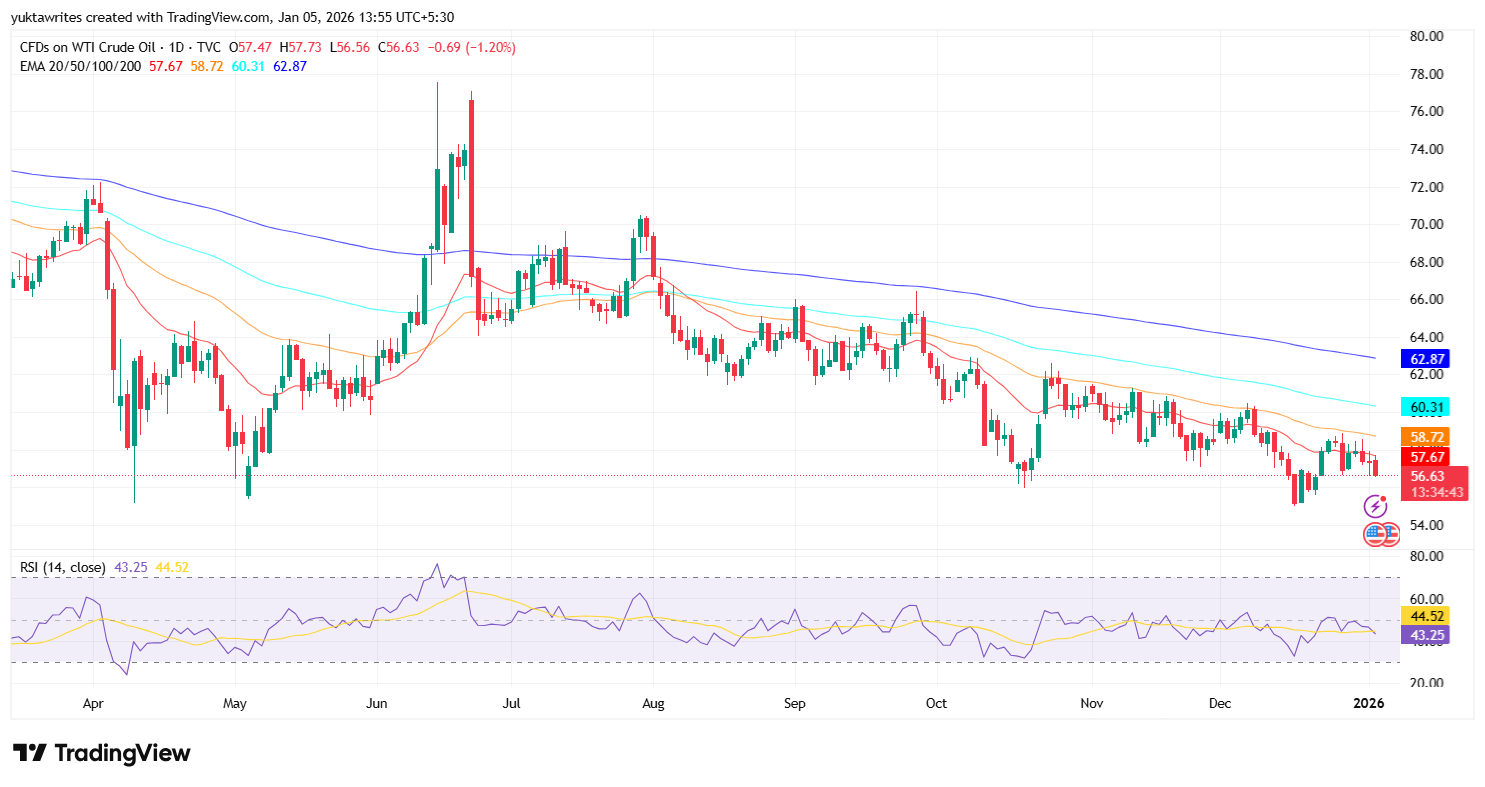
WTI CRUDE OIL price dynamics (Source: TradingView)
Momentum indicators confirm that message. Daily RSI is holding in the low-40, a zone that reflects weak buying interest rather than oversold stress. The absence of momentum extremes matters. Bear markets often end with capitulation and sharp momentum reversals. WTI has not shown that behavior. Instead, the decline has been measured and persistent, suggesting distribution rather than panic.
The most recent leg lower has followed that same pattern. WTI slipped beneath the $58 level late last week and has since struggled to reclaim it. What was previously supported has now flipped into resistance. On the downside, the $56.5 to $56 area has acted as a buffer, catching bids multiple times since December. As long as that zone holds, sellers are pressing their advantage without forcing a breakdown.
Intraday price action reinforces the bearish bias. On the 30-minute chart, WTI has been trending lower behind a falling Supertrend near $57.40, with parabolic SAR dots repeatedly capping upside attempts. Even brief moves above $57.5 have lacked follow-through. That behavior is typical of markets where traders are selling rallies rather than positioning for a rebound.
Fundamentals fail to justify a risk premium
The fundamental backdrop explains why crude has been unable to sustain upside. Venezuela headlines sound dramatic, but markets are looking past the rhetoric. Venezuela produces less than 1M barrels per day, accounting for under 1% of global supply. Even in a worst-case scenario, near-term disruptions are unlikely to materially tighten the global balance. There is also speculation that U.S. pressure could ultimately lead to higher Venezuelan output if Western companies are involved in restarting production as part of compensation or restructuring efforts. That possibility limits the upside risk premium.
At the same time, the broader supply picture remains heavy. OPEC+ has reiterated its plan to keep output steady through the first quarter, signaling no urgency to tighten supply despite weak prices. That stance suggests the group is willing to tolerate lower levels rather than sacrifice market share. Without surprise cuts or unplanned outages, WTI lacks a catalyst to reverse the trend.
Demand concerns remain the bigger drag. Growth expectations for early 2026 are modest, and refiners have shown little urgency to bid crude higher. Inventory data has done little to challenge the surplus narrative, and until draws become more consistent, rallies are likely to be sold.
That said, the downside is not without limits. Much of the bearish news is already reflected in price. Volatility has compressed, and downside extensions have been incremental rather than sharp. This suggests sellers are confident but not aggressive. If WTI were on the verge of collapse, price action would likely be more disorderly.
Market Outlook
The bullish path requires technical repair rather than new headlines. A sustained move back above $58 would be the first sign that selling pressure is easing. Acceptance above $59 would carry more weight, as it would reclaim the 50-day average and challenge the downtrend structure. From there, a move toward $61 becomes plausible, particularly if macro data weakens or geopolitical risk broadens beyond Venezuela. For now, that remains a secondary scenario.
The bearish path is clearer. A decisive break below $56 would expose $54.50 next, a level that provided support earlier in the year. Losing that zone would open the door toward the low $50s over time, especially if demand data continues to disappoint and supply remains ample.
Previously, we highlighted that WTI’s late-2025 weakness was driven by persistent supply overhangs and a lack of demand conviction. The current price action shows little has changed. Crude is still searching for a floor, not preparing for a breakout. Until evidence emerges that balances are tightening, WTI remains a market defined by patience on the long side and caution on rallies.





Latest WTI News








-
 Afghanistan
-
 Albania
-
 Algeria
-
 Angola
-
 Argentina
-
 Armenia
-
 Australia
-
 Austria
-
 Azerbaijan
-
 Bahamas
-
 Bahrain
-
 Bangladesh
-
 Belarus
-
 Belgium
-
 Bolivia
-
 Botswana
-
 Brazil
-
 Brunei
-
 Bulgaria
-
 Cambodia
-
 Cameroon
-
 Canada
-
 Chile
Chile
-
 China
China
-
 Colombia
-
 Congo
Congo
-
 Costa Rica
-
 Cote d'Ivoire
-
 Croatia
-
 Cuba
Cuba
-
 Cyprus
-
 Czechia
-
 DR Congo
-
 Denmark
-
 Dominican Republic
-
 Ecuador
-
 Egypt
Egypt
-
 El Salvador
-
 Estonia
-
 Eswatini
-
 Ethiopia
-
 Finland
-
 France
-
 Georgia
-
 Germany
-
 Ghana
Ghana
-
 Greece
-
 Haiti
Haiti
-
 Hong Kong
-
 Hungary
-
 India
India
-
 Indonesia
-
 Iran, Islamic republic
-
 Iraq
Iraq
-
 Ireland
-
 Israel
-
 Italy
Italy
-
 Jamaica
-
 Japan
Japan
-
 Jordan
-
 Kazakhstan
-
 Kenya
Kenya
-
 Korea
Korea
-
 Kuwait
-
 Kyrgyzstan
-
 Laos
Laos
-
 Latvia
-
 Lebanon
-
 Lesotho
-
 Libya
Libya
-
 Lithuania
-
 Luxembourg
-
 Madagascar
-
 Malaysia
-
 Malta
Malta
-
 Mauritius
-
 Mexico
-
 Moldova
-
 Mongolia
-
 Montenegro
-
 Morocco
-
 Mozambique
-
 Myanmar
-
 Namibia
-
 Nepal
Nepal
-
 Netherlands
-
 New Zealand
-
 Nigeria
-
 North Macedonia
-
 Norway
-
 Oman
Oman
-
 Pakistan
-
 Palestine
-
 Panama
-
 Papua New Guinea
-
 Paraguay
-
 Peru
Peru
-
 Philippines
-
 Poland
-
 Portugal
-
 Puerto Rico
-
 Qatar
Qatar
-
 Reunion
-
 Romania
-
 Rwanda
-
 Saudi Arabia
-
 Serbia
-
 Singapore
-
 Slovakia
-
 Slovenia
-
 Somalia
-
 South Africa
-
 Spain
Spain
-
 Sri Lanka
-
 Sweden
-
 Switzerland
-
 Syria
Syria
-
 Taiwan
-
 Tajikistan
-
 Tanzania
-
 Thailand
-
 Trinidad and Tobago
-
 Tunisia
-
 Turkey
-
 UAE
UAE
-
 Uganda
-
 Ukraine
-
 United Kingdom
-
United States
-
 Uruguay
-
 Uzbekistan
-
 Venezuela
-
 Vietnam
-
 Yemen
Yemen
-
 Zambia
-
 Zimbabwe
- Forex
- Crypto












