
+0.44% for Tesla stock — Oil prices spike to $100 on Middle East tensions

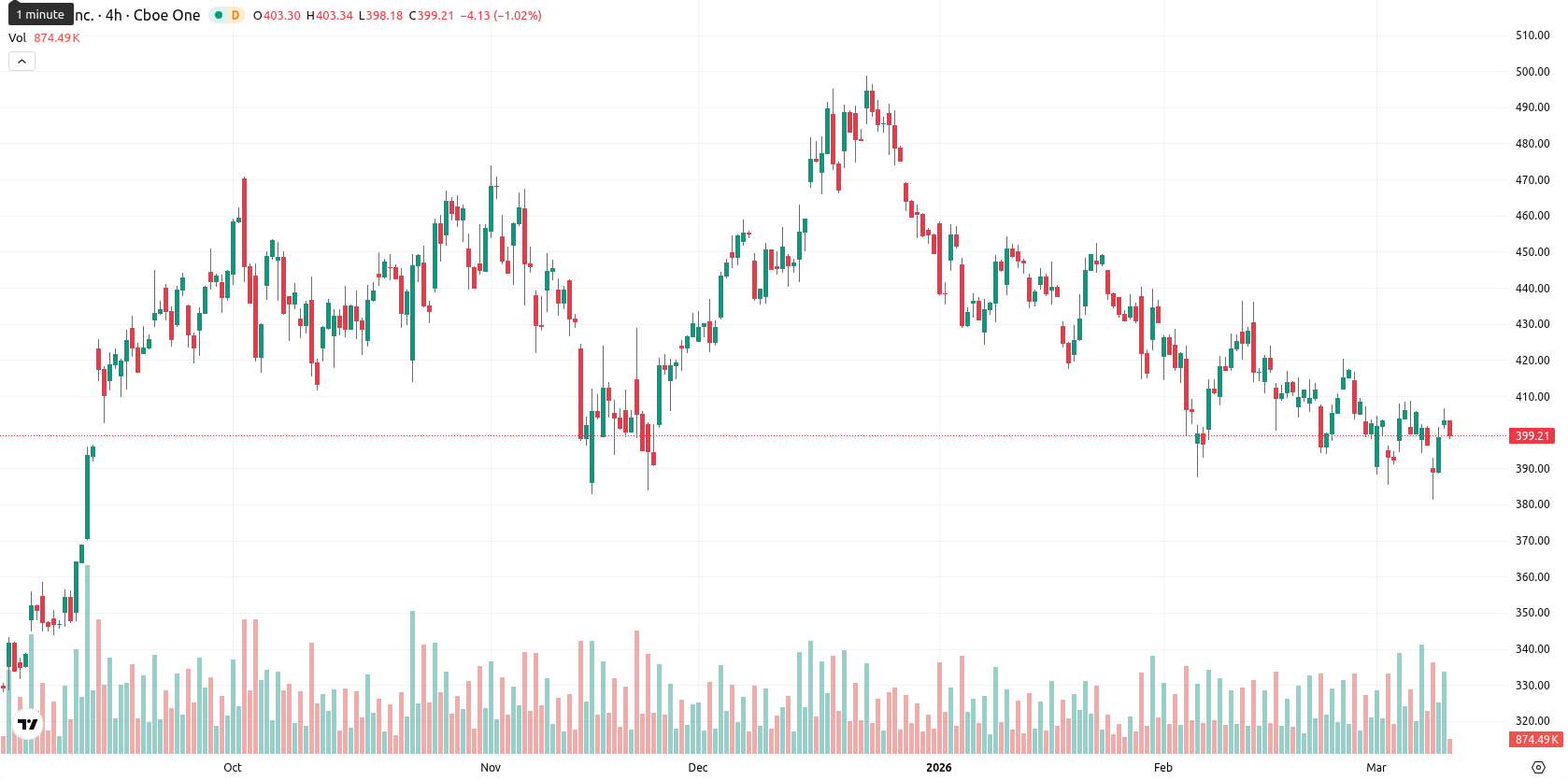
Tesla, Inc. (TSLA) is trading at $400.47, positioned below both the MA-20 ($409.56) and MA-50 ($426.28), but above the MA-200 ($392.36), showing short- and medium-term selling pressure with long-term support intact. The Ichimoku Kijun level stands at $410.61, acting as immediate resistance for the current price.
 413.06
420.00
413.06
420.00
Highlights
- Tesla faces elevated operational risk as Middle East conflict drives oil to $100 and heightens global supply chain uncertainty.
- Chinese regulatory support for domestic EVs and potential semiconductor export limits threaten Tesla’s China sales and production roadmap.
- TSLA trades below key moving averages with sellers dominating, likely remaining rangebound between $390 and $415 amid weak technical momentum.
Geopolitical turmoil and trade risks escalate Tesla’s operational uncertainty
On March 10, escalating geopolitical tensions in the Middle East, including the closure of the Strait of Hormuz by Iran during conflict with U.S.-Israeli forces, have caused oil prices to spike to $100 per barrel, increasing macroeconomic uncertainty and intensifying market pressure on Tesla’s stock. With approximately 30% of its sales sourced from China, Tesla is exposed to ongoing regulatory and protectionist risks as Chinese authorities intensify support for domestic EV manufacturers and hint at potential export restrictions on critical semiconductor components, directly threatening Tesla’s production and technology roadmap. The loss of U.S. federal EV tax credits in 2025, combined with localized battery sourcing requirements, has forced Tesla to shift its supply chain and manufacturing strategies, increasing operational risk and cost. The combination of supply chain vulnerabilities, regulatory shifts in the U.S. and China, and regional instability in global energy markets presents persistent threats to Tesla’s business continuity and valuation.
Oscillator divergence and weak momentum define current consolidation zone
Momentum is negative according to MACD (Sell) and ADX (Sell, with weak trend strength), while RSI ($42.25) and CCI (Oversold) indicate mild oversold conditions but not a firm reversal. BBP is firmly negative (Oversold), signaling sellers dominate intraday action, while conflicting oscillator signals (Stoch RSI Neutral, AO Neutral) highlight a lack of strong directional conviction. The stock opened at $404.18 after a small gap up from the previous close ($398.70) and is now mid-range for today ($400.86 – $406.55), with moderate volatility and slight upward pressure but no clear break from consolidation.
Downside favored as technical signals reinforce rangebound outlook
The expected trading range for the next five days is $390.00 to $415.00, reflecting a typical volatility band relative to current levels for TSLA with the price currently in the middle of this range. The probability of a price increase is very low (less than 20%), making a decrease more likely based on weekly RSI and ADX indicators, despite a bullish MACD on W1 and upward-sloping long-term moving averages. Baseline scenario: TSLA remains rangebound between $390 and $415, moving sideways. Bullish scenario: a break above $410.61 (Ichimoku Kijun) could target $415 and higher if volume returns, while a drop below $392 would reactivate downside momentum toward the $390 area.
Previously it was reported that Tesla, Inc. is trading modestly higher on the day but remains below its 20-day and 50-day moving averages, indicating ongoing technical pressure, while still holding above its 200-day average for longer-term support. Momentum indicators, including MACD, RSI, and CCI, point to weak bullish conviction and a bias toward consolidation, with near-term resistance seen at the $410–$411 level and key support near $395.









-
 Afghanistan
-
 Albania
-
 Algeria
-
 Angola
-
 Argentina
-
 Armenia
-
 Australia
-
 Austria
-
 Azerbaijan
-
 Bahamas
-
 Bahrain
-
 Bangladesh
-
 Belarus
-
 Belgium
-
 Bolivia
-
 Botswana
-
 Brazil
-
 Brunei
-
 Bulgaria
-
 Cambodia
-
 Cameroon
-
 Canada
-
 Chile
Chile
-
 China
China
-
 Colombia
-
 Congo
Congo
-
 Costa Rica
-
 Cote d'Ivoire
-
 Croatia
-
 Cuba
Cuba
-
 Cyprus
-
 Czechia
-
 DR Congo
-
 Denmark
-
 Dominican Republic
-
 Ecuador
-
 Egypt
Egypt
-
 El Salvador
-
 Estonia
-
 Eswatini
-
 Ethiopia
-
 Finland
-
 France
-
 Georgia
-
 Germany
-
 Ghana
Ghana
-
 Greece
-
 Haiti
Haiti
-
 Hong Kong
-
 Hungary
-
 India
India
-
 Indonesia
-
 Iran, Islamic republic
-
 Iraq
Iraq
-
 Ireland
-
 Israel
-
 Italy
Italy
-
 Jamaica
-
 Japan
Japan
-
 Jordan
-
 Kazakhstan
-
 Kenya
Kenya
-
 Korea
Korea
-
 Kuwait
-
 Kyrgyzstan
-
 Laos
Laos
-
 Latvia
-
 Lebanon
-
 Lesotho
-
 Libya
Libya
-
 Lithuania
-
 Luxembourg
-
 Madagascar
-
 Malaysia
-
 Malta
Malta
-
 Mauritius
-
 Mexico
-
 Moldova
-
 Mongolia
-
 Montenegro
-
 Morocco
-
 Mozambique
-
 Myanmar
-
 Namibia
-
 Nepal
Nepal
-
 Netherlands
-
 New Zealand
-
 Nigeria
-
 North Macedonia
-
 Norway
-
 Oman
Oman
-
 Pakistan
-
 Palestine
-
 Panama
-
 Papua New Guinea
-
 Paraguay
-
 Peru
Peru
-
 Philippines
-
 Poland
-
 Portugal
-
 Puerto Rico
-
 Qatar
Qatar
-
 Reunion
-
 Romania
-
 Rwanda
-
 Saudi Arabia
-
 Serbia
-
 Singapore
-
 Slovakia
-
 Slovenia
-
 Somalia
-
 South Africa
-
 Spain
Spain
-
 Sri Lanka
-
 Sweden
-
 Switzerland
-
 Syria
Syria
-
 Taiwan
-
 Tajikistan
-
 Tanzania
-
 Thailand
-
 Trinidad and Tobago
-
 Tunisia
-
 Turkey
-
 UAE
UAE
-
 Uganda
-
 Ukraine
-
 United Kingdom
-
United States
-
 Uruguay
-
 Uzbekistan
-
 Venezuela
-
 Vietnam
-
 Yemen
Yemen
-
 Zambia
-
 Zimbabwe
- Forex
- Crypto











