
The gas market in 2026 is undergoing a structural shift: Henry Hub is no longer seen as a local “U.S. spot toy,” but as part of the global LNG pricing system. At the same time, short-term fundamentals remain relatively soft (record production, high inventories, warm weather), yet the market is becoming less aggressive in selling every production peak, signaling a shift in behavior and risk perception.
Globalization of the Market: LNG Shock, Qatar, and Hormuz
Following strikes on infrastructure in Qatar and escalating tensions around the Strait of Hormuz, part of its LNG capacity has been paused, while force majeure on supplies has been extended until mid-June 2026. Hormuz remains one of the key chokepoints: around 20–30% of global LNG flows pass through it, and any disruption risk is immediately reflected in price spikes in TTF and JKM.
As a result, Europe and Asia have actively shifted toward U.S. LNG, strengthening the role of the United States as the “balancer” of the global market. Price spreads remain stark: Henry Hub is around 2.7–3.0 USD/MMBtu, TTF is near ~47–48 EUR/MWh (roughly equivalent to 15–18 USD/MMBtu), while JKM stands at around 17 USD/MMBtu or higher, creating a persistent arbitrage incentive for exporting U.S. gas.
LNG exports and structural repricing
The EIA forecasts U.S. natural gas exports at around 18.7 Bcf/d in 2026, with further growth to approximately 20.5 Bcf/d by 2027, with LNG accounting for a significant share. Key terminals coming online or expanding in 2026–2027 — Plaquemines LNG, Corpus Christi Stage 3, Golden Pass, and Cheniere expansions — reinforce the long-term linkage between U.S. production and export demand.
This is no longer a short-term cycle but a structural repricing: the market is beginning to price not only weather fluctuations and domestic inventories, but also global demand for U.S. LNG, risks in the Strait of Hormuz, and EU policy regarding gas imports from Russia and other suppliers. The EIA and the U.S. Department of Energy effectively confirm a tightening balance scenario, shifting expectations from around 3.5 USD/MMBtu in 2026 toward 4.6 USD/MMBtu in 2027.
Current market situation
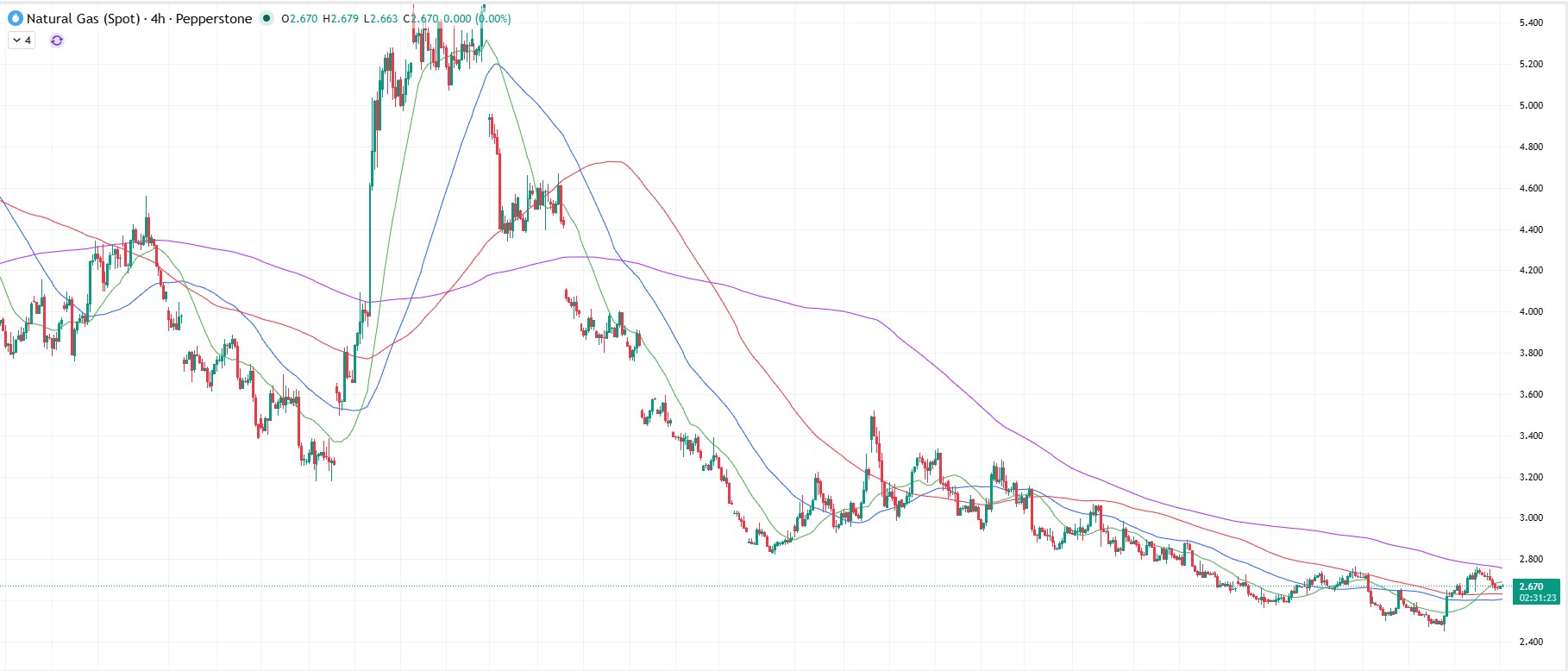
After rebounding toward resistance near 2.75, natural gas has come under pressure again, with prices retreating to support around 2.56. From current levels, a rebound toward 2.63–2.67 is possible, but moderate selling pressure may emerge on rallies. A loss of current support would open the way for a move toward 2.50–2.45.
As noted in Natural gas remains under pressure, but recovery odds increase, NATGAS may remain range-bound in the near term.


Latest Natural Gas News







-
 Afghanistan
-
 Albania
-
 Algeria
-
 Angola
-
 Argentina
-
 Armenia
-
 Australia
-
 Austria
-
 Azerbaijan
-
 Bahamas
-
 Bahrain
-
 Bangladesh
-
 Belarus
-
 Belgium
-
 Bolivia
-
 Botswana
-
 Brazil
-
 Brunei
-
 Bulgaria
-
 Cambodia
-
 Cameroon
-
 Canada
-
 Chile
Chile
-
 China
China
-
 Colombia
-
 Congo
Congo
-
 Costa Rica
-
 Cote d'Ivoire
-
 Croatia
-
 Cuba
Cuba
-
 Cyprus
-
 Czechia
-
 DR Congo
-
 Denmark
-
 Dominican Republic
-
 Ecuador
-
 Egypt
Egypt
-
 El Salvador
-
 Estonia
-
 Eswatini
-
 Ethiopia
-
 Finland
-
 France
-
 Georgia
-
 Germany
-
 Ghana
Ghana
-
 Greece
-
 Haiti
Haiti
-
 Hong Kong
-
 Hungary
-
 India
India
-
 Indonesia
-
 Iran, Islamic republic
-
 Iraq
Iraq
-
 Ireland
-
 Israel
-
 Italy
Italy
-
 Jamaica
-
 Japan
Japan
-
 Jordan
-
 Kazakhstan
-
 Kenya
Kenya
-
 Korea
Korea
-
 Kuwait
-
 Kyrgyzstan
-
 Laos
Laos
-
 Latvia
-
 Lebanon
-
 Lesotho
-
 Libya
Libya
-
 Lithuania
-
 Luxembourg
-
 Madagascar
-
 Malaysia
-
 Malta
Malta
-
 Mauritius
-
 Mexico
-
 Moldova
-
 Mongolia
-
 Montenegro
-
 Morocco
-
 Mozambique
-
 Myanmar
-
 Namibia
-
 Nepal
Nepal
-
 Netherlands
-
 New Zealand
-
 Nigeria
-
 North Macedonia
-
 Norway
-
 Oman
Oman
-
 Pakistan
-
 Palestine
-
 Panama
-
 Papua New Guinea
-
 Paraguay
-
 Peru
Peru
-
 Philippines
-
 Poland
-
 Portugal
-
 Puerto Rico
-
 Qatar
Qatar
-
 Reunion
-
 Romania
-
 Rwanda
-
 Saudi Arabia
-
 Serbia
-
 Singapore
-
 Slovakia
-
 Slovenia
-
 Somalia
-
 South Africa
-
 Spain
Spain
-
 Sri Lanka
-
 Sweden
-
 Switzerland
-
 Syria
Syria
-
 Taiwan
-
 Tajikistan
-
 Tanzania
-
 Thailand
-
 Trinidad and Tobago
-
 Tunisia
-
 Turkey
-
 UAE
UAE
-
 Uganda
-
 Ukraine
-
 United Kingdom
-
United States
-
 Uruguay
-
 Uzbekistan
-
 Venezuela
-
 Vietnam
-
 Yemen
Yemen
-
 Zambia
-
 Zimbabwe
- Forex
- Crypto











