
Tesla stock climbs above $339 despite forecast of 50% drop in U.S. EV sales

As of September 5, Tesla stock is trading at $339.27, up 1.6% in the past 24 hours. The stock has shown resilience in recent sessions, climbing above the 50-day and 100-day moving averages, now at $323.94 and $313.79 respectively.
Highlights
- Tesla stock is up 1.6% but faces headwinds from the upcoming expiration of U.S. EV tax credits on September 30.
- Analysts warn that U.S. EV sales could drop by up to 50%, with global demand already weakening in Europe and India.
- Despite Elon Musk’s optimism around AI and robotics, Wall Street remains cautious, maintaining a “Hold” rating with a $300 price target.
Tesla is currently hovering just below its 200-day moving average of $339.94, a key technical ceiling. The failure to close decisively above this line continues to limit further upside and keeps the broader trend in a neutral zone. The classic pivot point stands at $338.11, meaning the current price is right on the knife-edge of a breakout or a potential fade lower.
Resistance levels remain concentrated at R1 $344.51 and R2 $355.16, while support is seen at S1 $327.46 and S2 $321.06. A close above $345 could trigger a technical acceleration toward the $355–$360 band. But rejection at this zone may reinforce the $330–$335 consolidation range. Relative Strength Index (RSI) hovers near neutral at 52, suggesting neither overbought nor oversold conditions.
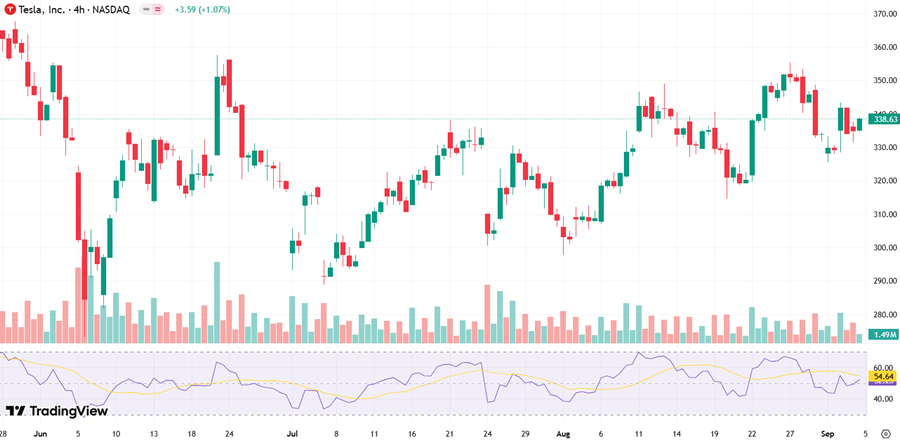
Tesla stock price dynamics (June 2025 - September 2025). Source: TradingView
Momentum indicators are mixed. MACD remains slightly below the signal line, while volume indicators show no significant accumulation or distribution. Notably, a golden cross pattern formed earlier in the year when the 50-day MA crossed above the 200-day MA. This bullish setup remains in place, though its validity is being tested as Tesla moves sideways in a tightening range.
EV credit expiry and global demand weigh on Tesla
The scheduled expiration of U.S. federal EV tax credits on September 30 is shaping up to be a major headwind for Tesla (TSLA). According to analyst Karl Brauer, electric vehicle sales in the U.S. could fall by as much as 50% once these incentives are removed. Brauer warned that EV market share may drop to just 4% by 2026—levels that would be disastrous for Tesla’s growth story.
Tesla stock has rallied approximately 56% off its April lows, yet it remains down over 20% from the year-to-date peak set in January. This suggests that while momentum has returned, investor conviction remains fragile—and vulnerable to macro or policy-driven shocks. The upcoming expiration of EV tax credits could act as a catalyst for renewed downside, especially if sales volumes begin to reflect the policy shift. At the same time, the stock's elevated valuation leaves little room for execution errors or negative surprises.
The removal of EV subsidies could not come at a worse time. Tesla is already contending with shrinking demand in key international markets. Sales in Europe plunged 40% year-over-year in July, and the company has reportedly received only 600 orders over several weeks in India—far below expectations for a high-profile market entry. If U.S. demand also contracts as tax incentives roll off under the Trump administration, Tesla could surrender much of the recovery it has staged in recent months.
Price compression signals imminent breakout range for Tesla
Tesla is now at a key technical inflection point. If bullish momentum can carry the stock above $345 and into the $355–$360 resistance zone, the next target becomes $370, particularly if positive updates emerge around robotaxi commercialization or September deliveries. A clean breakout above $360 would likely trigger algorithmic buying, reinforcing upward momentum in the short term.
The base-case scenario is continued consolidation in the $330–$345 range. This would reflect a market in wait-and-see mode, seeking more clarity on the success of Tesla’s autonomous platform and broader financial execution. Price may chop within this band unless macroeconomic conditions shift dramatically or a major company-specific catalyst emerges.
Tesla’s recent rebound is supported by strong August deliveries, including a 22.6% month-over-month rise in China and an 86% surge in Turkey, led by Model Y demand. However, this growth is tempered by a 40% year-over-year decline in European sales and weak momentum in India, raising concerns about regional imbalances heading into Q3.















-
 Afghanistan
-
 Albania
-
 Algeria
-
 Angola
-
 Argentina
-
 Armenia
-
 Australia
-
 Austria
-
 Azerbaijan
-
 Bahamas
-
 Bahrain
-
 Bangladesh
-
 Belarus
-
 Belgium
-
 Bolivia
-
 Botswana
-
 Brazil
-
 Brunei
-
 Bulgaria
-
 Cambodia
-
 Cameroon
-
 Canada
-
 Chile
Chile
-
 China
China
-
 Colombia
-
 Congo
Congo
-
 Costa Rica
-
 Cote d'Ivoire
-
 Croatia
-
 Cuba
Cuba
-
 Cyprus
-
 Czechia
-
 DR Congo
-
 Denmark
-
 Dominican Republic
-
 Ecuador
-
 Egypt
Egypt
-
 El Salvador
-
 Estonia
-
 Eswatini
-
 Ethiopia
-
 Finland
-
 France
-
 Georgia
-
 Germany
-
 Ghana
Ghana
-
 Greece
-
 Haiti
Haiti
-
 Hong Kong
-
 Hungary
-
 India
India
-
 Indonesia
-
 Iran, Islamic republic
-
 Iraq
Iraq
-
 Ireland
-
 Israel
-
 Italy
Italy
-
 Jamaica
-
 Japan
Japan
-
 Jordan
-
 Kazakhstan
-
 Kenya
Kenya
-
 Korea
Korea
-
 Kuwait
-
 Kyrgyzstan
-
 Laos
Laos
-
 Latvia
-
 Lebanon
-
 Lesotho
-
 Libya
Libya
-
 Lithuania
-
 Luxembourg
-
 Madagascar
-
 Malaysia
-
 Malta
Malta
-
 Mauritius
-
 Mexico
-
 Moldova
-
 Mongolia
-
 Montenegro
-
 Morocco
-
 Mozambique
-
 Myanmar
-
 Namibia
-
 Nepal
Nepal
-
 Netherlands
-
 New Zealand
-
 Nigeria
-
 North Macedonia
-
 Norway
-
 Oman
Oman
-
 Pakistan
-
 Palestine
-
 Panama
-
 Papua New Guinea
-
 Paraguay
-
 Peru
Peru
-
 Philippines
-
 Poland
-
 Portugal
-
 Puerto Rico
-
 Qatar
Qatar
-
 Reunion
-
 Romania
-
 Rwanda
-
 Saudi Arabia
-
 Serbia
-
 Singapore
-
 Slovakia
-
 Slovenia
-
 Somalia
-
 South Africa
-
 Spain
Spain
-
 Sri Lanka
-
 Sweden
-
 Switzerland
-
 Syria
Syria
-
 Taiwan
-
 Tajikistan
-
 Tanzania
-
 Thailand
-
 Trinidad and Tobago
-
 Tunisia
-
 Turkey
-
 UAE
UAE
-
 Uganda
-
 Ukraine
-
 United Kingdom
-
United States
-
 Uruguay
-
 Uzbekistan
-
 Venezuela
-
 Vietnam
-
 Yemen
Yemen
-
 Zambia
-
 Zimbabwe
- Forex
- Crypto












