

Nvidia stock slips 2% as China urges tech firms to halt chip purchases

As of September 18, Nvidia stock is trading at $171.35, down 2% in the past 24 hours, following escalating tensions with China over chip procurement. The stock has come off its recent highs around $180 and is now testing important support levels in the $170 range.
Highlights
- Nvidia stock fell 2% to $171.35 amid reports that China instructed major tech firms to stop purchasing its AI chips.
- Technical indicators point to weakening short-term momentum, with key support seen around the $160–165 range.
- Regulatory scrutiny and geopolitical tensions are creating headwinds for Nvidia’s growth in the Chinese market.
From a technical standpoint, Nvidia is showing early signs of weakening short-term momentum, though the broader long-term trend remains intact for now. Nvidia’s 50-day simple moving average is currently hovering near $174–175, slightly above the current trading level. The 200-day moving average remains below $150, indicating the stock is still in a long-term uptrend. However, the fact that NVDA is now trading under its 50-day MA for the first time since early summer could signal a shift in short-term sentiment.
The Relative Strength Index (RSI) has cooled to around 55, down from more elevated levels earlier this month, suggesting that Nvidia is no longer in overbought territory. The Moving Average Convergence Divergence (MACD) indicator is trending down, with the signal line crossing over the MACD line on daily charts—often interpreted as a bearish crossover. Volume has also spiked slightly in the last two sessions, pointing to heavier selling interest on the news flow from China.
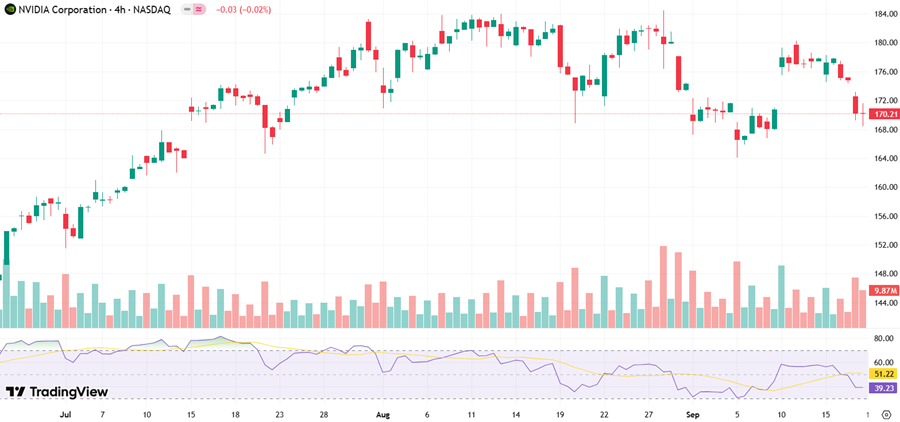
Nvidia stock price dynamics (July 2025 - September 2025). Source: TradingView
Support is currently seen at $168 and then more strongly at $160. These levels mark previous consolidation zones and areas of institutional buying. Resistance remains firm at $180–185, a price region that has capped Nvidia's recent rallies. If Nvidia fails to hold the $170 support zone, it may risk a deeper correction toward the $160–165 band, which coincides with a key Fibonacci retracement from the stock’s recent rally off May lows.
China regulatory action adds fresh pressure to Nvidia outlook
The immediate driver of downside pressure is geopolitical: according to a Financial Times report, Chinese authorities have told major domestic technology firms—including Alibaba and ByteDance—to stop purchasing Nvidia’s high-performance AI chips. Specifically, China is restricting procurement of chips like the RTX Pro 6000D, and has discouraged firms from buying Nvidia’s H20 chips for use in sensitive infrastructure or government projects.
This move comes just weeks after Bloomberg reported that Chinese regulators were advising local companies to seek domestic alternatives for AI chip needs, signaling a shift in official policy. The H20 chip was originally designed to comply with U.S. export controls, and its exclusion underscores the growing challenges Nvidia faces in one of its largest foreign markets.
Adding to the uncertainty, reports suggest that China’s State Administration for Market Regulation has opened a review into Nvidia’s previous acquisition of Mellanox Technologies, which could further constrain its business operations inside China. This move is widely seen as part of a broader regulatory push to limit foreign influence in China’s critical technology sectors.
Short-term correction likely, but medium-term support holds
Given the technical and geopolitical backdrop, the base-case scenario for Nvidia over the next two to four weeks is a continued pullback toward the $160–165 support region, followed by consolidation. If that zone holds, the stock could rebound toward $175–180, especially if earnings sentiment remains strong and no further China restrictions are announced. A sustained recovery will also depend on broader market stability, particularly in the tech sector, which has shown increased sensitivity to macroeconomic data and interest rate expectations.
A more bullish outcome would require a softening of geopolitical rhetoric and signs that Nvidia’s core AI chip demand remains unaffected. Under such a scenario, the stock could retest $185 and potentially break above $190, though this looks less probable in the short term. On the downside, a decisive break below $160 would raise red flags and open the door to a correction toward $150–155. That said, Nvidia’s fundamentals remain strong outside of China, particularly in the U.S. and European data center markets, and its leadership in AI compute hardware still gives it a significant moat.
Nvidia’s recent stock weakness is linked to the poor reception of its RTX6000D GPU, developed to meet U.S. export rules while serving Chinese clients. Major companies like Alibaba and ByteDance have rejected the chip due to its high $7,000 price tag and underwhelming performance compared to unofficial alternatives.





Latest NVIDIA News



-
 Afghanistan
-
 Albania
-
 Algeria
-
 Angola
-
 Argentina
-
 Armenia
-
 Australia
-
 Austria
-
 Azerbaijan
-
 Bahamas
-
 Bahrain
-
 Bangladesh
-
 Belarus
-
 Belgium
-
 Bolivia
-
 Botswana
-
 Brazil
-
 Brunei
-
 Bulgaria
-
 Cambodia
-
 Cameroon
-
 Canada
-
 Chile
Chile
-
 China
China
-
 Colombia
-
 Congo
Congo
-
 Costa Rica
-
 Cote d'Ivoire
-
 Croatia
-
 Cuba
Cuba
-
 Cyprus
-
 Czechia
-
 DR Congo
-
 Denmark
-
 Dominican Republic
-
 Ecuador
-
 Egypt
Egypt
-
 El Salvador
-
 Estonia
-
 Eswatini
-
 Ethiopia
-
 Finland
-
 France
-
 Georgia
-
 Germany
-
 Ghana
Ghana
-
 Greece
-
 Haiti
Haiti
-
 Hong Kong
-
 Hungary
-
 India
India
-
 Indonesia
-
 Iran, Islamic republic
-
 Iraq
Iraq
-
 Ireland
-
 Israel
-
 Italy
Italy
-
 Jamaica
-
 Japan
Japan
-
 Jordan
-
 Kazakhstan
-
 Kenya
Kenya
-
 Korea
Korea
-
 Kuwait
-
 Kyrgyzstan
-
 Laos
Laos
-
 Latvia
-
 Lebanon
-
 Lesotho
-
 Libya
Libya
-
 Lithuania
-
 Luxembourg
-
 Madagascar
-
 Malaysia
-
 Malta
Malta
-
 Mauritius
-
 Mexico
-
 Moldova
-
 Mongolia
-
 Montenegro
-
 Morocco
-
 Mozambique
-
 Myanmar
-
 Namibia
-
 Nepal
Nepal
-
 Netherlands
-
 New Zealand
-
 Nigeria
-
 North Macedonia
-
 Norway
-
 Oman
Oman
-
 Pakistan
-
 Palestine
-
 Panama
-
 Papua New Guinea
-
 Paraguay
-
 Peru
Peru
-
 Philippines
-
 Poland
-
 Portugal
-
 Puerto Rico
-
 Qatar
Qatar
-
 Reunion
-
 Romania
-
 Rwanda
-
 Saudi Arabia
-
 Serbia
-
 Singapore
-
 Slovakia
-
 Slovenia
-
 Somalia
-
 South Africa
-
 Spain
Spain
-
 Sri Lanka
-
 Sweden
-
 Switzerland
-
 Syria
Syria
-
 Taiwan
-
 Tajikistan
-
 Tanzania
-
 Thailand
-
 Trinidad and Tobago
-
 Tunisia
-
 Turkey
-
 UAE
UAE
-
 Uganda
-
 Ukraine
-
 United Kingdom
-
United States
-
 Uruguay
-
 Uzbekistan
-
 Venezuela
-
 Vietnam
-
 Yemen
Yemen
-
 Zambia
-
 Zimbabwe
- Forex
- Crypto












