

Nvidia stock climbs 3.6% as $5 billion Intel deal fuels tech rally
As of September 19, Nvidia stock is trading at $176.39, up 3.6% in the last 24 hours. This surge follows news that Nvidia will invest $5 billion to acquire a significant stake in Intel. The stock trades just below its all-time high of $184.48 and well above its 52-week low of $86.62.
Highlights
- Nvidia surged 3.6% after announcing a $5 billion stake in Intel, marking a strategic shift toward deeper chip collaboration.
- The partnership aims to develop custom CPUs optimized for Nvidia’s GPUs in both data center and consumer markets.
- While the stock nears all-time highs, future gains will depend on execution, AI demand, and macro stability.
Nvidia’s technical chart shows strong support at the $160 level, where the 50-day moving average converges with prior resistance turned support. Shorter-term moving averages (20-day and 10-day) are both sloping upward, indicating sustained positive momentum. RSI sits at 68, slightly below the overbought threshold of 70, suggesting more upside room before technical resistance kicks in. The MACD is in bullish crossover territory, and momentum indicators point to further strength if the current news flow continues to support sentiment.
Volume spiked on the back of the Intel deal, confirming the strength of the move. A successful breakout above $184.50 could trigger a new leg higher toward the $200 psychological mark. However, profit-taking could emerge near these levels given the sharp run-up. A pullback to the $165–$170 zone would not break the uptrend and could offer a reentry point for bullish traders.
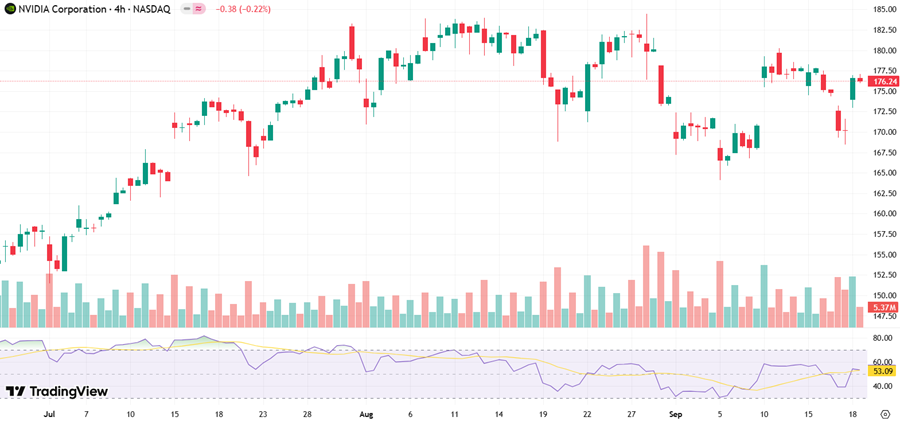
Nvidia stock price dynamics (July 2025 - September 2025). Source: TradingView
On fundamentals, Nvidia remains dominant in the AI data center segment. Its Q2 FY2026 earnings showed $46.74 billion in revenue, up 56% year-on-year, and net income of $26.42 billion, both driven primarily by hyperscaler demand for its H100 and B200 GPUs. Guidance for Q3 points to $54 billion in revenue, implying a quarter-on-quarter increase and sustaining its leadership in AI infrastructure.
Strategic Intel stake signals deeper ecosystem control
The recent announcement that Nvidia will invest $5 billion into Intel — acquiring close to 4% of the company — represents one of Nvidia's most consequential strategic moves in years. While Intel and Nvidia have traditionally been competitors in the broader semiconductor space, this deal represents a structural shift toward ecosystem integration.
Under the new arrangement, Intel will develop custom central processing units (CPUs) to pair with Nvidia's GPUs across both data center and consumer segments. This aligns with Nvidia’s goal of delivering fully optimized system architectures, rather than isolated components. It could also provide Nvidia with leverage in negotiating with other ecosystem players, including AMD, ARM licensees, and OEMs.
Crucially, Nvidia is not taking a stake in Intel’s foundry operations — a key distinction. Fabrication remains outsourced primarily to TSMC, which continues to build Nvidia’s next-generation chips on advanced nodes. However, Nvidia’s closer alignment with Intel in chip design could lead to better system-level performance, and eventually reduce its exposure to Taiwan-based manufacturing — an important hedge given ongoing U.S.-China tensions.
Upside remains, but risk now tied to macro and execution
In a bullish base case, if demand for AI GPUs continues to exceed supply, and the Intel collaboration leads to early design wins in 2026–2027, the stock could test the $190–$220 range in the next 3–6 months. This would assume stable macro conditions, no deterioration in U.S.-China trade, and continued earnings beats. Strong momentum from hyperscalers, cloud infrastructure buildouts, and sovereign AI initiatives would further support upward price action.
In a more neutral case, where Nvidia maintains strong fundamentals but the Intel integration takes longer or macro headwinds return (e.g., rising interest rates, weak global PC demand), the stock may consolidate in the $160–$190 zone. Pullbacks toward $150 would still be viewed as healthy corrections rather than breakdowns. In this scenario, valuation compression may occur even as topline growth remains intact, limiting near-term upside.
China has ordered major tech firms such as Alibaba and ByteDance to halt purchases of Nvidia’s advanced AI chips. The restrictions target models like the RTX Pro 6000D and discourage use of H20 chips in sensitive projects.




Latest NVIDIA News





-
 Afghanistan
-
 Albania
-
 Algeria
-
 Angola
-
 Argentina
-
 Armenia
-
 Australia
-
 Austria
-
 Azerbaijan
-
 Bahamas
-
 Bahrain
-
 Bangladesh
-
 Belarus
-
 Belgium
-
 Bolivia
-
 Botswana
-
 Brazil
-
 Brunei
-
 Bulgaria
-
 Cambodia
-
 Cameroon
-
 Canada
-
 Chile
Chile
-
 China
China
-
 Colombia
-
 Congo
Congo
-
 Costa Rica
-
 Cote d'Ivoire
-
 Croatia
-
 Cuba
Cuba
-
 Cyprus
-
 Czechia
-
 DR Congo
-
 Denmark
-
 Dominican Republic
-
 Ecuador
-
 Egypt
Egypt
-
 El Salvador
-
 Estonia
-
 Eswatini
-
 Ethiopia
-
 Finland
-
 France
-
 Georgia
-
 Germany
-
 Ghana
Ghana
-
 Greece
-
 Haiti
Haiti
-
 Hong Kong
-
 Hungary
-
 India
India
-
 Indonesia
-
 Iran, Islamic republic
-
 Iraq
Iraq
-
 Ireland
-
 Israel
-
 Italy
Italy
-
 Jamaica
-
 Japan
Japan
-
 Jordan
-
 Kazakhstan
-
 Kenya
Kenya
-
 Korea
Korea
-
 Kuwait
-
 Kyrgyzstan
-
 Laos
Laos
-
 Latvia
-
 Lebanon
-
 Lesotho
-
 Libya
Libya
-
 Lithuania
-
 Luxembourg
-
 Madagascar
-
 Malaysia
-
 Malta
Malta
-
 Mauritius
-
 Mexico
-
 Moldova
-
 Mongolia
-
 Montenegro
-
 Morocco
-
 Mozambique
-
 Myanmar
-
 Namibia
-
 Nepal
Nepal
-
 Netherlands
-
 New Zealand
-
 Nigeria
-
 North Macedonia
-
 Norway
-
 Oman
Oman
-
 Pakistan
-
 Palestine
-
 Panama
-
 Papua New Guinea
-
 Paraguay
-
 Peru
Peru
-
 Philippines
-
 Poland
-
 Portugal
-
 Puerto Rico
-
 Qatar
Qatar
-
 Reunion
-
 Romania
-
 Rwanda
-
 Saudi Arabia
-
 Serbia
-
 Singapore
-
 Slovakia
-
 Slovenia
-
 Somalia
-
 South Africa
-
 Spain
Spain
-
 Sri Lanka
-
 Sweden
-
 Switzerland
-
 Syria
Syria
-
 Taiwan
-
 Tajikistan
-
 Tanzania
-
 Thailand
-
 Trinidad and Tobago
-
 Tunisia
-
 Turkey
-
 UAE
UAE
-
 Uganda
-
 Ukraine
-
 United Kingdom
-
United States
-
 Uruguay
-
 Uzbekistan
-
 Venezuela
-
 Vietnam
-
 Yemen
Yemen
-
 Zambia
-
 Zimbabwe
- Forex
- Crypto












