
WTI crude oil slips to $60 as supply glut fears overshadow OPEC+ production pause

West Texas Intermediate (WTI) crude oil futures fell 0.5% to around $60.70 per barrel on Tuesday, retreating after a four-day advance as renewed oversupply concerns overshadowed OPEC+’s decision to pause production increases in early 2026. While the group signaled restraint through the first quarter, traders remained focused on rising non-OPEC supply and weakening global demand forecasts, both of which continue to cap upside potential.
Highlights
- WTI crude dips 0.5% to $60.70 as OPEC+ pause fails to lift sentiment.
- Rising U.S. and non-OPEC output heightens oversupply risks for 2026.
- Key support at $60, with deeper downside potential toward $55 if demand weakens.
OPEC+ announced that it would freeze planned output hikes from January through March 2026, citing seasonal demand weakness and growing inventory risks. The decision underscores the producer group’s cautious approach after months of volatile trading, yet the market reaction remained muted. Analysts argue that the move reflects acknowledgment of a fragile demand environment rather than renewed confidence in price stability.
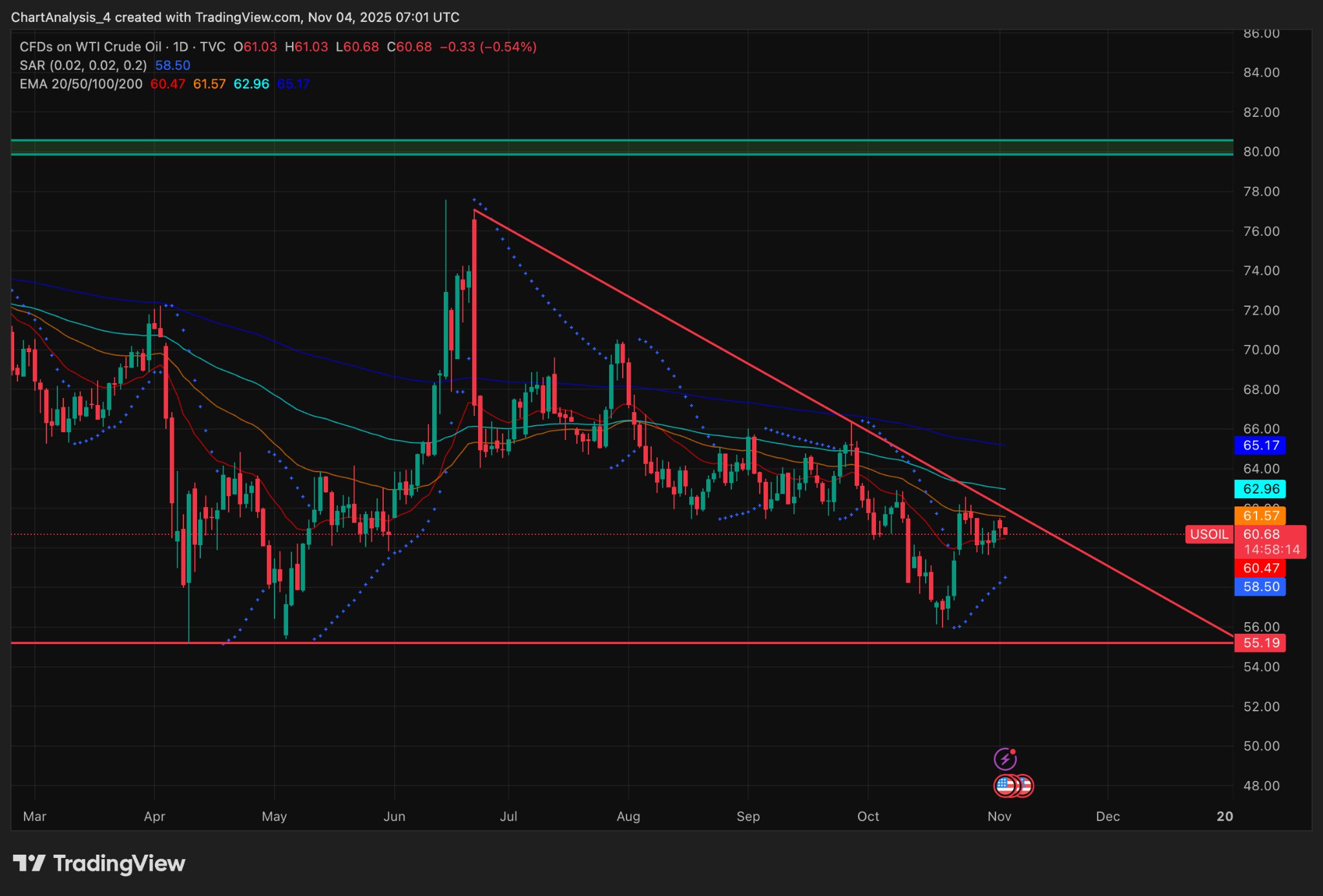
WTI price dynamics (Source: TradingView)
Reports from the International Energy Agency (IEA) and several major banks continue to project a mild supply surplus next year, driven primarily by record U.S. shale output and steady growth from Brazil and Guyana. This non-OPEC expansion, coupled with lackluster industrial demand in China and Europe, has reinforced bearish sentiment even as OPEC+ attempts to stabilize expectations.
Adding to the complexity, geopolitical developments have introduced sporadic volatility. Ukrainian drone attacks on Russia’s Tuapse refinery briefly disrupted exports through the Black Sea, but markets largely shrugged off the incident, viewing it as a short-term event rather than a structural supply constraint.
Technical picture: sellers maintain control below $63
Technically, WTI remains entrenched in a descending channel, with repeated failures to break above resistance near the 20-day EMA ($60.47) and 50-day EMA ($61.57). Monday’s rejection at these levels reaffirmed bearish control, while the longer-term downtrend from June’s high near $77 continues to define price action.
The 100-day EMA at $62.96 and 200-day EMA at $65.17 form a key resistance cluster, a zone that must be cleared for any meaningful reversal. Until then, price remains vulnerable to further declines. Immediate support is seen at $60, followed by a stronger demand area near $55.20 — a level that coincides with the June 2023 low and a critical psychological threshold for market stability.
Momentum indicators paint a cautious picture. The RSI remains below 50, signaling weak buyer conviction, while the Parabolic SAR continues to print above price levels, confirming sustained downside pressure. As long as prices stay capped under $63, risk remains skewed to the downside, with potential tests of $56–$55 should macro sentiment deteriorate further.
Outlook: Consolidation before possible breakdown
The near-term outlook for WTI crude remains uncertain, with fundamental and technical factors both leaning toward consolidation or modest retracement. Traders will monitor U.S. inventory data and refinery utilization for clues about domestic demand resilience. While sanctions on Russian energy firms could tighten localized supply, the broader picture remains dominated by excess output and muted consumption.
In the weeks ahead, maintaining support at $60 will be key to avoiding a deeper sell-off. A decisive breakdown below this level could invite a move toward $55–$54.50, marking a retest of last year’s floor. Conversely, a breakout above $63–$65 would be needed to restore bullish sentiment and pave the way for recovery toward $70.
At present, WTI crude remains caught between geopolitical undercurrents and economic reality — supported by regional disruptions but weighed down by the persistent specter of surplus. Unless demand signals improve or production curbs deepen, the path of least resistance appears tilted lower as the market approaches the year’s end.


Latest WTI News









-
 Afghanistan
-
 Albania
-
 Algeria
-
 Angola
-
 Argentina
-
 Armenia
-
 Australia
-
 Austria
-
 Azerbaijan
-
 Bahamas
-
 Bahrain
-
 Bangladesh
-
 Belarus
-
 Belgium
-
 Bolivia
-
 Botswana
-
 Brazil
-
 Brunei
-
 Bulgaria
-
 Cambodia
-
 Cameroon
-
 Canada
-
 Chile
Chile
-
 China
China
-
 Colombia
-
 Congo
Congo
-
 Costa Rica
-
 Cote d'Ivoire
-
 Croatia
-
 Cuba
Cuba
-
 Cyprus
-
 Czechia
-
 DR Congo
-
 Denmark
-
 Dominican Republic
-
 Ecuador
-
 Egypt
Egypt
-
 El Salvador
-
 Estonia
-
 Eswatini
-
 Ethiopia
-
 Finland
-
 France
-
 Georgia
-
 Germany
-
 Ghana
Ghana
-
 Greece
-
 Haiti
Haiti
-
 Hong Kong
-
 Hungary
-
 India
India
-
 Indonesia
-
 Iran, Islamic republic
-
 Iraq
Iraq
-
 Ireland
-
 Israel
-
 Italy
Italy
-
 Jamaica
-
 Japan
Japan
-
 Jordan
-
 Kazakhstan
-
 Kenya
Kenya
-
 Korea
Korea
-
 Kuwait
-
 Kyrgyzstan
-
 Laos
Laos
-
 Latvia
-
 Lebanon
-
 Lesotho
-
 Libya
Libya
-
 Lithuania
-
 Luxembourg
-
 Madagascar
-
 Malaysia
-
 Malta
Malta
-
 Mauritius
-
 Mexico
-
 Moldova
-
 Mongolia
-
 Montenegro
-
 Morocco
-
 Mozambique
-
 Myanmar
-
 Namibia
-
 Nepal
Nepal
-
 Netherlands
-
 New Zealand
-
 Nigeria
-
 North Macedonia
-
 Norway
-
 Oman
Oman
-
 Pakistan
-
 Palestine
-
 Panama
-
 Papua New Guinea
-
 Paraguay
-
 Peru
Peru
-
 Philippines
-
 Poland
-
 Portugal
-
 Puerto Rico
-
 Qatar
Qatar
-
 Reunion
-
 Romania
-
 Rwanda
-
 Saudi Arabia
-
 Serbia
-
 Singapore
-
 Slovakia
-
 Slovenia
-
 Somalia
-
 South Africa
-
 Spain
Spain
-
 Sri Lanka
-
 Sweden
-
 Switzerland
-
 Syria
Syria
-
 Taiwan
-
 Tajikistan
-
 Tanzania
-
 Thailand
-
 Trinidad and Tobago
-
 Tunisia
-
 Turkey
-
 UAE
UAE
-
 Uganda
-
 Ukraine
-
 United Kingdom
-
United States
-
 Uruguay
-
 Uzbekistan
-
 Venezuela
-
 Vietnam
-
 Yemen
Yemen
-
 Zambia
-
 Zimbabwe
- Forex
- Crypto












