
Nikkei 225 drops 1.7% as profit-taking hits tech stocks after U.S. chip export comments

The Nikkei 225 fell 1.74% on Tuesday to close near 51,497, snapping its record-setting rally as traders booked profits amid global risk aversion and renewed trade uncertainty. The decline followed disappointing U.S. manufacturing data, mixed Federal Reserve commentary, and fresh concerns over semiconductor exports after President Trump hinted at stricter limits on overseas sales of advanced AI chips.
Highlights
- Nikkei 225 slips 1.74% to 51,497, ending record run as traders lock in profits.
- Tech stocks lead declines after Trump hints at tighter U.S. chip export curbs.
- BOJ policy meeting and U.S. data now in focus for next directional move.
SoftBank Group slumped over 7%, leading losses across Japan’s heavyweight tech and semiconductor stocks. Chip-testing giant Advantest dropped nearly 6%, while IBIDEN, Fujikura, and Hitachi also fell sharply. The remarks reignited worries about potential restrictions on Nvidia’s most advanced processors being sold abroad, sparking risk-off sentiment across Asia’s tech sector.
Technical setup: Cooling after an overextended rally
The Nikkei’s rapid climb into the upper range of its rising channel created an overbought technical condition that set the stage for a pullback. On the daily chart, the index had advanced steadily within a steep short-term ascending channel, logging higher highs without consolidation. This move pushed the Relative Strength Index (RSI) toward 68—an area that often precedes exhaustion phases in bull markets.
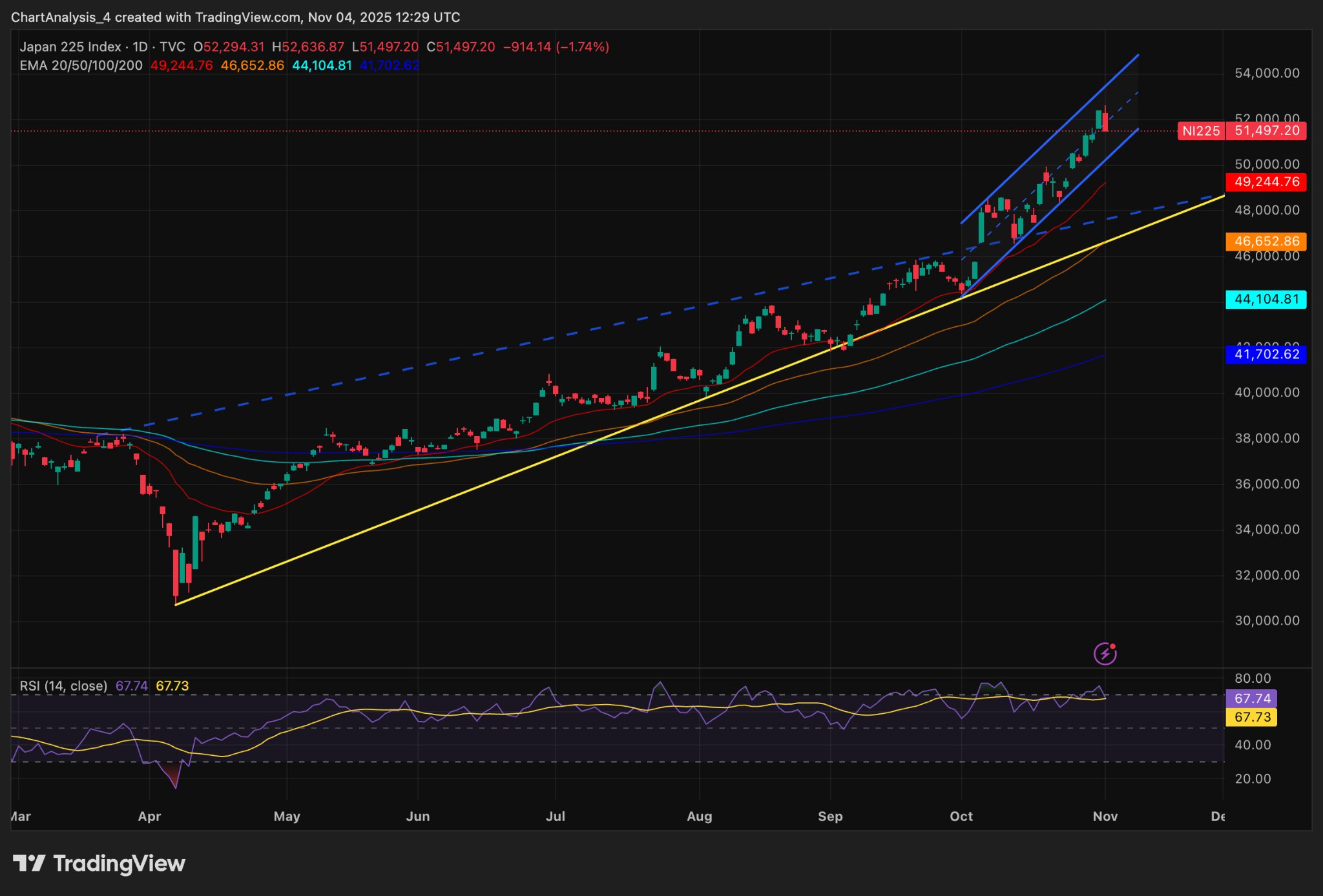
Nikkei 225 index price dynamics (Source: TradingView)
Tuesday’s reversal marks the first clear rejection from the channel’s upper boundary in weeks. Despite the pullback, the longer-term outlook remains constructive. The Nikkei continues to trade above all major moving averages: the 20-day EMA near 49,200, the 50-day EMA around 46,650, and the 100-day EMA near 44,100. The upward slope of these lines suggests sustained medium- and long-term momentum in favor of buyers.
Immediate support lies in the 50,300–49,900 range, where the 20-day EMA converges with prior breakout levels. A retest of this zone could allow the index to consolidate before another attempt to climb toward 53,000 and possibly 54,500. A deeper correction would likely target the 50-day EMA near 46,700, while the long-term trendline and 100-day EMA around 44,000 remain the ultimate support protecting the uptrend.
Upside momentum would resume only if the index reclaims the channel midpoint and closes above 52,300, signaling renewed strength after profit-taking. Until then, the market appears to be digesting gains from its steep ascent.
Macro outlook: BOJ policy and global signals in focus
Beyond technicals, investor sentiment in Tokyo was dampened by uncertainty surrounding global policy direction. The Federal Reserve’s recent caution—underscored by mixed signals from multiple officials—has left traders unclear about the U.S. rate path. Meanwhile, geopolitical friction over chip exports revived concerns about trade retaliation and potential disruptions to Japan’s technology supply chain.
Attention now shifts to the Bank of Japan’s upcoming policy meeting, where speculation is mounting that policymakers may consider a rate hike in December to counter persistent yen weakness and imported inflation pressures. Domestic data releases later this week, including household spending and wage growth figures, are also expected to guide market expectations.
While short-term volatility may persist, the broader structure of the Nikkei remains bullish. The index has gained more than 20% this year, underpinned by strong foreign inflows and earnings optimism in Japan’s tech sector. Tuesday’s drop appears more like a healthy correction within a well-established uptrend than the start of a sustained reversal.
Outlook: Consolidation before next leg higher
For now, the Nikkei is in a cooling phase following its vertical rise. As long as prices hold above the 20-day EMA and the lower boundary of the rising channel, the structure remains intact. Traders view dips toward 50,000 as potential buying opportunities rather than warning signals.
The next major catalyst will come from the BOJ’s policy stance and clarity around U.S. export rules for semiconductors. Should those risks stabilize, momentum could return, allowing the index to retest record highs above 53,000 in the coming weeks.





Latest Nikkei 225 News










-
 Afghanistan
-
 Albania
-
 Algeria
-
 Angola
-
 Argentina
-
 Armenia
-
 Australia
-
 Austria
-
 Azerbaijan
-
 Bahamas
-
 Bahrain
-
 Bangladesh
-
 Belarus
-
 Belgium
-
 Bolivia
-
 Botswana
-
 Brazil
-
 Brunei
-
 Bulgaria
-
 Cambodia
-
 Cameroon
-
 Canada
-
 Chile
Chile
-
 China
China
-
 Colombia
-
 Congo
Congo
-
 Costa Rica
-
 Cote d'Ivoire
-
 Croatia
-
 Cuba
Cuba
-
 Cyprus
-
 Czechia
-
 DR Congo
-
 Denmark
-
 Dominican Republic
-
 Ecuador
-
 Egypt
Egypt
-
 El Salvador
-
 Estonia
-
 Eswatini
-
 Ethiopia
-
 Finland
-
 France
-
 Georgia
-
 Germany
-
 Ghana
Ghana
-
 Greece
-
 Haiti
Haiti
-
 Hong Kong
-
 Hungary
-
 India
India
-
 Indonesia
-
 Iran, Islamic republic
-
 Iraq
Iraq
-
 Ireland
-
 Israel
-
 Italy
Italy
-
 Jamaica
-
 Japan
Japan
-
 Jordan
-
 Kazakhstan
-
 Kenya
Kenya
-
 Korea
Korea
-
 Kuwait
-
 Kyrgyzstan
-
 Laos
Laos
-
 Latvia
-
 Lebanon
-
 Lesotho
-
 Libya
Libya
-
 Lithuania
-
 Luxembourg
-
 Madagascar
-
 Malaysia
-
 Malta
Malta
-
 Mauritius
-
 Mexico
-
 Moldova
-
 Mongolia
-
 Montenegro
-
 Morocco
-
 Mozambique
-
 Myanmar
-
 Namibia
-
 Nepal
Nepal
-
 Netherlands
-
 New Zealand
-
 Nigeria
-
 North Macedonia
-
 Norway
-
 Oman
Oman
-
 Pakistan
-
 Palestine
-
 Panama
-
 Papua New Guinea
-
 Paraguay
-
 Peru
Peru
-
 Philippines
-
 Poland
-
 Portugal
-
 Puerto Rico
-
 Qatar
Qatar
-
 Reunion
-
 Romania
-
 Rwanda
-
 Saudi Arabia
-
 Serbia
-
 Singapore
-
 Slovakia
-
 Slovenia
-
 Somalia
-
 South Africa
-
 Spain
Spain
-
 Sri Lanka
-
 Sweden
-
 Switzerland
-
 Syria
Syria
-
 Taiwan
-
 Tajikistan
-
 Tanzania
-
 Thailand
-
 Trinidad and Tobago
-
 Tunisia
-
 Turkey
-
 UAE
UAE
-
 Uganda
-
 Ukraine
-
 United Kingdom
-
United States
-
 Uruguay
-
 Uzbekistan
-
 Venezuela
-
 Vietnam
-
 Yemen
Yemen
-
 Zambia
-
 Zimbabwe
- Forex
- Crypto












