
Nikkei 225 falls 1.77% as global tech selloff hits Japan market

The Nikkei 225 retreated sharply on Friday, dropping 1.77 percent to close at 50,376, erasing the previous session’s advance as global tech sentiment weakened. The decline mirrored Wall Street’s steep pullback, where stretched AI-linked valuations and reduced expectations for near-term Federal Reserve cuts triggered broad liquidation.
Highlights
- Nikkei drops 1.77 percent to 50,376 as tech stocks slide.
- SoftBank falls more than 6 percent amid renewed pressure on high-beta tech.
- Index tests lower boundary of its short-term rising channel.
Japan’s tech-heavy index followed the move, with SoftBank sliding more than 6 percent and semiconductor names including Advantest, Fujikura, Tokyo Electron, Lasertec and Disco facing coordinated selling pressure. Despite the reversal, the benchmark still ended the week with a modest gain as its broader uptrend stayed intact.
Pullback tests the ascending structure
The index remains inside a strong rising structure that has guided the advance since April. A steep ascending channel formed in October, and Friday’s decline brought price back toward the lower boundary of that band. This marks the first meaningful test of the channel floor since the October breakout. A clean break below it would expose the deeper ascending trendline drawn from June, currently near 47,700.
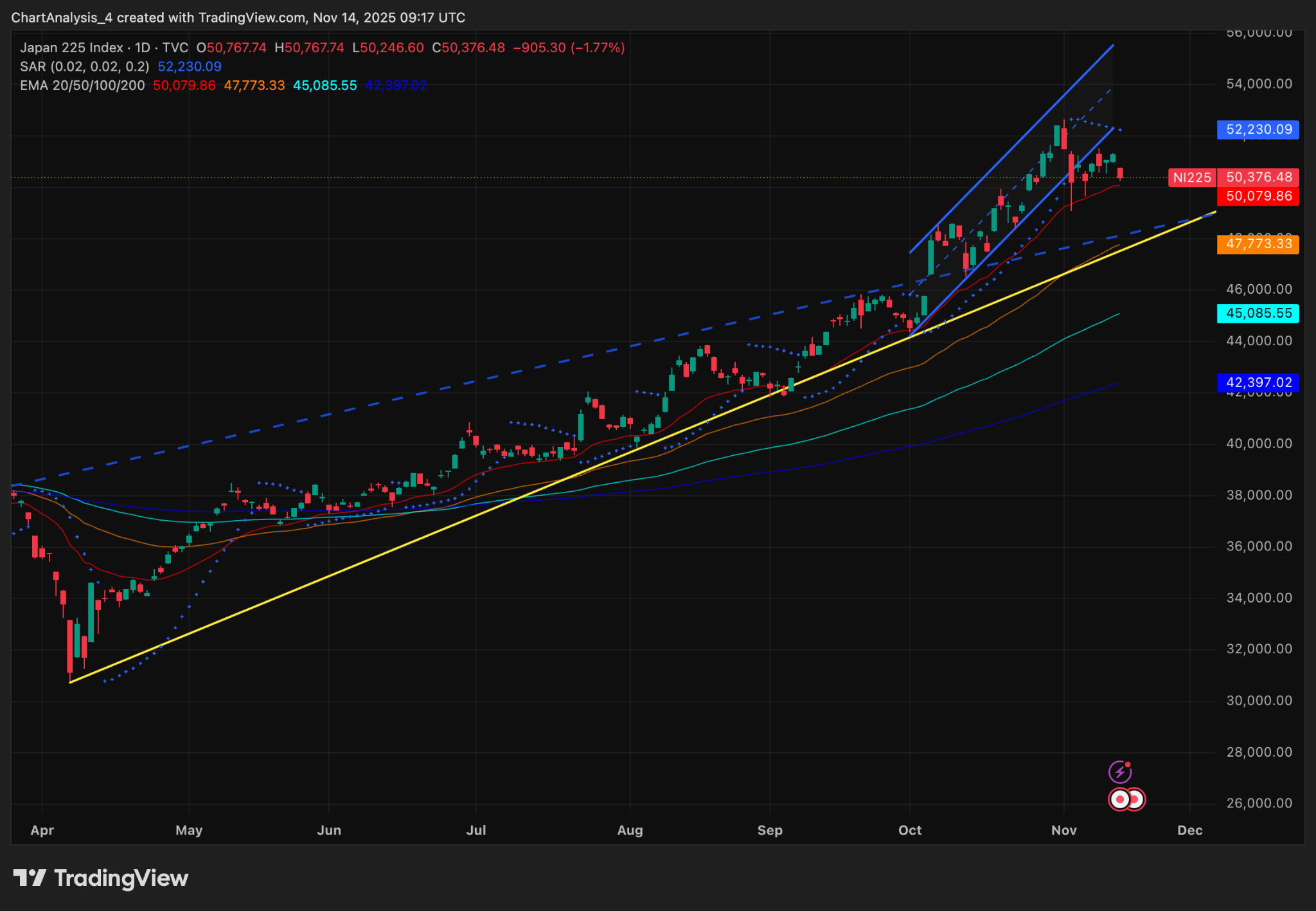
Nikkei 225 index price dynamics (Source: TradingView)
The EMA configuration still supports the long-term trend. The Nikkei 225 sits marginally above the 20-day EMA at 50,079, making this level an immediate pivot for sentiment. The 50-day EMA at 47,773 and 100-day EMA at 45,085 remain well below, showing how extended the rally has been. As long as the index holds above the 20-day EMA, near-term momentum remains constructive. A decisive close below it would signal that the market is cooling and likely to retest deeper structural support.
The Parabolic SAR flipped bullish in recent weeks as momentum lifted the index toward 52,230, but the latest downturn places pressure on that signal. Should sellers continue to press the market lower, the indicator may turn bearish, signaling a pause in the trend. For now, the broader trajectory remains upward, though the pullback calls for caution.
Tech weakness and policy divergence shape market tone
Friday’s decline underscores Japan’s sensitivity to global technology flows. The synchronized drops across SoftBank and major semiconductor suppliers reflect growing investor concern over overheated AI valuations and tightening financial conditions abroad. SoftBank’s steep fall is particularly notable given renewed scrutiny around the Vision Fund’s performance. Stress inside the firm often acts as a gauge for broader risk appetite in Japan’s technology sector.
Local fundamentals remain mixed but supportive for equities in the broader sense. Prime Minister Sanae Takaichi has urged the Bank of Japan to maintain accommodative policy to strengthen purchasing power and offset rising inflation pressures. This political push contrasts with cautious signals from BOJ officials who have reiterated that tightening remains possible depending on wage and price data. The divergence has preserved a favorable backdrop for exporters and tech firms, even as global sentiment weakens.
In earlier commentary, we noted that the Nikkei’s advance was becoming stretched and that any weakness in global technology names could serve as the trigger for a pullback toward the lower channel boundary. Friday’s decline followed that pattern, bringing the index directly into the zone we identified as the first test of trend strength.





Latest Nikkei 225 News









-
 Afghanistan
-
 Albania
-
 Algeria
-
 Angola
-
 Argentina
-
 Armenia
-
 Australia
-
 Austria
-
 Azerbaijan
-
 Bahamas
-
 Bahrain
-
 Bangladesh
-
 Belarus
-
 Belgium
-
 Bolivia
-
 Botswana
-
 Brazil
-
 Brunei
-
 Bulgaria
-
 Cambodia
-
 Cameroon
-
 Canada
-
 Chile
Chile
-
 China
China
-
 Colombia
-
 Congo
Congo
-
 Costa Rica
-
 Cote d'Ivoire
-
 Croatia
-
 Cuba
Cuba
-
 Cyprus
-
 Czechia
-
 DR Congo
-
 Denmark
-
 Dominican Republic
-
 Ecuador
-
 Egypt
Egypt
-
 El Salvador
-
 Estonia
-
 Eswatini
-
 Ethiopia
-
 Finland
-
 France
-
 Georgia
-
 Germany
-
 Ghana
Ghana
-
 Greece
-
 Haiti
Haiti
-
 Hong Kong
-
 Hungary
-
 India
India
-
 Indonesia
-
 Iran, Islamic republic
-
 Iraq
Iraq
-
 Ireland
-
 Israel
-
 Italy
Italy
-
 Jamaica
-
 Japan
Japan
-
 Jordan
-
 Kazakhstan
-
 Kenya
Kenya
-
 Korea
Korea
-
 Kuwait
-
 Kyrgyzstan
-
 Laos
Laos
-
 Latvia
-
 Lebanon
-
 Lesotho
-
 Libya
Libya
-
 Lithuania
-
 Luxembourg
-
 Madagascar
-
 Malaysia
-
 Malta
Malta
-
 Mauritius
-
 Mexico
-
 Moldova
-
 Mongolia
-
 Montenegro
-
 Morocco
-
 Mozambique
-
 Myanmar
-
 Namibia
-
 Nepal
Nepal
-
 Netherlands
-
 New Zealand
-
 Nigeria
-
 North Macedonia
-
 Norway
-
 Oman
Oman
-
 Pakistan
-
 Palestine
-
 Panama
-
 Papua New Guinea
-
 Paraguay
-
 Peru
Peru
-
 Philippines
-
 Poland
-
 Portugal
-
 Puerto Rico
-
 Qatar
Qatar
-
 Reunion
-
 Romania
-
 Rwanda
-
 Saudi Arabia
-
 Serbia
-
 Singapore
-
 Slovakia
-
 Slovenia
-
 Somalia
-
 South Africa
-
 Spain
Spain
-
 Sri Lanka
-
 Sweden
-
 Switzerland
-
 Syria
Syria
-
 Taiwan
-
 Tajikistan
-
 Tanzania
-
 Thailand
-
 Trinidad and Tobago
-
 Tunisia
-
 Turkey
-
 UAE
UAE
-
 Uganda
-
 Ukraine
-
 United Kingdom
-
United States
-
 Uruguay
-
 Uzbekistan
-
 Venezuela
-
 Vietnam
-
 Yemen
Yemen
-
 Zambia
-
 Zimbabwe
- Forex
- Crypto












