
Nikkei 225 slides 2.4% as AI rout deepens and wedge support breaks
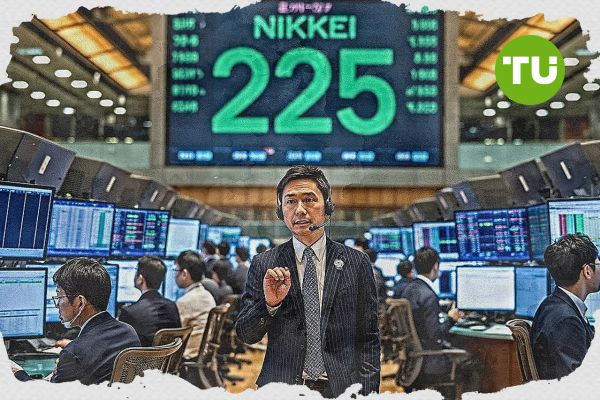
The Nikkei 225 closed 2.4% lower at 48,626, marking its sharpest single-day slide in weeks and extending its retreat from the early-November peak above 53,000. The decline comes as the index breaks decisively below its rising wedge, a structure that had supported Japan’s strongest multi-month rally since 2023.
Highlights
- Nikkei drops 2.4% as rising wedge breaks for the first time since April.
- SoftBank, Advantest and Tokyo Electron fall 7–12% as AI unwind accelerates.
- Japan’s new 21.3 trillion yen stimulus raises fresh fiscal concerns.
The latest pullback reflects how tightly Japan’s equity landscape remains tied to U.S. tech sentiment, with Wall Street’s renewed selloff dictating direction across global markets.
Tech rout hits Japan as AI fears ripple across global markets
The selling pressure in the U.S. tech sector spilled into Japan with full force, driven by growing concerns that the rapid expansion of AI-linked valuations has entered a corrective phase. The Nikkei’s heaviest growth names were the first to absorb the hit.
SoftBank Group, Advantest, Kioxia Holdings, Fujikura and Tokyo Electron sank between 7% and 12%, erasing much of their November gains in a single session. These companies have been critical to the Nikkei’s advance in 2024 and 2025, benefiting from global AI infrastructure demand and surging semiconductor capital expenditure.
The synchronous decline with the Nasdaq reinforces how tightly Japan’s bull cycle has been tethered to U.S. risk appetite. When Wall Street’s AI trade loses momentum, the Nikkei rarely escapes the spillover. Thursday’s move underscores that dynamic, with Tokyo’s session essentially mirroring the overnight tone set in the U.S.
Beyond the headline losses, institutional traders noted a shift in positioning. Futures flows showed steady defensive hedging, while options markets registered elevated demand for downside protection. Volatility indicators, which had remained subdued during the Nikkei’s climb, picked up sharply as investors recalibrated exposure to high-beta sectors.
Fiscal questions rise as Japan unveils new stimulus package
Japan’s cabinet approved a 21.3 trillion yen stimulus package earlier this week, the largest since the pandemic era. While framed as a measure to support domestic demand, the announcement triggered fresh debate about Japan’s long-term fiscal stability.
Investors reacted cautiously. The spending plan increases pressure on long-term yields and raises new questions about how the government plans to balance inflation risks, deficit spending and yen stability. With global markets shifting into risk-off mode, the size of the package amplified unease rather than easing it.
At the macro level, Japan posted a three-month high in core inflation and stronger-than-expected export data. Those figures present a mixed backdrop: stronger exports support earnings for Japan’s largest corporates, but rising inflation reduces the likelihood of additional monetary support from the Bank of Japan. The combination creates a challenging environment for equities navigating a structural pullback.
Technical picture points toward deeper correction
Technically, the Nikkei has entered a decisive area on the chart. The index now rests directly on the rising trendline that has supported its advance since April. This trendline converges with the 20-week EMA, forming one of the most important support zones of the year.
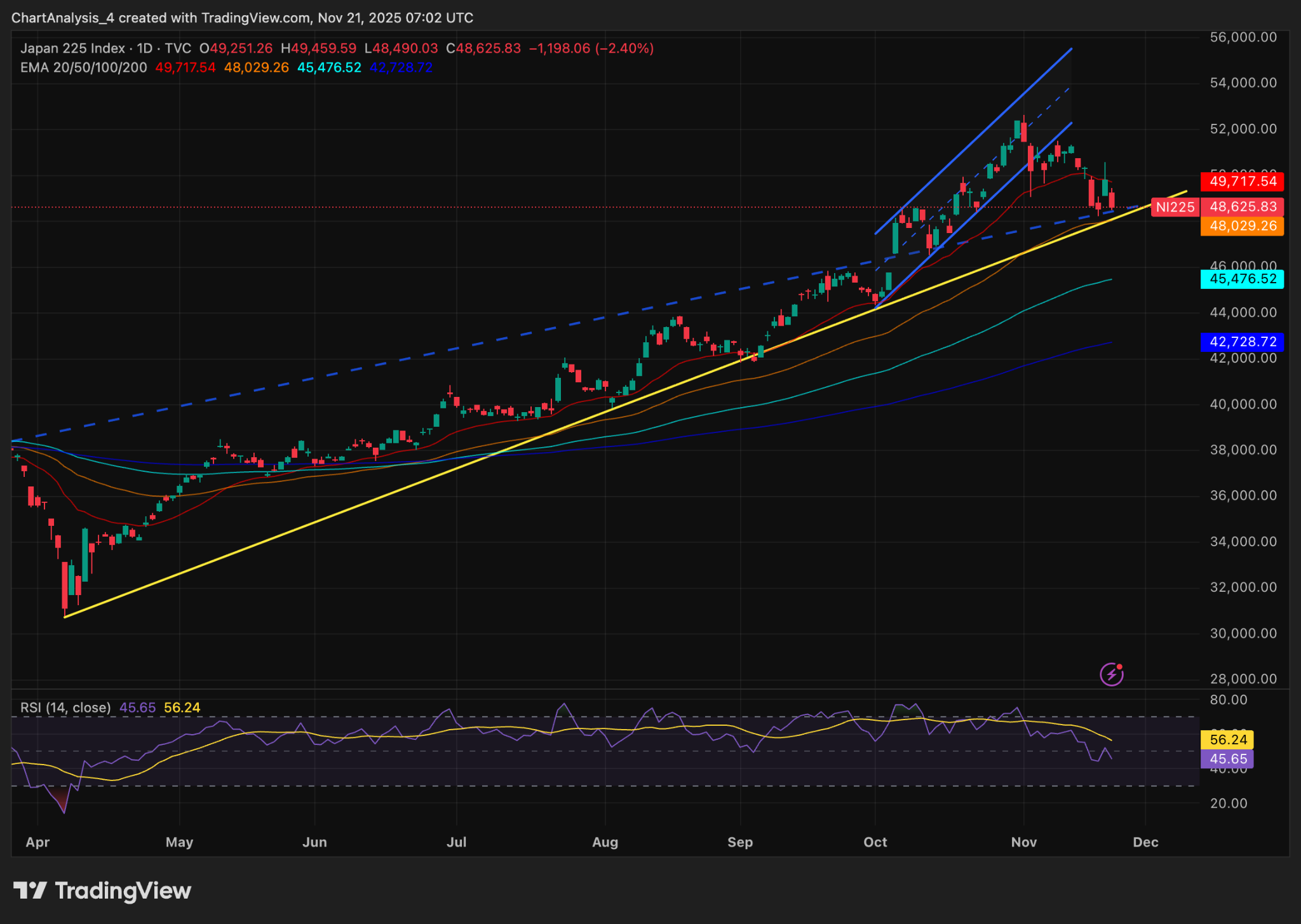
Nikkei 225 index price dynamics (Source: TradingView)
A daily or weekly close below the 48,300–48,000 region would shift the structure into a deeper correction, exposing the 46,500–46,000 pocket where the 100-day EMA sits. That level also corresponds with a minor demand area formed during the September consolidation.Momentum indicators reflect the shift. The RSI has fallen toward 45, signaling cooling momentum but leaving room for further downside before hitting oversold territory. The 20-day and 50-day EMAs have now turned into active resistance for the first time since late August, confirming the loss of upward trend strength. A recovery above 49,700 is needed to restore any semblance of bullish momentum.
Outlook
The Nikkei 225 enters a critical stretch as global tech sentiment weakens and Japan’s fiscal expansion stirs fresh policy questions. The rising wedge breakdown marks a clear structural shift, and the reversal in AI-linked heavyweights confirms that investors are reducing exposure rather than buying dips.
A stabilization in U.S. tech markets and firmer communication from the Bank of Japan will likely be required before a meaningful recovery takes shape. Until price reclaims the 20-day EMA with conviction, downside risk toward 46,500 remains in focus.
In earlier coverage, we highlighted the Nikkei’s reliance on its ascending trendline and semiconductor leadership. The latest breakdown validates those concerns, showing how quickly sentiment can reverse once the AI trade cools and wedge support gives way.




Latest Nikkei 225 News









-
 Afghanistan
-
 Albania
-
 Algeria
-
 Angola
-
 Argentina
-
 Armenia
-
 Australia
-
 Austria
-
 Azerbaijan
-
 Bahamas
-
 Bahrain
-
 Bangladesh
-
 Belarus
-
 Belgium
-
 Bolivia
-
 Botswana
-
 Brazil
-
 Brunei
-
 Bulgaria
-
 Cambodia
-
 Cameroon
-
 Canada
-
 Chile
Chile
-
 China
China
-
 Colombia
-
 Congo
Congo
-
 Costa Rica
-
 Cote d'Ivoire
-
 Croatia
-
 Cuba
Cuba
-
 Cyprus
-
 Czechia
-
 DR Congo
-
 Denmark
-
 Dominican Republic
-
 Ecuador
-
 Egypt
Egypt
-
 El Salvador
-
 Estonia
-
 Eswatini
-
 Ethiopia
-
 Finland
-
 France
-
 Georgia
-
 Germany
-
 Ghana
Ghana
-
 Greece
-
 Haiti
Haiti
-
 Hong Kong
-
 Hungary
-
 India
India
-
 Indonesia
-
 Iran, Islamic republic
-
 Iraq
Iraq
-
 Ireland
-
 Israel
-
 Italy
Italy
-
 Jamaica
-
 Japan
Japan
-
 Jordan
-
 Kazakhstan
-
 Kenya
Kenya
-
 Korea
Korea
-
 Kuwait
-
 Kyrgyzstan
-
 Laos
Laos
-
 Latvia
-
 Lebanon
-
 Lesotho
-
 Libya
Libya
-
 Lithuania
-
 Luxembourg
-
 Madagascar
-
 Malaysia
-
 Malta
Malta
-
 Mauritius
-
 Mexico
-
 Moldova
-
 Mongolia
-
 Montenegro
-
 Morocco
-
 Mozambique
-
 Myanmar
-
 Namibia
-
 Nepal
Nepal
-
 Netherlands
-
 New Zealand
-
 Nigeria
-
 North Macedonia
-
 Norway
-
 Oman
Oman
-
 Pakistan
-
 Palestine
-
 Panama
-
 Papua New Guinea
-
 Paraguay
-
 Peru
Peru
-
 Philippines
-
 Poland
-
 Portugal
-
 Puerto Rico
-
 Qatar
Qatar
-
 Reunion
-
 Romania
-
 Rwanda
-
 Saudi Arabia
-
 Serbia
-
 Singapore
-
 Slovakia
-
 Slovenia
-
 Somalia
-
 South Africa
-
 Spain
Spain
-
 Sri Lanka
-
 Sweden
-
 Switzerland
-
 Syria
Syria
-
 Taiwan
-
 Tajikistan
-
 Tanzania
-
 Thailand
-
 Trinidad and Tobago
-
 Tunisia
-
 Turkey
-
 UAE
UAE
-
 Uganda
-
 Ukraine
-
 United Kingdom
-
United States
-
 Uruguay
-
 Uzbekistan
-
 Venezuela
-
 Vietnam
-
 Yemen
Yemen
-
 Zambia
-
 Zimbabwe
- Forex
- Crypto












