
Nikkei 225 holds 49,303 as markets stabilize after BOJ yield shock and policy reassurance

The Nikkei 225 closed almost unchanged at 49,303 on Tuesday, signaling a stabilizing shift in sentiment after Monday’s sharp downturn. The index defended its major ascending trendline despite a surge in Japanese government bond yields to multi-decade highs.
Highlights
- The Nikkei 225 holds 49,303 as buyers defend the long-term ascending trendline.
- Ueda signals policy caution, easing investor concerns after JGB yields spike.
- Financials and manufacturing stocks lead selective rotation despite macro pressure.
Improved equity tone followed Governor Kazuo Ueda’s assurance that financial conditions would remain accommodative even after a potential rate hike, easing fears of an abrupt policy turn.
Technical structure holds firm as the index defends long-term support
Technically, the Nikkei remains in a constructive multi-month uptrend. The index has continued to trade above its rising 20, 50, and 100-day EMAs, with the 20-day average near ¥49,644 acting as short-term support. Dip-buyers stepped in again at this level following Monday’s decline, reflecting consistent confidence in the trend structure.
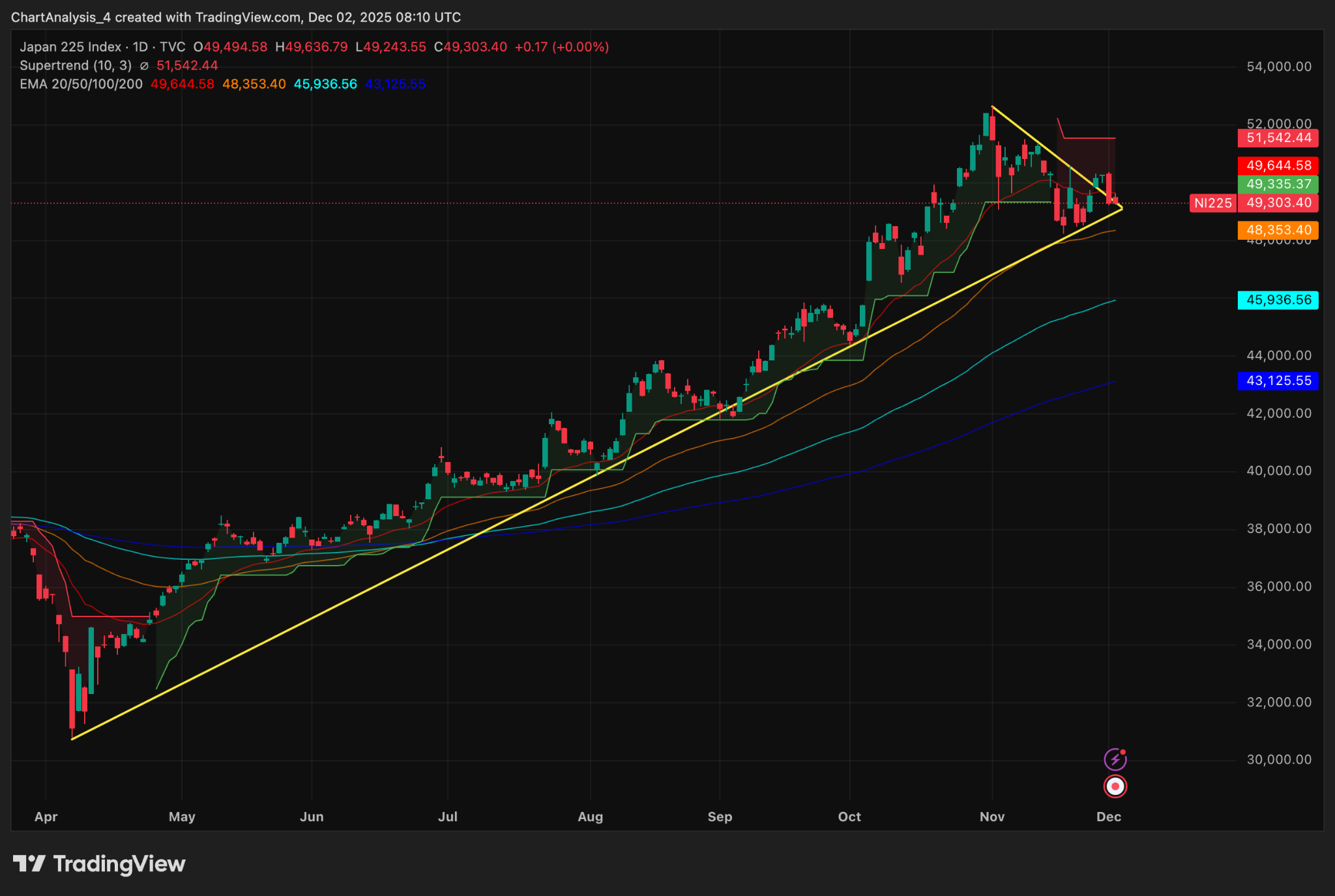
Nikkei 225 index price dynamics (Source: TradingView)
Price action shows the index consolidating inside a symmetrical triangle, a formation typically signaling equilibrium before a directional breakout. Tuesday’s close brought the Nikkei back toward the triangle’s upper boundary, though without a clear break. As long as the ascending trendline around ¥48,400 remains intact, the broader bullish bias remains dominant.
Momentum indicators suggest digestion rather than exhaustion. The recent retreat relieved stretched conditions without inflicting structural damage to the uptrend. Both the 50-day and 100-day EMAs continue to slope upward, showing that medium-term capital remains invested in Japanese equities. A breakout above ¥51,500, where the Supertrend resistance currently sits, would likely ignite renewed momentum toward ¥52,500. A failure to reclaim the level could keep price trapped within its narrowing consolidation band.
Sector rotation highlights resilience as investors look past bond-market volatility
Market internals reflected a resilient tone despite macro headwinds. Gains in financials, electronic technology, and retail trade helped offset declines in interest-sensitive names. Notable performers included Nippon Electric Glass (+9.9%), NGK Insulators (+7.2%), and Fanuc Corp (+6.4%), showing strong rotation into manufacturing and growth names. Meanwhile, Tokyo Electric Power (-6.7%), Isetan Mitsukoshi (-6.1%), and Sumitomo Pharma (-5.6%) led declines, though weakness remained contained rather than broad-based.
Macro commentary supported stability. Finance Minister Satyuki Katayama stated that there was “no gap” between the government and the Bank of Japan, a message that helped reassure traders after the spike in bond yields prompted fears of policy discord. Investors interpreted the remarks as a signal that normalization will remain gradual and predictable, reducing the risk of liquidity shocks.
Japan’s equity market continues to benefit from this measured policy communication. Even as inflation pressures build, the BOJ has signaled that any tightening path will be slow, preserving favorable liquidity conditions relative to Western peers still navigating late-cycle policy shifts.Outlook: Consolidation continues as investors await breakout confirmation
Structurally, the Nikkei remains in a healthy uptrend, but price is now approaching a compressed inflection zone where direction must soon resolve. A clean breakout above triangle resistance — ideally accompanied by rising volume — would confirm trend continuation. Repeated rejection below ¥51,500, however, risks a pullback toward the mid-channel region or the ¥48,350 support area.
For now, market behavior reflects digestion rather than reversal. Dip-buyers remain active, macro messaging has turned supportive, and sector rotation suggests that investors are adjusting rather than exiting risk. Unless the BOJ signals a more aggressive tightening path, equities remain positioned to resume their advance once consolidation completes.
In our prior analysis, we highlighted that the Nikkei’s long-term trend structure remained intact as long as the ascending support trendline continued to attract buyers. This week’s defense of the 49,300 area reinforces that view, with price stability and sector rotation confirming the market’s underlying resilience.





Latest Nikkei 225 News









-
 Afghanistan
-
 Albania
-
 Algeria
-
 Angola
-
 Argentina
-
 Armenia
-
 Australia
-
 Austria
-
 Azerbaijan
-
 Bahamas
-
 Bahrain
-
 Bangladesh
-
 Belarus
-
 Belgium
-
 Bolivia
-
 Botswana
-
 Brazil
-
 Brunei
-
 Bulgaria
-
 Cambodia
-
 Cameroon
-
 Canada
-
 Chile
Chile
-
 China
China
-
 Colombia
-
 Congo
Congo
-
 Costa Rica
-
 Cote d'Ivoire
-
 Croatia
-
 Cuba
Cuba
-
 Cyprus
-
 Czechia
-
 DR Congo
-
 Denmark
-
 Dominican Republic
-
 Ecuador
-
 Egypt
Egypt
-
 El Salvador
-
 Estonia
-
 Eswatini
-
 Ethiopia
-
 Finland
-
 France
-
 Georgia
-
 Germany
-
 Ghana
Ghana
-
 Greece
-
 Haiti
Haiti
-
 Hong Kong
-
 Hungary
-
 India
India
-
 Indonesia
-
 Iran, Islamic republic
-
 Iraq
Iraq
-
 Ireland
-
 Israel
-
 Italy
Italy
-
 Jamaica
-
 Japan
Japan
-
 Jordan
-
 Kazakhstan
-
 Kenya
Kenya
-
 Korea
Korea
-
 Kuwait
-
 Kyrgyzstan
-
 Laos
Laos
-
 Latvia
-
 Lebanon
-
 Lesotho
-
 Libya
Libya
-
 Lithuania
-
 Luxembourg
-
 Madagascar
-
 Malaysia
-
 Malta
Malta
-
 Mauritius
-
 Mexico
-
 Moldova
-
 Mongolia
-
 Montenegro
-
 Morocco
-
 Mozambique
-
 Myanmar
-
 Namibia
-
 Nepal
Nepal
-
 Netherlands
-
 New Zealand
-
 Nigeria
-
 North Macedonia
-
 Norway
-
 Oman
Oman
-
 Pakistan
-
 Palestine
-
 Panama
-
 Papua New Guinea
-
 Paraguay
-
 Peru
Peru
-
 Philippines
-
 Poland
-
 Portugal
-
 Puerto Rico
-
 Qatar
Qatar
-
 Reunion
-
 Romania
-
 Rwanda
-
 Saudi Arabia
-
 Serbia
-
 Singapore
-
 Slovakia
-
 Slovenia
-
 Somalia
-
 South Africa
-
 Spain
Spain
-
 Sri Lanka
-
 Sweden
-
 Switzerland
-
 Syria
Syria
-
 Taiwan
-
 Tajikistan
-
 Tanzania
-
 Thailand
-
 Trinidad and Tobago
-
 Tunisia
-
 Turkey
-
 UAE
UAE
-
 Uganda
-
 Ukraine
-
 United Kingdom
-
United States
-
 Uruguay
-
 Uzbekistan
-
 Venezuela
-
 Vietnam
-
 Yemen
Yemen
-
 Zambia
-
 Zimbabwe
- Forex
- Crypto












