


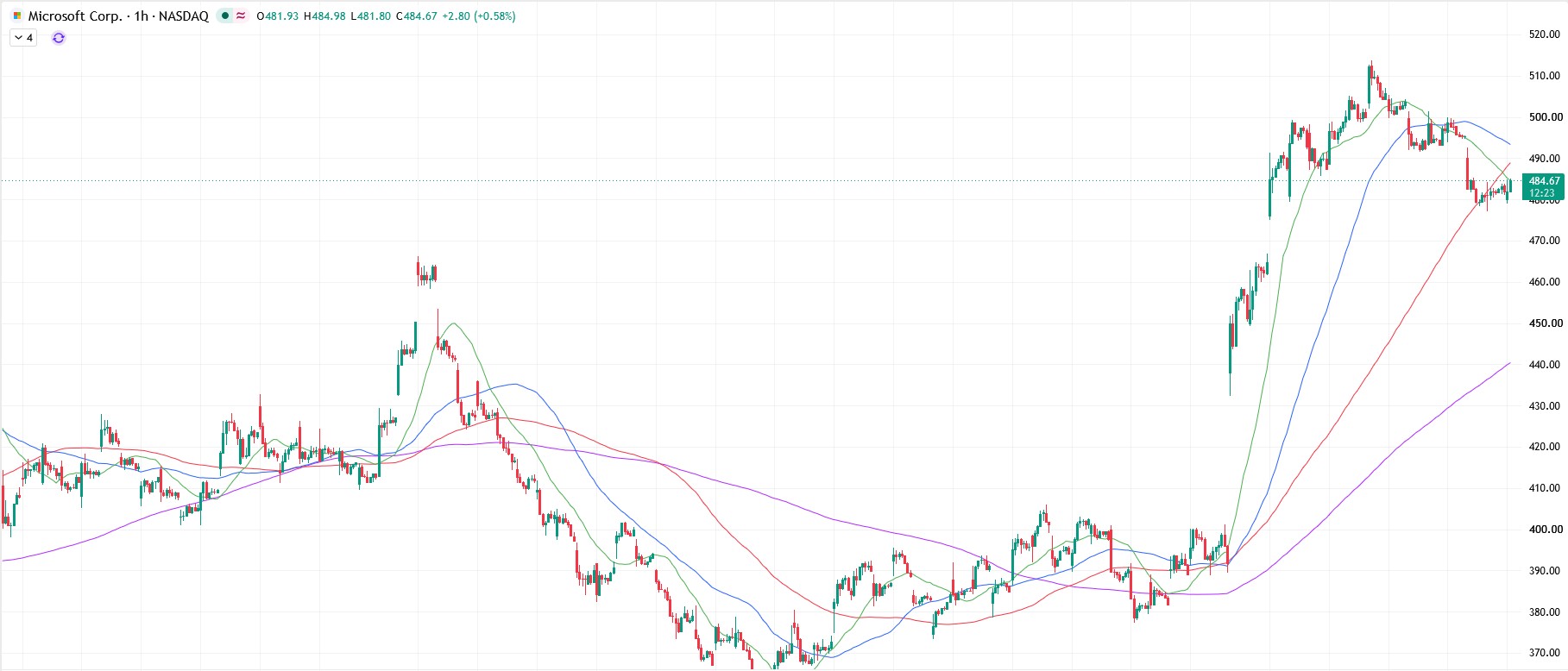
Microsoft (MSFT) shares are gaining around 0.5% today and are trading near $484, after moving up from an intraday low around $477. Today’s macro backdrop is especially important for MSFT, as the U.S. Treasury announced that it will at least double buyback operations in long-term fixed-coupon Treasuries starting September 9.
Treasury buybacks support megacap valuations
The maximum size of a single operation in the 10-20-year and 20-30-year sectors will increase from $2 billion to at least $4 billion. Following the announcement, the 10-year Treasury yield declined from around 4.68% to 4.65%, while the 30-year yield fell from 5.27% to 5.20%. For Microsoft, this is potentially positive through two channels. First, lower long-term yields reduce the discount rate applied to future cash flows and support the valuation multiples of large technology companies.
Second, a more stable government bond market may reduce the cost of financing the enormous AI capex, which is becoming increasingly sensitive to expensive capital. At the same time, Treasury buybacks are not QE and do not in themselves create new liquidity in the banking system, so their effect on MSFT is more about reducing rate volatility and the term premium than directly stimulating the equity market.
Azure growth keeps fundamentals strong
Support is still coming from strong June-quarter results: revenue for the fiscal fourth quarter rose 18% year over year to $90.0 billion, adjusted earnings per share came in at $4.74, while Azure and other cloud services accelerated by 43%. For the full 2026 fiscal year, Microsoft revenue reached $331.8 billion, while Azure exceeded $100 billion in annual revenue for the first time.
The main question for investors now is not whether there is demand for AI, but the cost of scaling it. Microsoft invested around $41 billion in capital expenditures in the latest quarter alone and expects more than $50 billion in the current period, as it continues to expand data centers, its GPU fleet, and proprietary infrastructure. At the same time, commercial obligations tied to future revenue remain extremely high, while Microsoft 365 Copilot already has more than 30 million paid users.
Meanwhile, the market is paying increasingly close attention to the risk of overheating in the investment cycle: Big Tech commitments for future data-center leases have exceeded $1 trillion, while some Microsoft projects are facing power constraints and delays in bringing capacity online. A positive factor is that the company is trying to reduce AI costs through its own models and chips, including the next generation of Maia, while also expanding the geographic footprint of its infrastructure, having recently launched its largest data center in India.
Microsoft targets $495-500 resistance
At the moment, MSFT is trying to consolidate above the $480 level, which would allow for a move toward resistance at $495-500, where bulls may face moderate resistance from bears. A break above the latter level would open the way toward $505-510; a loss of support, as I warned in the article Microsoft under pressure as AI spending and bond yields weigh on shares, would lead to a decline toward $470-465, where buying may emerge.





Latest Microsoft News




-
 Afghanistan
-
 Albania
-
 Algeria
-
 Angola
-
 Argentina
-
 Armenia
-
 Australia
-
 Austria
-
 Azerbaijan
-
 Bahamas
-
 Bahrain
-
 Bangladesh
-
 Belarus
-
 Belgium
-
 Bolivia
-
 Botswana
-
 Brazil
-
 Brunei
-
 Bulgaria
-
 Cambodia
-
 Cameroon
-
 Canada
-
 Chile
Chile
-
 China
China
-
 Colombia
-
 Congo
Congo
-
 Costa Rica
-
 Cote d'Ivoire
-
 Croatia
-
 Cuba
Cuba
-
 Cyprus
-
 Czechia
-
 DR Congo
-
 Denmark
-
 Dominican Republic
-
 Ecuador
-
 Egypt
Egypt
-
 El Salvador
-
 Estonia
-
 Eswatini
-
 Ethiopia
-
 Finland
-
 France
-
 Georgia
-
 Germany
-
 Ghana
Ghana
-
 Greece
-
 Haiti
Haiti
-
 Hong Kong
-
 Hungary
-
 India
India
-
 Indonesia
-
 Iran, Islamic republic
-
 Iraq
Iraq
-
 Ireland
-
 Israel
-
 Italy
Italy
-
 Jamaica
-
 Japan
Japan
-
 Jordan
-
 Kazakhstan
-
 Kenya
Kenya
-
 Korea
Korea
-
 Kuwait
-
 Kyrgyzstan
-
 Laos
Laos
-
 Latvia
-
 Lebanon
-
 Lesotho
-
 Libya
Libya
-
 Lithuania
-
 Luxembourg
-
 Madagascar
-
 Malaysia
-
 Malta
Malta
-
 Mauritius
-
 Mexico
-
 Moldova
-
 Mongolia
-
 Montenegro
-
 Morocco
-
 Mozambique
-
 Myanmar
-
 Namibia
-
 Nepal
Nepal
-
 Netherlands
-
 New Zealand
-
 Nigeria
-
 North Macedonia
-
 Norway
-
 Oman
Oman
-
 Pakistan
-
 Palestine
-
 Panama
-
 Papua New Guinea
-
 Paraguay
-
 Peru
Peru
-
 Philippines
-
 Poland
-
 Portugal
-
 Puerto Rico
-
 Qatar
Qatar
-
 Reunion
-
 Romania
-
 Rwanda
-
 Saudi Arabia
-
 Serbia
-
 Singapore
-
 Slovakia
-
 Slovenia
-
 Somalia
-
 South Africa
-
 Spain
Spain
-
 Sri Lanka
-
 Sweden
-
 Switzerland
-
 Syria
Syria
-
 Taiwan
-
 Tajikistan
-
 Tanzania
-
 Thailand
-
 Trinidad and Tobago
-
 Tunisia
-
 Turkey
-
 UAE
UAE
-
 Uganda
-
 Ukraine
-
 United Kingdom
-
United States
-
 Uruguay
-
 Uzbekistan
-
 Venezuela
-
 Vietnam
-
 Yemen
Yemen
-
 Zambia
-
 Zimbabwe
- Forex
- Crypto












