


Denison Mines Corp (DNN) advanced 5.47% in a short-term rebound as traders positioned ahead of the upcoming Q3 2026 earnings release. The move looks limited, with DNN still trading below its 20-day, 50-day, and 200-day moving averages and a bearish trend bias capping upside momentum.
 2.18
2.42
Highlights
- Denison Mines will publish its Q3 2026 earnings report after markets close on Tuesday, November 3.
- The report will be made available through the MarketBeat website for investor review.
- Shares of Denison Mines are trading below key moving averages with strong selling signals and an expected trading range of $2.20 to $2.43 for the coming week.
Earnings release date shapes trader positioning ahead of new data
Denison Mines will release its Q3 2026 earnings report after the market closes on Tuesday, November 3. The report will be published on the MarketBeat website.
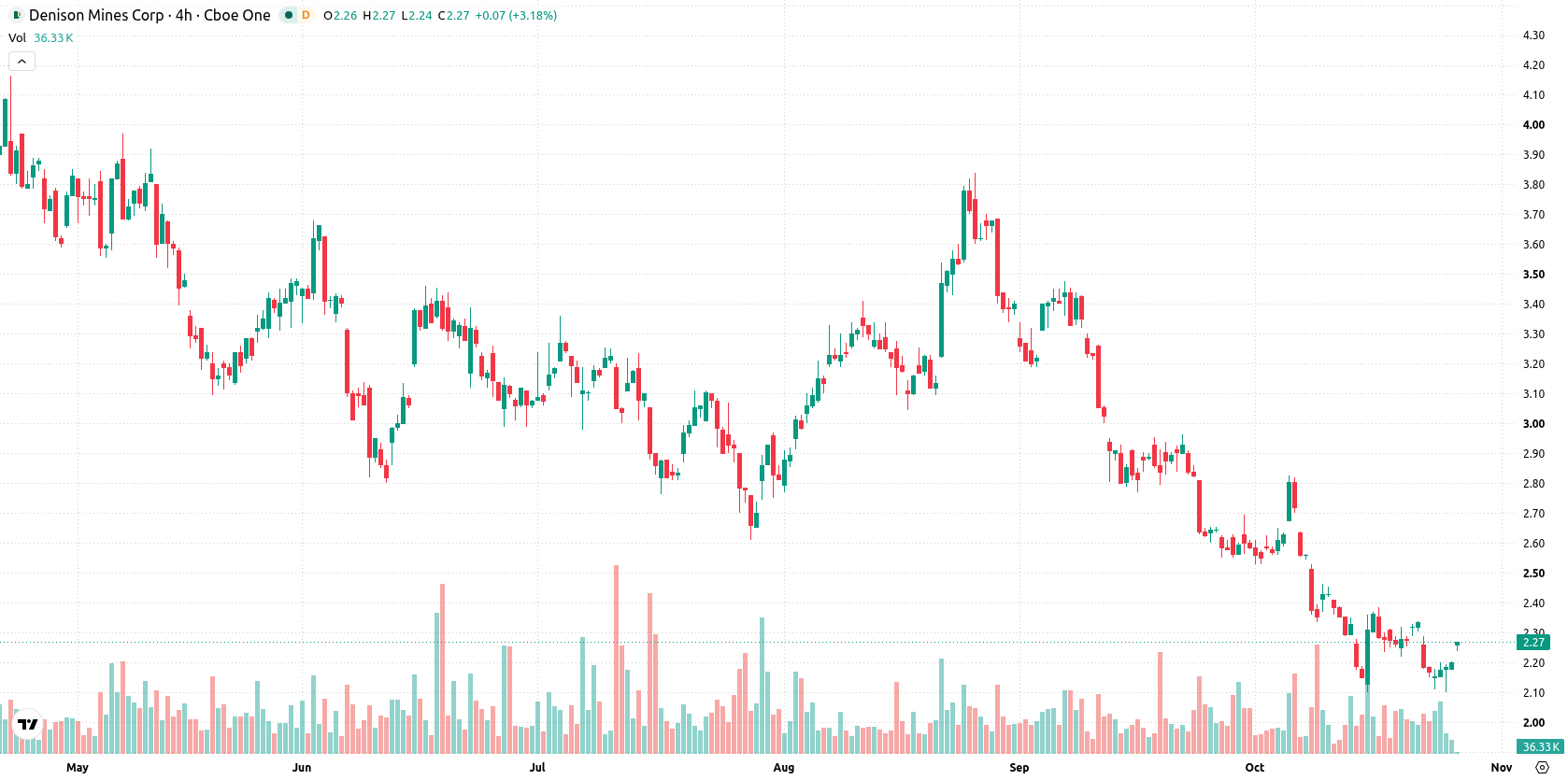
Downside momentum persists as oversold signals and resistance converge
DNN remains under pressure, trading below its 20-day, 50-day, and 200-day moving averages ($2.39, $2.85, and $3.35), highlighting sustained weakness across all timeframes. Immediate resistance is at $2.34 (week high), with support at $2.21 (today high), while the bearish trend is confirmed by the alignment between the MA-50 and MA-200. Momentum indicators are mixed: the MACD and ADX continue to indicate selling pressure, but the RSI at 36.05 and CCI at -100.17 show the stock nearing oversold levels. Stochastic RSI hints at a potential bounce, yet day-to-day momentum remains negative, supported by a Bull/Bear Power reading of -0.1 and a 'Sell' signal. The CCI also flags an 'Oversold' environment. Intraday, DNN jumped to $2.32, gaining $0.12 or 5.47% after an initial downside gap, with volatility at 4.25%. Action reflects renewed intraday strength near the highs, but overall signals remain split between downside risk and oversold bounce potential.
In a recent review, analysts highlighted Denison Mines' constrained upward movement amid persistent technical pressure and mixed momentum signals. The current assessment reinforces this view, emphasizing that sustained downside risk remains dominant and that the $2.21 support level serves as a critical threshold for gauging further declines in the days ahead.






Latest Denison Mines News




-
 Afghanistan
-
 Albania
-
 Algeria
-
 Angola
-
 Argentina
-
 Armenia
-
 Australia
-
 Austria
-
 Azerbaijan
-
 Bahamas
-
 Bahrain
-
 Bangladesh
-
 Belarus
-
 Belgium
-
 Bolivia
-
 Botswana
-
 Brazil
-
 Brunei
-
 Bulgaria
-
 Cambodia
-
 Cameroon
-
 Canada
-
 Chile
-
 China
-
 Colombia
-
 Congo
-
 Costa Rica
-
 Cote d'Ivoire
-
 Croatia
-
 Cuba
-
 Cyprus
-
 Czechia
-
 DR Congo
-
 Denmark
-
 Dominican Republic
-
 Ecuador
-
 Egypt
-
 El Salvador
-
 Estonia
-
 Eswatini
-
 Ethiopia
-
 Finland
-
 France
-
 Georgia
-
 Germany
-
 Ghana
-
 Greece
-
 Haiti
-
 Hong Kong
-
 Hungary
-
 India
-
 Indonesia
-
 Iran, Islamic republic
-
 Iraq
-
 Ireland
-
 Israel
-
 Italy
-
 Jamaica
-
 Japan
-
 Jordan
-
 Kazakhstan
-
 Kenya
-
 Korea
-
 Kuwait
-
 Kyrgyzstan
-
 Laos
-
 Latvia
-
 Lebanon
-
 Lesotho
-
 Libya
-
 Lithuania
-
 Luxembourg
-
 Madagascar
-
 Malaysia
-
 Malta
-
 Mauritius
-
 Mexico
-
 Moldova
-
 Mongolia
-
 Montenegro
-
 Morocco
-
 Mozambique
-
 Myanmar
-
 Namibia
-
 Nepal
-
 Netherlands
-
 New Zealand
-
 Nigeria
-
 North Macedonia
-
 Norway
-
 Oman
-
 Pakistan
-
 Palestine
-
 Panama
-
 Papua New Guinea
-
 Paraguay
-
 Peru
-
 Philippines
-
 Poland
-
 Portugal
-
 Puerto Rico
-
 Qatar
-
 Reunion
-
 Romania
-
 Rwanda
-
 Saudi Arabia
-
 Serbia
-
 Singapore
-
 Slovakia
-
 Slovenia
-
 Somalia
-
 South Africa
-
 Spain
-
 Sri Lanka
-
 Sweden
-
 Switzerland
-
 Syria
-
 Taiwan
-
 Tajikistan
-
 Tanzania
-
 Thailand
-
 Trinidad and Tobago
-
 Tunisia
-
 Turkey
-
 UAE
-
 Uganda
-
 Ukraine
-
 United Kingdom
-
United States
-
 Uruguay
-
 Uzbekistan
-
 Venezuela
-
 Vietnam
-
 Yemen
-
 Zambia
-
 Zimbabwe
- Forex
- Crypto












