

Nvidia stock falls as planned congressional AI regulation and export control probes weigh

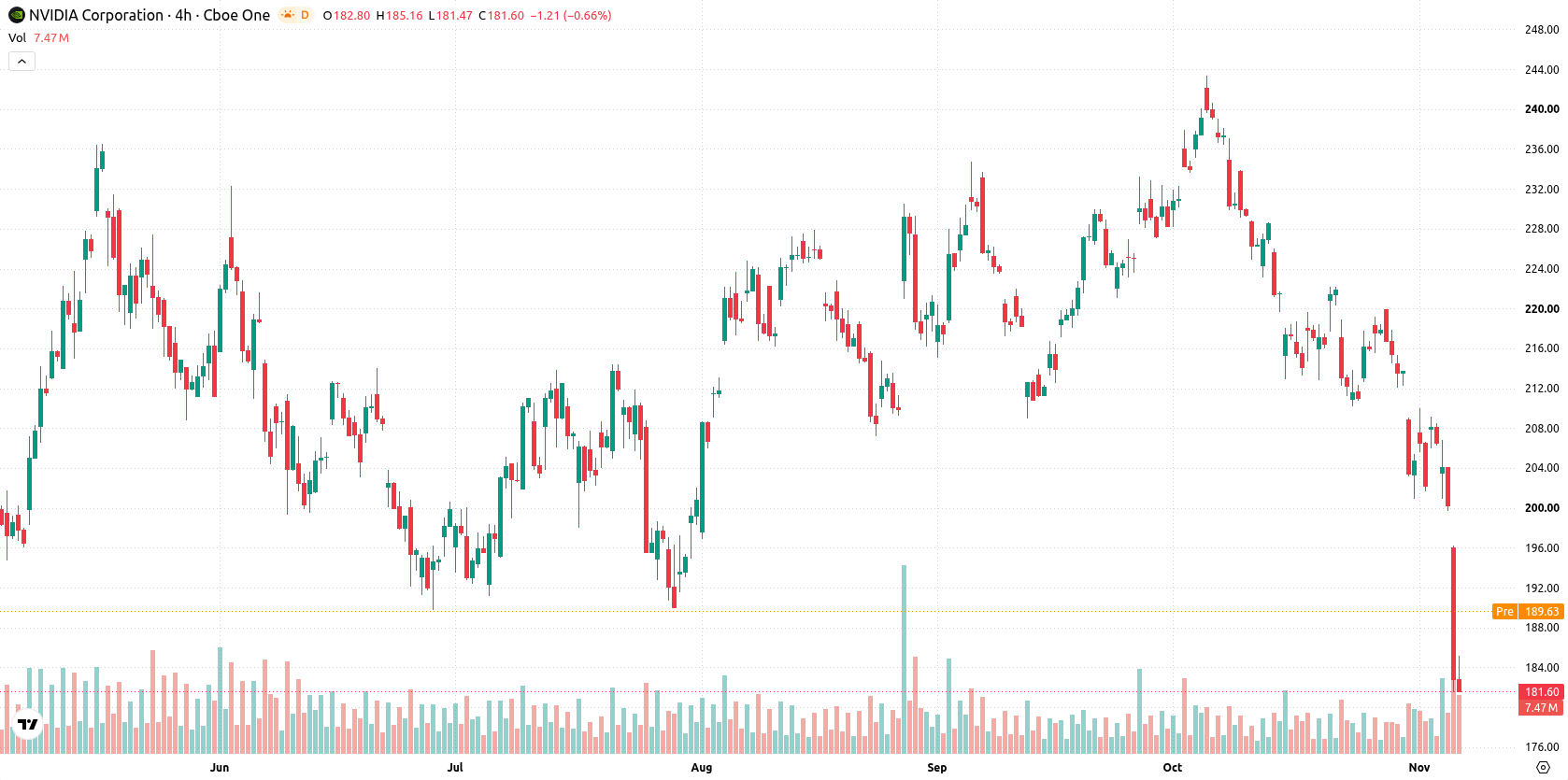
Nvidia (NVDA) stock is trading at $182.46, marking a daily decline of 8.83%. The current price is well below its key moving averages, indicating intensified selling activity.
 187.99
209.95
Highlights
- Democratic lawmakers are preparing new AI regulations and export control investigations involving Nvidia, increasing scrutiny of the company.
- Congress plans hearings with Nvidia executives, introducing regulatory uncertainty and adding pressure to the company’s AI business operations.
- Nvidia stock trades below key moving averages with persistent selling pressure, and is expected to remain in the $168.22 to $196.71 range with a 79% probability of further downside.
Regulatory scrutiny rises as lawmakers target Nvidia’s AI activities
Democratic lawmakers are preparing to introduce new regulations on artificial intelligence and initiate export control investigations that involve Nvidia, according to Agentlocker. This heightened focus by Congress signals prospective regulatory scrutiny for the company, raising uncertainty regarding the operational and compliance landscape for its AI business. Plans for hearings with Nvidia executives add further pressure, weighing on near-term investor sentiment as the market absorbs the potential risk of stricter oversight.
Bearish momentum confirmed as price breaches technical floors
On the technical front, NVDA remains below its MA-20 and MA-50 on the H4 chart and under its MA-200 on the daily timeframe. Ichimoku Kijun resistance is currently set at $201.83. Both the MACD and ADX have turned in Sell signals, while RSI, Stoch RSI, and CCI are all in oversold zones. Bull/Bear Power's pronounced negative reading and Awesome Oscillator alignment further confirm sustained selling momentum.
Further downside risk as bearish odds outweigh rebound prospects
In the short term, NVDA is expected to oscillate within a $168.22 to $196.71 volatility band. There is a 21% probability for an upward move and a 79% likelihood of further losses. The base case assumes continued consolidation, while a break below support could trigger additional downside, and a recovery above resistance would be required to initiate any significant rebound.
Earlier, analysts noted that as AI infrastructure investment accelerates and becomes more complex, challengers face daunting barriers created by dominant players like Nvidia, with future opportunities hinging on differentiation in architecture and the ability to lower switching costs for customers. The prospect of Congressional hearings and new regulatory oversight now adds a critical new dimension of risk for Nvidia, making sustained scrutiny around export controls and compliance a key variable for traders monitoring potential downside extensions below current volatility support levels.











-
 Afghanistan
-
 Albania
-
 Algeria
-
 Angola
-
 Argentina
-
 Armenia
-
 Australia
-
 Austria
-
 Azerbaijan
-
 Bahamas
-
 Bahrain
-
 Bangladesh
-
 Belarus
-
 Belgium
-
 Bolivia
-
 Botswana
-
 Brazil
-
 Brunei
-
 Bulgaria
-
 Cambodia
-
 Cameroon
-
 Canada
-
 Chile
-
 China
-
 Colombia
-
 Congo
-
 Costa Rica
-
 Cote d'Ivoire
-
 Croatia
-
 Cuba
-
 Cyprus
-
 Czechia
-
 DR Congo
-
 Denmark
-
 Dominican Republic
-
 Ecuador
-
 Egypt
-
 El Salvador
-
 Estonia
-
 Eswatini
-
 Ethiopia
-
 Finland
-
 France
-
 Georgia
-
 Germany
-
 Ghana
-
 Greece
-
 Haiti
-
 Hong Kong
-
 Hungary
-
 India
-
 Indonesia
-
 Iran, Islamic republic
-
 Iraq
-
 Ireland
-
 Israel
-
 Italy
-
 Jamaica
-
 Japan
-
 Jordan
-
 Kazakhstan
-
 Kenya
-
 Korea
-
 Kuwait
-
 Kyrgyzstan
-
 Laos
-
 Latvia
-
 Lebanon
-
 Lesotho
-
 Libya
-
 Lithuania
-
 Luxembourg
-
 Madagascar
-
 Malaysia
-
 Malta
-
 Mauritius
-
 Mexico
-
 Moldova
-
 Mongolia
-
 Montenegro
-
 Morocco
-
 Mozambique
-
 Myanmar
-
 Namibia
-
 Nepal
-
 Netherlands
-
 New Zealand
-
 Nigeria
-
 North Macedonia
-
 Norway
-
 Oman
-
 Pakistan
-
 Palestine
-
 Panama
-
 Papua New Guinea
-
 Paraguay
-
 Peru
-
 Philippines
-
 Poland
-
 Portugal
-
 Puerto Rico
-
 Qatar
-
 Reunion
-
 Romania
-
 Rwanda
-
 Saudi Arabia
-
 Serbia
-
 Singapore
-
 Slovakia
-
 Slovenia
-
 Somalia
-
 South Africa
-
 Spain
-
 Sri Lanka
-
 Sweden
-
 Switzerland
-
 Syria
-
 Taiwan
-
 Tajikistan
-
 Tanzania
-
 Thailand
-
 Trinidad and Tobago
-
 Tunisia
-
 Turkey
-
 UAE
-
 Uganda
-
 Ukraine
-
 United Kingdom
-
United States
-
 Uruguay
-
 Uzbekistan
-
 Venezuela
-
 Vietnam
-
 Yemen
-
 Zambia
-
 Zimbabwe
- Forex
- Crypto












