
Most Popular Crypto Scalping Strategies And Tools



Editorial Note: While we adhere to strict Editorial Integrity, this post may contain references to products from our partners. Here's an explanation for How We Make Money. None of the data and information on this webpage constitutes investment advice according to our Disclaimer.
Best crypto scalping strategies:
Range trading: buys at support and sells at resistance within stable price ranges.
Support/Resistance Flips: trades based on levels switching roles during price trends.
Bid-Ask spread: gains from rapid trades exploiting small buy-sell price gaps.
Volume-Based Scalping: exploits volume spikes to catch short-term momentum.
Breakout Scalping: targets price jumps after breaking key support or resistance levels.
Scalping in crypto isn’t just fast trading; it’s about making smart, quick decisions in a market that’s always moving. Instead of chasing big wins, scalpers aim for small, consistent profits that add up. For beginners, the trick is understanding the market’s rhythm and using tools like live charts and analytics to stay one step ahead. In this guide, we’ll break down strategies that work for newcomers and show you how to make the most of the tools available, so you can get into crypto scalping without feeling overwhelmed.
Best crypto scalping strategies
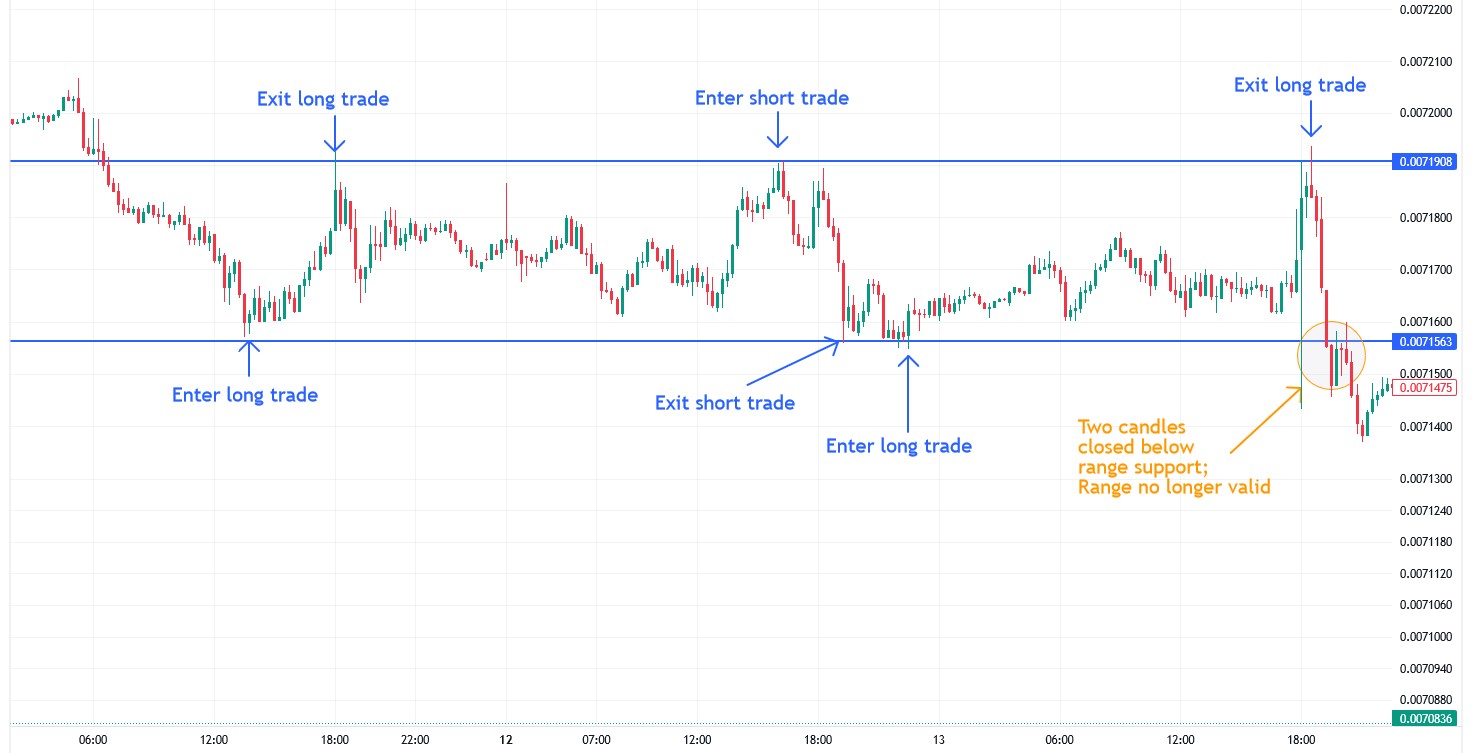
Range Trading
Range trading is a scalping strategy where a trader identifies a range within which to buy or sell over a short period. For example, if a crypto asset has a current price of $20 and you believe it will increase to $25, you will trade in the range between $20 and $25 over the next few weeks. You can buy the crypto asset at $20 and then sell it when it rises to $25. With this strategy, you will repeat the process of buying low and selling high until the crypto no longer trades in this range.
The most important feature of range trading is the risk associated. It requires precise market timing, which means knowing when and the duration a crypto asset might trade between 2 prices. If the crypto price does not move in the direction you expect, there could be losses. Range trading involves identifying significant price levels. The technical analysis strategies used with range trading include volume trends, moving averages, and support and resistance.
Support/Resistance Flips
This strategy involves watching key support and resistance levels on the charts and entering trades when the price breaks out of these zones.
First, identify clear support and resistance levels. This can be done by spotting horizontal price levels that have bounced price up or down multiple times. These become clear areas where buyers/sellers tend to enter. Mark these support and resistance (S/R) zones on your charts. Some popular ways to do this are using horizontal lines or rectangles.
Watch the price action closely around these levels. If the price breaks above resistance, this level can flip to become new support. If the price drops below support, this level can flip to become new resistance.
When you see a support/resistance flip occur, enter a short-term trade in the direction of the flip. For example, if resistance flips to support, go long. If support flips to resistance, go short. Set tight stop losses above the flip level if going short, or below the flip level if going long. This defines your risk on the trade.
Take quick profits as the price moves in your favor, scaling out of parts of the position. Crypto tends to make sharp moves so you don't need to capture the whole move.

Bid-Ask Spread
The bid-ask spread is the difference between the bid and asking prices. The bid-ask spread allows scalpers to open a position at the ask or bid price and then close the position quickly and a few points higher or lower to make a profit. In scalp trading, the bid-ask spread can happen either of two ways;
Wide Bid-Ask spread. This happens when the asking price is higher and the bid price lower than normal. This is typically caused when there are more buyers than sellers, leading to surges in prices and causing scalpers to sell.
Narrow Bid-Ask spread. The narrow bid-ask spread happens when the number of sellers outnumbers the buyers. In this case, the bid will be higher, while the asking price will be lower. Scalpers usually use this strategy to fast-track the buy-in frequency to even out the selling pressure.
Volume-based scalping
Volume-based scalping leverages trading volume spikes to detect moments of heightened market activity, often signaling potential price movements. Traders monitor volume indicators like the Volume Oscillator or On-Balance Volume (OBV) to identify anomalies.
A sudden increase in volume typically indicates strong buyer or seller interest, allowing scalpers to ride short-term momentum. For instance, after spotting a spike, a trader might quickly enter a position in the direction of the volume surge and exit as the movement stabilizes. This strategy thrives in highly liquid markets where execution speed and tight spreads are critical to capturing profits.
Breakout scalping
Breakout scalping targets significant price movements following a breakout from established levels, such as support, resistance, or trendlines. Traders use tools like Bollinger Bands or Moving Averages to identify breakout zones.
For example, when the price breaks above a resistance level with strong volume, it often signals the start of an upward trend, prompting a quick buy entry. Conversely, a break below support can indicate a downward trend, triggering a sell. Timing is crucial, as traders aim to capture profits before the price reverses or consolidates.
What is scalping in crypto trading?
Scalping or scalp trading is a short-term trading strategy that enables a trader to make small profits from daily, small movements in the price of an asset. By adding up these small profits from each trade, the trader can generate a significant amount over time. Due to the cryptocurrency market's volatility, scalping is a common strategy as scalpers usually use leverage to place more trades and tight stop losses to manage their risks.
In scalping, the main factors that determine success are speed and consistency. Crypto traders use this strategy through quick responses to market movements. Instead of holding a position for days, weeks, or even hours, scalpers tend to make their decision within minutes or seconds. To use the scalping strategy, the currency pair needs to be highly volatile because, through short bursts of volatility, there are significant movements in price, and scalpers use these price changes to generate profits.
How to make money with a crypto scalping strategy
Crypto scalping is all about building a trading system that suits your style and goals. While some traders stick to their own strategies, many share tips and methods that can help others improve. Scalping only works if you stay on top of real-time charts and technical analysis. Most scalpers open trades every 5 to 10 minutes, often using the 5-minute (M5) chart because it’s flexible and works well with other strategies. It’s not unusual for scalpers to make dozens or even hundreds of trades in a single day.
Timeframes in crypto scalping
The timeframe you choose for scalping directly affects how many trades you can make in a day. Most scalpers stick to shorter charts, usually between 5 and 30 minutes, because they offer more frequent opportunities for trades. The smaller the timeframe, the more setups you’ll see, but this depends on your strategy and comfort level. With the right plan, scalping can help you lock in multiple small wins throughout the day, which can add up to a solid profit.
Crypto scalping indicators and tools
Many tools are important for making successful trades. Some of these tools are free, and others paid, although the paid tools are considered more helpful and functional. Here are some of the tools.
Technical analysis indicators
Analysing trading charts is important for every scalp trader. Volume and price charts give vital information, and it would be impossible to develop a strategy without it. Also, aside from trading charts, tools like stop-loss help traders make logical decisions.
Crypto API tools
APIs make sure that you're able to interact with trading platforms and other blockchain-based projects. APIs provides a range of functions like transaction support, market price tracking, wallet integration, and more.
Bots
Trading bots are the most common software developed for traders. A trading bot is a predefined set of instructions that performs automated trading decisions. Human traders can't take advantage of every opportunity in the market where technology comes in. Algorithmic trading now plays a huge part in the crypto markets.
How to scalp crypto - top tips
Learning how to place orders quickly and accurately is essential for scalping. Even a slight delay or an incorrectly executed order can cost you hard-earned profits. Since each trade has a tight profit margin, precision in execution is non-negotiable.
As a new scalper, it's also important to be mindful of the costs involved in trading. Scalping often requires making up to 100 trades in one session, and all those transactions can pile up in commissions, eating into your profits. That’s why picking a crypto exchange with fair and low fees is a must. To help you with the same, we have compared the crypto exchanges offering low-cost crypto trading and scalping capabilities for you to choose from:
| Coins supported | Demo | Min. Deposit, $ | Spot Maker Fee, % | Spot Taker fee, % | Deposit fee, % | Withdrawal fee, % | Open an account | |
|---|---|---|---|---|---|---|---|---|
| 249 | No | 10 | 0.5 | 0.5 | No | Fixed fee - 25 USD PayPal - 1.5% USDC - 10 USD | Go to broker Your capital is at risk. |
|
| 329 | Yes | 10 | 0.08 | 0.1 | No | 0.0004 BTC 2.6 USDT | Go to broker Your capital is at risk. |
|
| 250 | No | 1 | 0.25 | 0.5 | No | 0.0005 BTC | Go to broker Your capital is at risk. |
|
| 278 | No | 10 | 0.25 | 0.4 | No | 0.0005 BTC | Go to broker Your capital is at risk. |
|
| 1000 | No | No | 0 | 0 | No | No | Go to broker Your capital is at risk. |
Apart from this, scalpers also need to quickly spot trends and ride the market’s momentum since trades are opened and closed within moments. Understanding how the market behaves can help you make smarter decisions and increase your chances of profiting. While many beginners find it easier to start with buying, sticking to this side initially is wise until you’ve mastered the complexities of short selling. However, with time, you’ll need to balance your skills on both sides to become a well-rounded trader.
The modern trading environment, dominated by algorithms and high-frequency trading, also operates in areas like dark pools that lack real-time transparency. For beginners, understanding the basics of technical analysis is critical to keep up with this fast-paced world of intraday trading.
As a rule of thumb, scalpers should never hold positions overnight or for extended periods, as this goes against the core principle of the strategy. Following this structure and staying disciplined can help scalpers maximize their potential and minimize unnecessary risks.
Cryptocurrency scalping risks
Fees. Considering that you will be making a large number of trades daily, which translates to substantial fees, it is important to ensure that you consider the costs of scalping before venturing into this strategy.
Leverage. For traders who prefer margin trading, scalping requires you to use a lot of leverage which is extremely risky, and more so for inexperienced traders. Using leverage like these can result in substantial losses.
Competition with bots. Using trading bots for scalp trading can be highly beneficial, but this also means that you are trading in a market that is saturated with intelligent bots. You have to compete with all of them.
Speed, patience, and commitment. Scalp trading not only requires real-time decisions but also, you have to be proactive, patient, and fast when making these decisions. This is why scalping is a high-risk trading strategy.
Put your money into predictable pairs

Scalping in crypto isn’t just about making fast trades — it’s about spotting the right moments to act. Instead of jumping into random coins, stick to pairs like BTC/USDT or ETH/USDT where the action is steady and predictable.
Use tools like heatmaps to find big buy or sell orders, which can show where prices might bounce or stall. Pair this with a short time frame chart (like 1 or 5 minutes) and watch the trading volume to make sure you’re not going against the market flow. If you’re new, try trading during busy hours, like when the New York and London markets overlap — it’s when prices move the most and give you better chances to scalp.
If you’re open to automation, give trading bots a try, but don’t overdo it. Start with simple settings — like letting the bot buy slightly below the current price and sell just above it. This trick, known as arbitrage scalping, works best when the market isn’t too crazy. Even with bots, you’ll need to tweak their settings as the market changes, so don’t leave them on autopilot. Keep things simple at first and focus on managing risks — it’s better to make small, consistent wins than to chase big trades and lose it all.
Conclusion
Mastering crypto scalping requires a keen understanding of both proven strategies and the tools that streamline fast-paced trades. Whether leveraging popular approaches like range trading or technical indicators such as the RSI, consistency and discipline remain non-negotiable for successful scalping. Newcomers should start small, perhaps practicing with paper trades, before committing significant capital in real markets. Ultimately, the most powerful edge lies not just in the strategy chosen, but in the trader's ability to rapidly adapt and manage risk—turning fleeting market moves into steady gains.
FAQs
What is the ideal timeframe for executing the best crypto scalping strategies?
Which tools can help reduce errors and improve efficiency when applying crypto scalping strategies?
What common risks should traders be aware of when using the best crypto scalping strategies?
How does market liquidity influence the effectiveness of crypto scalping strategies?
Editors' Top Picks and Insights

Bitcoin mining is getting greener, but the debate isn't over

Asia's largest IPO: How CXMT became China's most valuable company

Global fintech in 2026: Three trends that matter

From Jesus Christ to aliens: Polymarket's most absurd prediction markets

Hunting crypto owners: Why criminals have gone offline

BitMEX is shutting down: Why Trump could not save the exchange
Related Articles
Team that worked on the article
Parshwa is a content expert and finance professional possessing deep knowledge of stock and options trading, technical and fundamental analysis, and equity research. As a Chartered Accountant Finalist, Parshwa also has expertise in Forex, crypto trading, and personal taxation.
Dan Blystone began his trading career in 1998 as an arbitrage clerk on the floor of the Chicago Mercantile Exchange (CME). He later traded bond and Eurex futures at proprietary firms such as Altea Trading, gaining valuable experience in high-frequency trading and risk management.
Chinmay Soni is a financial analyst with more than 5 years of experience in working with stocks, Forex, derivatives, and other assets. As a founder of a boutique research firm and an active researcher, he covers various industries and fields, providing insights backed by statistical data.
Day trading involves buying and selling financial assets within the same trading day, with the goal of profiting from short-term price fluctuations, and positions are typically not held overnight.
Volatility refers to the degree of variation or fluctuation in the price or value of a financial asset, such as stocks, bonds, or cryptocurrencies, over a period of time. Higher volatility indicates that an asset's price is experiencing more significant and rapid price swings, while lower volatility suggests relatively stable and gradual price movements.
Uptrend is a market condition in which prices are generally rising. Uptrends can be identified by using moving averages, trendlines, and support and resistance levels.
Fundamental analysis is a method or tool that investors use that seeks to determine the intrinsic value of a security by examining economic and financial factors. It considers macroeconomic factors such as the state of the economy and industry conditions.
CFD is a contract between an investor/trader and seller that demonstrates that the trader will need to pay the price difference between the current value of the asset and its value at the time of contract to the seller.

-
 Afghanistan
-
 Albania
-
 Algeria
-
 Angola
-
 Argentina
-
 Armenia
-
 Australia
-
 Austria
-
 Azerbaijan
-
 Bahamas
-
 Bahrain
-
 Bangladesh
-
 Belarus
-
 Belgium
-
 Bolivia
-
 Botswana
-
 Brazil
-
 Brunei
-
 Bulgaria
-
 Cambodia
-
 Cameroon
-
 Canada
-
 Chile
Chile
-
 China
China
-
 Colombia
-
 Congo
Congo
-
 Costa Rica
-
 Cote d'Ivoire
-
 Croatia
-
 Cuba
Cuba
-
 Cyprus
-
 Czechia
-
 DR Congo
-
 Denmark
-
 Dominican Republic
-
 Ecuador
-
 Egypt
Egypt
-
 El Salvador
-
 Estonia
-
 Eswatini
-
 Ethiopia
-
 Finland
-
 France
-
 Georgia
-
 Germany
-
 Ghana
Ghana
-
 Greece
-
 Haiti
Haiti
-
 Hong Kong
-
 Hungary
-
 India
India
-
 Indonesia
-
 Iran, Islamic republic
-
 Iraq
Iraq
-
 Ireland
-
 Israel
-
 Italy
Italy
-
 Jamaica
-
 Japan
Japan
-
 Jordan
-
 Kazakhstan
-
 Kenya
Kenya
-
 Korea
Korea
-
 Kuwait
-
 Kyrgyzstan
-
 Laos
Laos
-
 Latvia
-
 Lebanon
-
 Lesotho
-
 Libya
Libya
-
 Lithuania
-
 Luxembourg
-
 Madagascar
-
 Malaysia
-
 Malta
Malta
-
 Mauritius
-
 Mexico
-
 Moldova
-
 Mongolia
-
 Montenegro
-
 Morocco
-
 Mozambique
-
 Myanmar
-
 Namibia
-
 Nepal
Nepal
-
 Netherlands
-
 New Zealand
-
 Nigeria
-
 North Macedonia
-
 Norway
-
 Oman
Oman
-
 Pakistan
-
 Palestine
-
 Panama
-
 Papua New Guinea
-
 Paraguay
-
 Peru
Peru
-
 Philippines
-
 Poland
-
 Portugal
-
 Puerto Rico
-
 Qatar
Qatar
-
 Reunion
-
 Romania
-
 Rwanda
-
 Saudi Arabia
-
 Serbia
-
 Singapore
-
 Slovakia
-
 Slovenia
-
 Somalia
-
 South Africa
-
 Spain
Spain
-
 Sri Lanka
-
 Sweden
-
 Switzerland
-
 Syria
Syria
-
 Taiwan
-
 Tajikistan
-
 Tanzania
-
 Thailand
-
 Trinidad and Tobago
-
 Tunisia
-
 Turkey
-
 UAE
UAE
-
 Uganda
-
 Ukraine
-
 United Kingdom
-
United States
-
 Uruguay
-
 Uzbekistan
-
 Venezuela
-
 Vietnam
-
 Yemen
Yemen
-
 Zambia
-
 Zimbabwe
- Forex
- Crypto












