
Bitcoin price prediction: BTC holds near $87,700 as geopolitical risk sustains defensive positioning

Bitcoin is oscillating near $87,693 after slipping 1.2% over the past day, reflecting renewed caution as geopolitical stress remains unresolved across multiple regions. The asset is holding a $1.75 trillion market capitalization with 24-hour trading volume near $40.47 billion, while price action stayed active between $87,632 and $90,353. Market sentiment is being shaped by fragile ceasefire dynamics in the Middle East, prolonged strategic deadlock between Russia and Europe, entrenched U.S.-China rivalry, and localized instability across emerging markets, keeping global risk premia elevated and conviction fragile.
Highlights
- Middle East ceasefire remains fragile as Gaza negotiations stall and northern border risks persist.
- Russia and Europe remain locked in a prolonged Ukraine stalemate with expanding financial pressure.
- U.S.-China rivalry continues to harden around Taiwan, reinforcing long-term geopolitical uncertainty.
Bitcoin is attempting to stabilize near $87,693 as geopolitical developments reinforce caution rather than panic. Investors are adapting to an environment where conflicts are contained but unresolved, diplomacy lacks credibility, and strategic competition is becoming structural. This backdrop limits aggressive risk-taking and keeps Bitcoin’s recovery attempts shallow despite intermittent technical rebounds.
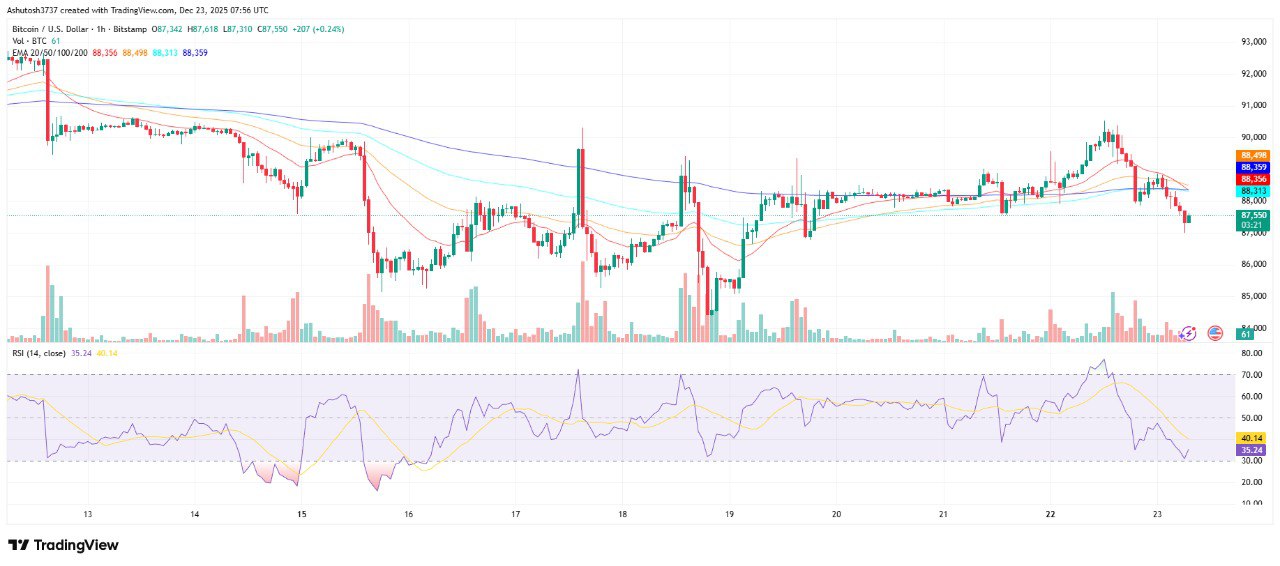
Bitcoin price dynamics (Source: TradingView)
Bitcoin consolidates as unresolved conflicts sustain elevated risk premia
The Middle East remains the dominant source of geopolitical pressure. Gaza ceasefire negotiations continue without a durable resolution, with attention shifting toward post-conflict governance and security control rather than long-term stability. Israel’s continued military pressure on Hezbollah-linked targets in southern Lebanon reinforces concerns that containment, not resolution, remains the guiding strategy. For Bitcoin and broader risk assets, this sustains background risk premia without triggering disorderly capital flight.In Europe, the Russia-Ukraine conflict remains entrenched. Diplomatic efforts are stalled over territorial recognition and long-term security guarantees, while European governments continue expanding economic and legal pressure, including frameworks to mobilize frozen Russian assets. Moscow’s rhetoric remains firm, reinforcing expectations that the conflict will extend well into 2026. This prolonged standoff continues to influence energy markets, defense spending, and European political risk assumptions.
U.S.-China relations remain structurally tense. Strategic messaging from Washington continues to emphasize deterrence and alliance building in the Indo-Pacific, while Beijing has reiterated firm opposition to external involvement around Taiwan. Taiwan’s leadership continues to accelerate defense preparedness. Economically, trade friction shows no easing, with China maintaining export strength through supply chain rerouting, confirming that the rivalry is long-term rather than cyclical.
Emerging markets add another layer of instability. Political uncertainty and security risks persist across parts of Africa, Eastern Europe, and Southeast Asia, while several large non-Western economies continue expanding local currency trade to reduce dollar exposure. These shifts highlight ongoing fragmentation in global finance and governance, contributing to a more volatile and less predictable global environment.
Analysts highlight persistent tension without immediate catalysts
Anton Kharitonov notes that geopolitical stress remains broad and unresolved, keeping risk premia elevated without delivering a single shock that would force rapid repricing.Viktoras Karapetyants explains that prolonged conflicts and strategic rivalry encourage defensive positioning rather than speculative risk-taking.
Jainam Mehta adds that geopolitical fragmentation is becoming structural, limiting Bitcoin’s ability to decouple from broader risk sentiment.
Technical view shows consolidation with downside pressure
Bitcoin is trading near $87,693, with the 20 EMA near $87,900 acting as immediate resistance and the 50 EMA around $88,700 forming a higher ceiling. The 100 EMA near $89,600 remains a key upside threshold that must be reclaimed to restore bullish structure. The RSI near 46 reflects weakening momentum consistent with cautious consolidation. A sustained move above $90,000 would improve near-term stability, while a break below $87,500 risks opening downside toward the $85,500 zone.Background and earlier analysis
In earlier analysis, Bitcoin’s movement was shaped primarily by liquidity positioning and macro caution rather than individual geopolitical shocks. Today’s environment aligns with that pattern. Geopolitical tension remains broad, persistent, and unresolved, but not yet catalytic. This keeps Bitcoin locked in a restrained consolidation phase as global fragmentation intensifies and investors remain defensively positioned.





Latest Bitcoin News










-
 Afghanistan
-
 Albania
-
 Algeria
-
 Angola
-
 Argentina
-
 Armenia
-
 Australia
-
 Austria
-
 Azerbaijan
-
 Bahamas
-
 Bahrain
-
 Bangladesh
-
 Belarus
-
 Belgium
-
 Bolivia
-
 Botswana
-
 Brazil
-
 Brunei
-
 Bulgaria
-
 Cambodia
-
 Cameroon
-
 Canada
-
 Chile
Chile
-
 China
China
-
 Colombia
-
 Congo
Congo
-
 Costa Rica
-
 Cote d'Ivoire
-
 Croatia
-
 Cuba
Cuba
-
 Cyprus
-
 Czechia
-
 DR Congo
-
 Denmark
-
 Dominican Republic
-
 Ecuador
-
 Egypt
Egypt
-
 El Salvador
-
 Estonia
-
 Eswatini
-
 Ethiopia
-
 Finland
-
 France
-
 Georgia
-
 Germany
-
 Ghana
Ghana
-
 Greece
-
 Haiti
Haiti
-
 Hong Kong
-
 Hungary
-
 India
India
-
 Indonesia
-
 Iran, Islamic republic
-
 Iraq
Iraq
-
 Ireland
-
 Israel
-
 Italy
Italy
-
 Jamaica
-
 Japan
Japan
-
 Jordan
-
 Kazakhstan
-
 Kenya
Kenya
-
 Korea
Korea
-
 Kuwait
-
 Kyrgyzstan
-
 Laos
Laos
-
 Latvia
-
 Lebanon
-
 Lesotho
-
 Libya
Libya
-
 Lithuania
-
 Luxembourg
-
 Madagascar
-
 Malaysia
-
 Malta
Malta
-
 Mauritius
-
 Mexico
-
 Moldova
-
 Mongolia
-
 Montenegro
-
 Morocco
-
 Mozambique
-
 Myanmar
-
 Namibia
-
 Nepal
Nepal
-
 Netherlands
-
 New Zealand
-
 Nigeria
-
 North Macedonia
-
 Norway
-
 Oman
Oman
-
 Pakistan
-
 Palestine
-
 Panama
-
 Papua New Guinea
-
 Paraguay
-
 Peru
Peru
-
 Philippines
-
 Poland
-
 Portugal
-
 Puerto Rico
-
 Qatar
Qatar
-
 Reunion
-
 Romania
-
 Rwanda
-
 Saudi Arabia
-
 Serbia
-
 Singapore
-
 Slovakia
-
 Slovenia
-
 Somalia
-
 South Africa
-
 Spain
Spain
-
 Sri Lanka
-
 Sweden
-
 Switzerland
-
 Syria
Syria
-
 Taiwan
-
 Tajikistan
-
 Tanzania
-
 Thailand
-
 Trinidad and Tobago
-
 Tunisia
-
 Turkey
-
 UAE
UAE
-
 Uganda
-
 Ukraine
-
 United Kingdom
-
United States
-
 Uruguay
-
 Uzbekistan
-
 Venezuela
-
 Vietnam
-
 Yemen
Yemen
-
 Zambia
-
 Zimbabwe
- Forex
- Crypto












