
Uniswap price prediction for 2030: Can BlackRock integration push UNI to $25?

This week delivered the biggest institutional catalyst in DeFi history when BlackRock announced it will bring its Treasury-backed BUIDL token onto Uniswap, purchasing an undisclosed amount of UNI tokens as part of the partnership.
Highlights
- Uniswap currently trades near $3.32, down roughly 92.4% from its all-time high of $44.92 reached in 2021.
- Technical charts show UNI in downtrend with Supertrend at $4.40 and Bollinger Bands at $4.94 overhead.
- Long-term forecasts for 2030 range from $20 to $30 if institutional tokenized assets flow through Uniswap infrastructure.
UNI benefits from BlackRock's BUIDL integration, Bitwise spot ETF filing, patent lawsuit dismissal, and fee switch activation.
Right now, Uniswap is trading around $3.32, positioned as DeFi's dominant exchange despite brutal 92% collapse from all-time highs. BlackRock's integration relies on a request-for-quote model rather than open liquidity pools, reflecting compliance needs of large financial institutions.
This means Uniswap functions as an execution and settlement layer for institutional trades. On-chain data shows aggressive positioning following the announcement, with 10 addresses executing $1 million+ transactions in 24 hours and over 175 addresses moving $100,000+.
Technical structure shows volatility after news
The daily chart reveals UNI in a sustained downtrend with the Supertrend indicator at $4.40 confirming bearish structure remains intact despite recent spike. Bollinger Bands sit at $4.94 upper band and $2.81 lower band, with price consolidating near the midband at $3.87.
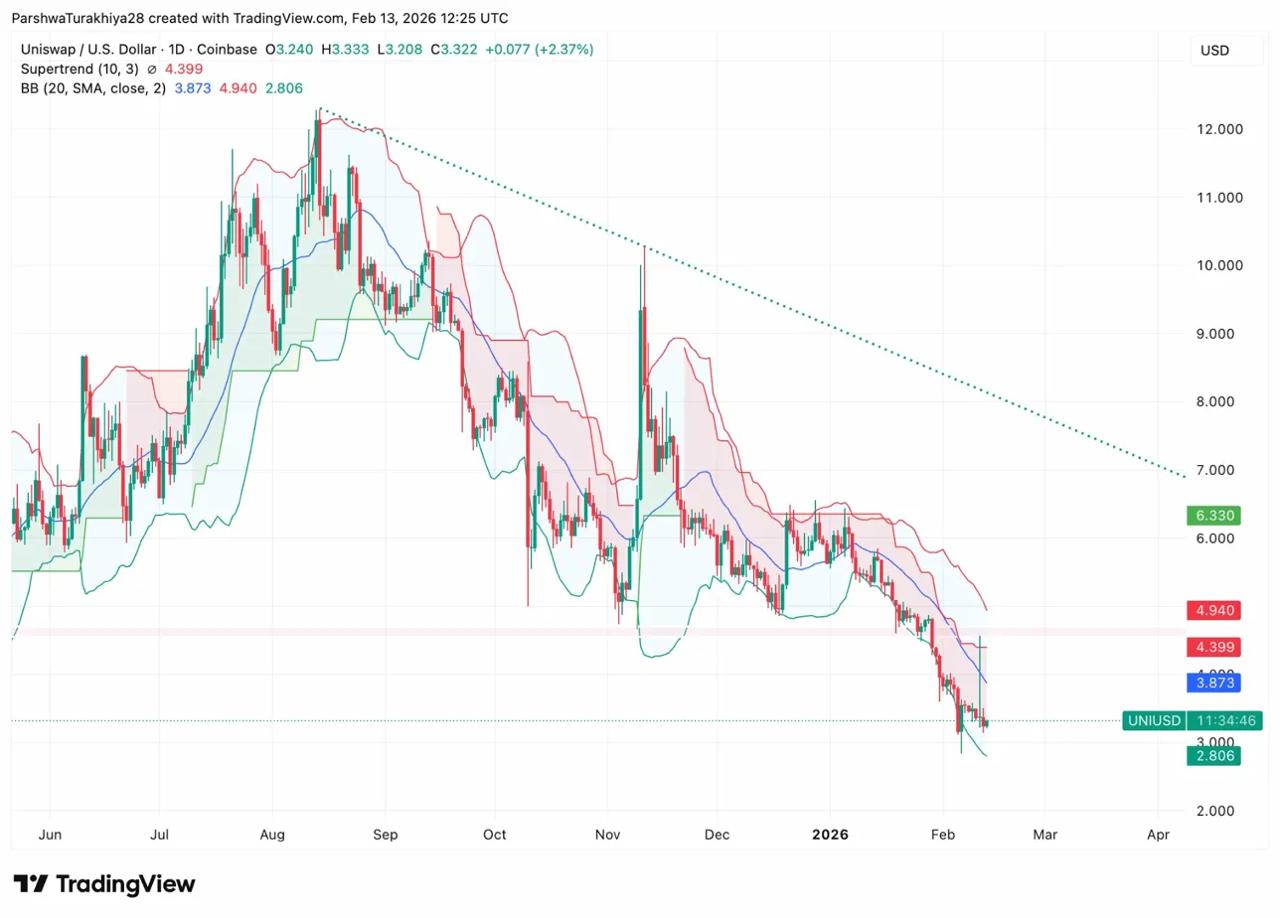
UNI price dynamics (Source: TradingView)
Price action has formed lower highs since August 2024, though the BlackRock news created the first meaningful buying pressure in months. Volume patterns show institutional accumulation with 10 addresses executing $1 million+ transactions in 24 hours. UNI needs to reclaim $5.50-$7.00 resistance to signal trend reversal.
Uniswap's 2030 outlook depends on tokenized asset adoption
Looking ahead to 2030, Uniswap's case hinges on whether tokenized real-world assets flow through DeFi infrastructure. If BlackRock's integration attracts other institutions and Bitwise's spot ETF gets approved, UNI could realistically trade between $20 and $30 by 2030. Spot trading volume surged 84% month-over-month in January, proving protocol utilization is growing despite price collapse. UNI holders approved fee switch activation and 100 million token burn (11% of supply), finally enabling revenue capture.
Judge Koeltl dismissed Bancor's patent lawsuit, ruling automated market maker formulas are abstract ideas ineligible for patent protection. This removes legal overhang and de-risks AMM innovation sector-wide. Uniswap v4 is live on 10 blockchains with custom hooks and gas savings. The $120.5 million "Uniswap Unleashed" governance plan runs through 2027 funding grants and liquidity incentives. However, whale selling pressure followed the BlackRock announcement with 6 million UNI offloaded.
What investors should monitor
Uniswap remains sensitive to institutional tokenized asset announcements and ETF approval timeline. Protocol fee revenue and v4 adoption metrics provide real demand signals. Investors should track BlackRock's BUIDL integration progress and whether other asset managers follow. The Bitwise ETF decision matters for regulatory legitimacy.
Analyst Viktoras Karapetjanc noted:
"BlackRock integrating BUIDL is the institutional validation DeFi needed. If tokenized treasuries, stocks, and bonds flow through Uniswap, current prices are absurdly cheap."By 2030, UNI's valuation will reflect whether it became the execution layer for institutional on-chain finance or remained a retail-focused DEX.
Recently we discussed that Uniswap won dismissal of Bancor's patent lawsuit, with the judge ruling AMM formulas are abstract economic concepts ineligible for patent protection.






-
 Afghanistan
-
 Albania
-
 Algeria
-
 Angola
-
 Argentina
-
 Armenia
-
 Australia
-
 Austria
-
 Azerbaijan
-
 Bahamas
-
 Bahrain
-
 Bangladesh
-
 Belarus
-
 Belgium
-
 Bolivia
-
 Botswana
-
 Brazil
-
 Brunei
-
 Bulgaria
-
 Cambodia
-
 Cameroon
-
 Canada
-
 Chile
Chile
-
 China
China
-
 Colombia
-
 Congo
Congo
-
 Costa Rica
-
 Cote d'Ivoire
-
 Croatia
-
 Cuba
Cuba
-
 Cyprus
-
 Czechia
-
 DR Congo
-
 Denmark
-
 Dominican Republic
-
 Ecuador
-
 Egypt
Egypt
-
 El Salvador
-
 Estonia
-
 Eswatini
-
 Ethiopia
-
 Finland
-
 France
-
 Georgia
-
 Germany
-
 Ghana
Ghana
-
 Greece
-
 Haiti
Haiti
-
 Hong Kong
-
 Hungary
-
 India
India
-
 Indonesia
-
 Iran, Islamic republic
-
 Iraq
Iraq
-
 Ireland
-
 Israel
-
 Italy
Italy
-
 Jamaica
-
 Japan
Japan
-
 Jordan
-
 Kazakhstan
-
 Kenya
Kenya
-
 Korea
Korea
-
 Kuwait
-
 Kyrgyzstan
-
 Laos
Laos
-
 Latvia
-
 Lebanon
-
 Lesotho
-
 Libya
Libya
-
 Lithuania
-
 Luxembourg
-
 Madagascar
-
 Malaysia
-
 Malta
Malta
-
 Mauritius
-
 Mexico
-
 Moldova
-
 Mongolia
-
 Montenegro
-
 Morocco
-
 Mozambique
-
 Myanmar
-
 Namibia
-
 Nepal
Nepal
-
 Netherlands
-
 New Zealand
-
 Nigeria
-
 North Macedonia
-
 Norway
-
 Oman
Oman
-
 Pakistan
-
 Palestine
-
 Panama
-
 Papua New Guinea
-
 Paraguay
-
 Peru
Peru
-
 Philippines
-
 Poland
-
 Portugal
-
 Puerto Rico
-
 Qatar
Qatar
-
 Reunion
-
 Romania
-
 Rwanda
-
 Saudi Arabia
-
 Serbia
-
 Singapore
-
 Slovakia
-
 Slovenia
-
 Somalia
-
 South Africa
-
 Spain
Spain
-
 Sri Lanka
-
 Sweden
-
 Switzerland
-
 Syria
Syria
-
 Taiwan
-
 Tajikistan
-
 Tanzania
-
 Thailand
-
 Trinidad and Tobago
-
 Tunisia
-
 Turkey
-
 UAE
UAE
-
 Uganda
-
 Ukraine
-
 United Kingdom
-
United States
-
 Uruguay
-
 Uzbekistan
-
 Venezuela
-
 Vietnam
-
 Yemen
Yemen
-
 Zambia
-
 Zimbabwe
- Forex
- Crypto












