
Gold price forecast: XAU consolidates near $4,516 after strong breakout

Gold is trading near $4,516 per ounce on December 26, consolidating just below record territory after briefly printing a fresh all-time high near $4,530 earlier in the session. The pause comes after one of the strongest structural rallies in modern market history, with price action reflecting controlled digestion rather than exhaustion.
Highlights
- Gold consolidates just below record highs after a controlled breakout above $4,500.
- Momentum remains elevated but stable, with pullbacks staying shallow and corrective.
- Macro risk, policy easing expectations, and central bank demand continue to anchor the trend.
The market is digesting gains, not distributing them. Unlike episodic fear-driven spikes, the current advance has been orderly, persistent, and broad-based, underpinned by macro stress, shifting monetary expectations, and sustained institutional demand.
Technical structure confirms trend dominance
From a technical perspective, gold remains firmly embedded in a powerful uptrend. On the daily chart, price is trading well above all EMAs, with the 20-day EMA near $4,319 acting as consistent dynamic support throughout December. Each minor pullback has been absorbed quickly, reinforcing buyer control and preventing any test of deeper trend levels.
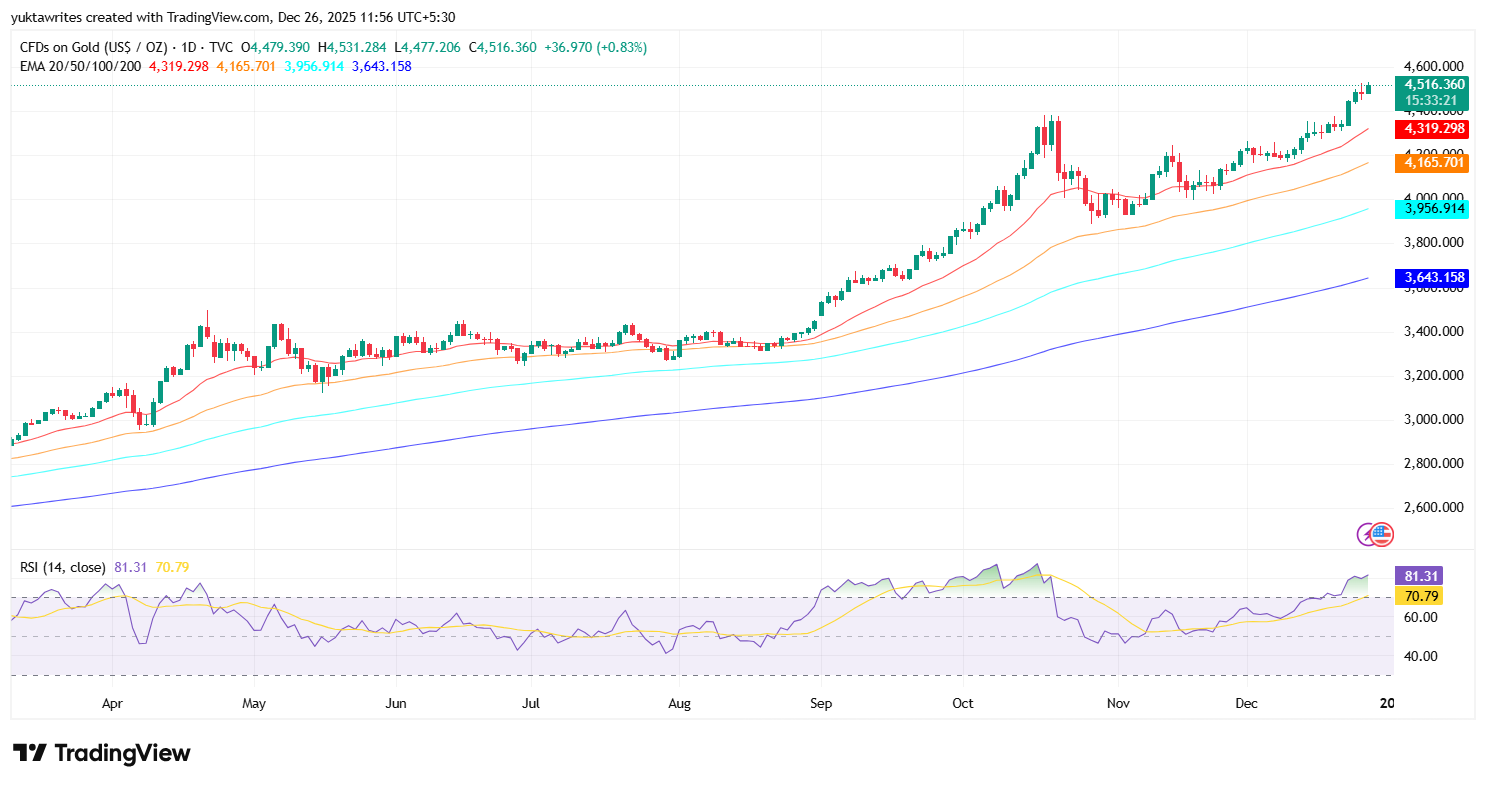
Gold price dynamics (Source: TradingView)
The 50-day EMA around $4,165 and the 100-day EMA near $3,957 continue to slope higher in clean alignment, confirming strength across multiple timeframes. The 200-day EMA, now above $3,640, highlights the scale and durability of the move. Importantly, recent consolidation has taken place far above long-term support, a hallmark of trend continuation rather than late-stage instability.
Momentum indicators reinforce this view. Daily RSI remains above 80, a level that would typically suggest overbought conditions. In strong macro-driven bull markets, however, gold has historically maintained elevated RSI readings for extended periods without triggering meaningful reversals. The current momentum profile resembles previous monetary-stress-driven extensions rather than speculative blow-offs. RSI has cooled modestly during consolidation, but it has not broken down, indicating digestion rather than exhaustion.
Intraday behavior reflects accumulation, not profit-taking
Lower-timeframe price action adds further confirmation. On the 30-minute chart, gold has reclaimed its Supertrend following a brief pullback, with Parabolic SAR dots positioned below price. The $4,480-$4,500 zone has emerged as a near-term support band, repeatedly absorbing intraday selling pressure and acting as a base for renewed upside probes.
Crucially, consolidation has taken the form of tight ranges rather than sharp retracements. Sellers have been unable to force price materially lower, even after a rapid advance. This pattern reflects strong underlying demand and disciplined positioning, not speculative churn.
Macro and geopolitical forces remain aligned
The fundamental backdrop continues to justify gold’s technical strength. Safe-haven demand remains elevated amid escalating geopolitical tensions, including the U.S. blockade of Venezuelan crude shipments, renewed hostilities between Russia and Ukraine, and recent U.S. military action against ISIS-linked targets in Nigeria. These developments have reinforced gold’s role as a defensive asset amid rising global uncertainty.
At the same time, monetary expectations have shifted decisively. Markets are increasingly confident that the Federal Reserve will begin easing policy next year, with futures pricing in at least two rate cuts as inflation moderates and labor market conditions soften. Even with Fed officials divided on timing, the direction of travel has been sufficient to push real yields lower, a key tailwind for non-yielding assets such as gold.
Currency dynamics have added another layer of support. A softer U.S. dollar, driven by easing expectations and widening fiscal concerns, has improved gold’s relative appeal for global investors, further reinforcing demand.
Structural demand reinforces the floor
Beyond short-term drivers, structural demand remains a defining feature of this rally. Gold is up more than 70% year-to-date, marking its strongest annual performance since 1979. Central bank buying has remained robust, particularly from emerging markets seeking to diversify reserves away from dollar-denominated assets.
ETF inflows have also played a stabilizing role, providing steady incremental demand rather than speculative bursts. This combination has created a durable floor beneath pullbacks and reduced the likelihood of disorderly corrections, even as prices reach historic levels.
In earlier analysis, gold’s ability to hold elevated levels without sharp drawdowns was highlighted as a key signal of structural strength. That theme remains intact. Each consolidation phase over recent months has resolved higher, not lower, reinforcing the view that the market is accumulating rather than distributing.
Looking ahead, the $4,500 level now serves as both a psychological and technical pivot. Sustained acceptance above this zone would open the door to further trend extension. Near-term pullbacks toward $4,320 or even $4,165 would likely be viewed as corrective within the broader uptrend rather than trend-threatening.
For now, gold remains firmly in control, consolidating strength just below record highs as macro uncertainty, policy expectations, and institutional demand continue to favor the metal over risk-sensitive assets.





Latest XAU/USD News










-
 Afghanistan
-
 Albania
-
 Algeria
-
 Angola
-
 Argentina
-
 Armenia
-
 Australia
-
 Austria
-
 Azerbaijan
-
 Bahamas
-
 Bahrain
-
 Bangladesh
-
 Belarus
-
 Belgium
-
 Bolivia
-
 Botswana
-
 Brazil
-
 Brunei
-
 Bulgaria
-
 Cambodia
-
 Cameroon
-
 Canada
-
 Chile
Chile
-
 China
China
-
 Colombia
-
 Congo
Congo
-
 Costa Rica
-
 Cote d'Ivoire
-
 Croatia
-
 Cuba
Cuba
-
 Cyprus
-
 Czechia
-
 DR Congo
-
 Denmark
-
 Dominican Republic
-
 Ecuador
-
 Egypt
Egypt
-
 El Salvador
-
 Estonia
-
 Eswatini
-
 Ethiopia
-
 Finland
-
 France
-
 Georgia
-
 Germany
-
 Ghana
Ghana
-
 Greece
-
 Haiti
Haiti
-
 Hong Kong
-
 Hungary
-
 India
India
-
 Indonesia
-
 Iran, Islamic republic
-
 Iraq
Iraq
-
 Ireland
-
 Israel
-
 Italy
Italy
-
 Jamaica
-
 Japan
Japan
-
 Jordan
-
 Kazakhstan
-
 Kenya
Kenya
-
 Korea
Korea
-
 Kuwait
-
 Kyrgyzstan
-
 Laos
Laos
-
 Latvia
-
 Lebanon
-
 Lesotho
-
 Libya
Libya
-
 Lithuania
-
 Luxembourg
-
 Madagascar
-
 Malaysia
-
 Malta
Malta
-
 Mauritius
-
 Mexico
-
 Moldova
-
 Mongolia
-
 Montenegro
-
 Morocco
-
 Mozambique
-
 Myanmar
-
 Namibia
-
 Nepal
Nepal
-
 Netherlands
-
 New Zealand
-
 Nigeria
-
 North Macedonia
-
 Norway
-
 Oman
Oman
-
 Pakistan
-
 Palestine
-
 Panama
-
 Papua New Guinea
-
 Paraguay
-
 Peru
Peru
-
 Philippines
-
 Poland
-
 Portugal
-
 Puerto Rico
-
 Qatar
Qatar
-
 Reunion
-
 Romania
-
 Rwanda
-
 Saudi Arabia
-
 Serbia
-
 Singapore
-
 Slovakia
-
 Slovenia
-
 Somalia
-
 South Africa
-
 Spain
Spain
-
 Sri Lanka
-
 Sweden
-
 Switzerland
-
 Syria
Syria
-
 Taiwan
-
 Tajikistan
-
 Tanzania
-
 Thailand
-
 Trinidad and Tobago
-
 Tunisia
-
 Turkey
-
 UAE
UAE
-
 Uganda
-
 Ukraine
-
 United Kingdom
-
United States
-
 Uruguay
-
 Uzbekistan
-
 Venezuela
-
 Vietnam
-
 Yemen
Yemen
-
 Zambia
-
 Zimbabwe
- Forex
- Crypto












