

Nvidia stock climbs 1.2% as China clears path for H200 chip orders
As of January 26, Nvidia stock is trading at $186.83, up 1.2% in the past 24 hours. The stock has recovered moderately from recent weakness but remains well off its November highs. Nvidia has seen increased volatility in January.
Highlights
- Nvidia shares gained 1.2% after reports that Chinese firms like Alibaba and Tencent received approval to prepare orders for H200 chips.
- Technical indicators show the stock consolidating between $180 and $195, with key resistance near $200.
- A confirmed breakout or breakdown from this range will likely set the short-term direction.
On the technical side, Nvidia's stock is holding above immediate support near the $180 level, which coincides with its 20-day moving average and has acted as a pivot point for much of the month. Below that, $175 serves as stronger support, with $170 as the critical floor in the near term.
On the upside, resistance is forming in the $190–$195 zone. A sustained move above $195 would put the psychological $200 level back in play, followed by the December peak around $210–$212. Nvidia’s 50-day moving average is currently near $185 and is being tested for the third time in two weeks. A decisive break above this average would improve short-term momentum.
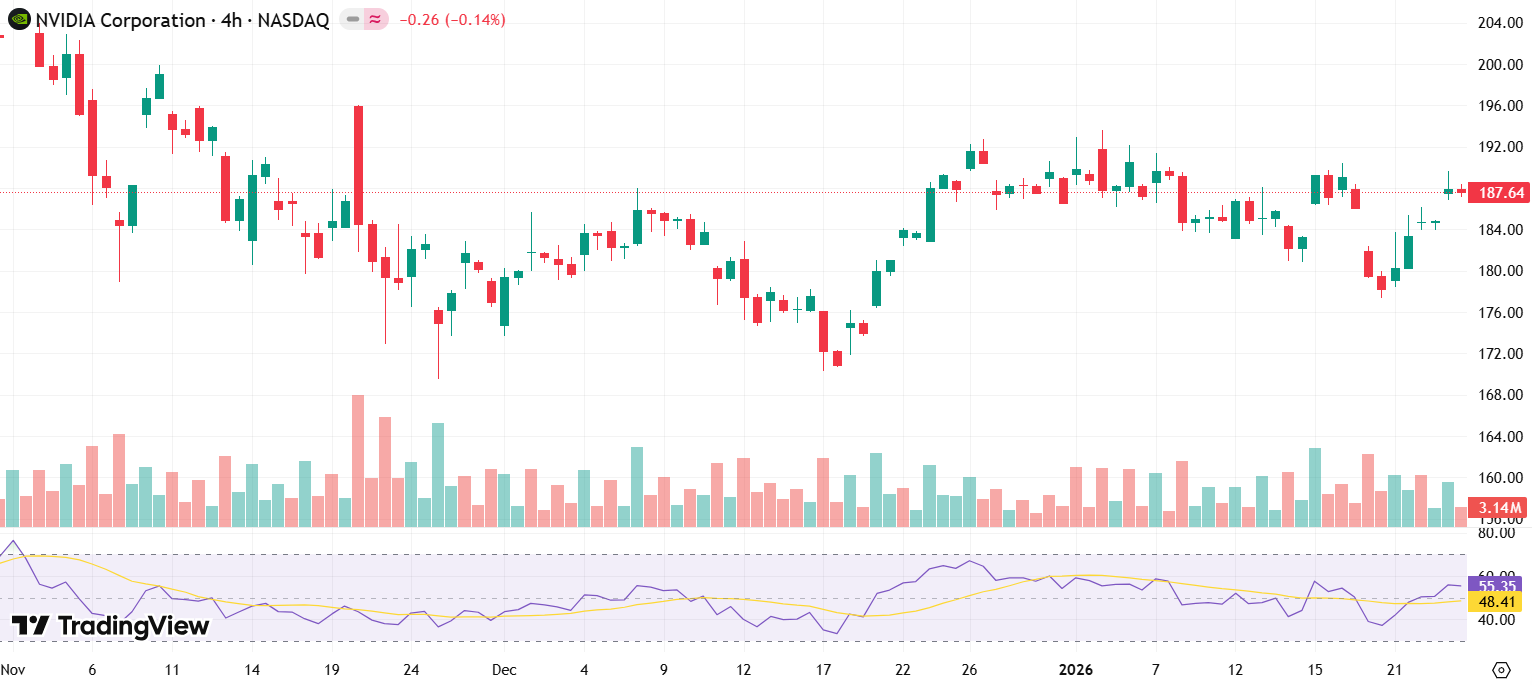
Nvidia stock price dynamics (November 2025 - January 2025). Source: TradingView
Momentum indicators remain mixed. The Relative Strength Index (RSI) hovers around 52, indicating neutral sentiment with no immediate overbought or oversold conditions. The MACD is flatlining, suggesting a lack of directional bias. Volume has also remained relatively subdued over the past week, showing no strong accumulation by institutional buyers. These conditions highlight a market in waiting mode, with participants eyeing the next catalyst to determine short-term trend direction.
China chip order thaw lifts sentiment, but uncertainty persists
China’s top tech firms—including Alibaba, Tencent, and ByteDance—have received permission from authorities to prepare orders for Nvidia’s H200 chips. The news marks a reversal from prior headlines earlier in January that Chinese regulators had blocked H200 shipments due to national security concerns, despite U.S. clearance for export.
According to sources, China’s Ministry of Industry and Information Technology has granted preliminary approval for these companies to engage Nvidia and its distributors to place orders, pending final sign-off. This move is viewed by analysts as a potential olive branch amid broader U.S.-China tech tensions, though full implementation remains uncertain. Shares of Nvidia climbed over 1% following the news, reflecting improved market sentiment.
Still, analysts caution that this reprieve may be temporary or symbolic. China’s broader policy push for semiconductor independence has not shifted, and there is no formal assurance that Nvidia’s chips will be delivered at scale. Earlier in the month, Chinese regulators had asked data center firms to pause Nvidia chip orders, raising concerns about long-term viability of the company’s China revenue stream. While the H200 is not subject to the same export bans as the A100 or H100 chips, the regulatory and geopolitical environment remains fluid.
Key levels at $180–$195 may determine Nvidia’s next breakout or breakdown
Nvidia’s stock is approaching a technical inflection point. The base-case scenario sees the stock consolidating between $180 and $195 in the short term, with the possibility of a breakout if China H200 approvals are confirmed with meaningful volume. Should the stock clear $195 and sustain momentum above $200, a retest of the $210–$212 November highs becomes viable. This bullish scenario would require confirmation via improved volume and continued AI infrastructure spending in Q1.
The bearish scenario involves Nvidia falling back below $180. A breakdown through $175 support could trigger accelerated selling, bringing $160 into focus. Macro risks—such as rising bond yields, further U.S.-China tech restrictions, or weaker-than-expected earnings—could catalyze this downside move.
At the World Economic Forum in Davos, Nvidia CEO Jensen Huang highlighted the massive infrastructure investment needed to support global AI growth. His statement that the era of artificial intelligence is "just beginning" reinforced market confidence in Nvidia’s central role in the future of technology.







-
 Afghanistan
-
 Albania
-
 Algeria
-
 Angola
-
 Argentina
-
 Armenia
-
 Australia
-
 Austria
-
 Azerbaijan
-
 Bahamas
-
 Bahrain
-
 Bangladesh
-
 Belarus
-
 Belgium
-
 Bolivia
-
 Botswana
-
 Brazil
-
 Brunei
-
 Bulgaria
-
 Cambodia
-
 Cameroon
-
 Canada
-
 Chile
Chile
-
 China
China
-
 Colombia
-
 Congo
Congo
-
 Costa Rica
-
 Cote d'Ivoire
-
 Croatia
-
 Cuba
Cuba
-
 Cyprus
-
 Czechia
-
 DR Congo
-
 Denmark
-
 Dominican Republic
-
 Ecuador
-
 Egypt
Egypt
-
 El Salvador
-
 Estonia
-
 Eswatini
-
 Ethiopia
-
 Finland
-
 France
-
 Georgia
-
 Germany
-
 Ghana
Ghana
-
 Greece
-
 Haiti
Haiti
-
 Hong Kong
-
 Hungary
-
 India
India
-
 Indonesia
-
 Iran, Islamic republic
-
 Iraq
Iraq
-
 Ireland
-
 Israel
-
 Italy
Italy
-
 Jamaica
-
 Japan
Japan
-
 Jordan
-
 Kazakhstan
-
 Kenya
Kenya
-
 Korea
Korea
-
 Kuwait
-
 Kyrgyzstan
-
 Laos
Laos
-
 Latvia
-
 Lebanon
-
 Lesotho
-
 Libya
Libya
-
 Lithuania
-
 Luxembourg
-
 Madagascar
-
 Malaysia
-
 Malta
Malta
-
 Mauritius
-
 Mexico
-
 Moldova
-
 Mongolia
-
 Montenegro
-
 Morocco
-
 Mozambique
-
 Myanmar
-
 Namibia
-
 Nepal
Nepal
-
 Netherlands
-
 New Zealand
-
 Nigeria
-
 North Macedonia
-
 Norway
-
 Oman
Oman
-
 Pakistan
-
 Palestine
-
 Panama
-
 Papua New Guinea
-
 Paraguay
-
 Peru
Peru
-
 Philippines
-
 Poland
-
 Portugal
-
 Puerto Rico
-
 Qatar
Qatar
-
 Reunion
-
 Romania
-
 Rwanda
-
 Saudi Arabia
-
 Serbia
-
 Singapore
-
 Slovakia
-
 Slovenia
-
 Somalia
-
 South Africa
-
 Spain
Spain
-
 Sri Lanka
-
 Sweden
-
 Switzerland
-
 Syria
Syria
-
 Taiwan
-
 Tajikistan
-
 Tanzania
-
 Thailand
-
 Trinidad and Tobago
-
 Tunisia
-
 Turkey
-
 UAE
UAE
-
 Uganda
-
 Ukraine
-
 United Kingdom
-
United States
-
 Uruguay
-
 Uzbekistan
-
 Venezuela
-
 Vietnam
-
 Yemen
Yemen
-
 Zambia
-
 Zimbabwe
- Forex
- Crypto












