
Silver price crashes below $86 as leverage unwind sparks historic selloff

Silver is trading at $85.34, down 25.5% in the last trading session, marking one of the sharpest single-day declines in the modern history. The collapse follows an extended parabolic rally and reflects an aggressive unwinding of leveraged positions.
Highlights
- Silver crashed 25.5% to $85.34 in a single session, driven by aggressive unwinding of leveraged positions after an extended parabolic rally.
- The selloff erased multiple key support levels, shifting the short-term technical outlook decisively bearish and pushing volatility sharply higher.
- Until silver stabilizes above major support, risks remain tilted toward further downside and choppy consolidation
From a technical perspective, silver’s price action has shifted decisively from a momentum-driven uptrend to a disorderly correction. Prior to the crash, silver had been trading well above all major moving averages, with price stretched nearly 40% above the 50-day simple moving average and more than 60% above the 200-day average. Such deviations historically signal an unstable trend vulnerable to sharp mean reversion.
The 24-hour collapse sliced through multiple layers of support without pause. The former support zone near $110 failed almost immediately, followed by a clean break below the psychological $100 level, which had acted as a consolidation floor during the previous advance. The speed of the move suggests forced liquidation rather than discretionary selling.
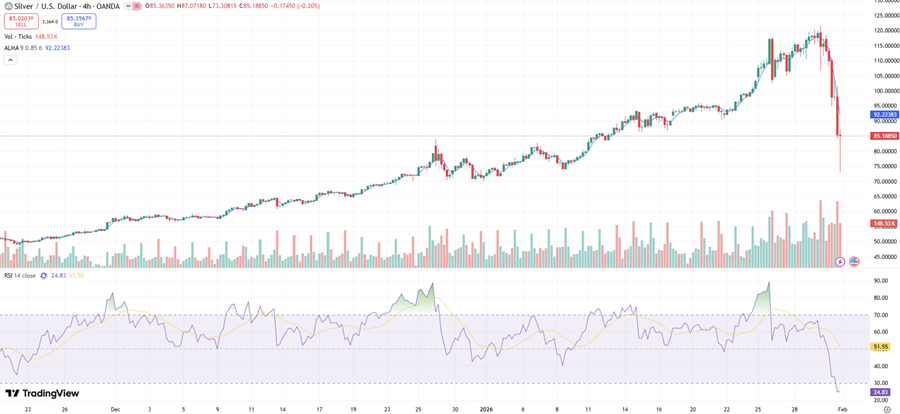
Silver price dynamics (November 2025 - January 2025). Source: TradingView
Silver is now trading below its short-term moving averages, while momentum indicators have flipped decisively bearish. The relative strength index, which had been deeply overbought during the rally, has plunged into oversold territory in a single session, highlighting the violence of the reversal rather than signaling an immediate bottom. Volatility has expanded sharply, a typical feature of silver market tops.
Leverage shock and sentiment reversal drive the collapse
The selloff cannot be explained by fundamentals alone. Instead, it reflects a classic leverage shock in a market that had become overcrowded on the long side. Silver’s rally was fueled by a combination of inflation hedging, speculative momentum trading, and retail participation, all of which tend to amplify price swings once volatility spikes.
As prices accelerated higher, leverage built rapidly through futures and derivatives. When the market finally turned, margin calls and forced selling cascaded through the system, overwhelming available liquidity. Silver, unlike gold, has a smaller and thinner market structure, which makes it particularly sensitive to rapid shifts in positioning.
The broader market environment also played a role. A reassessment of macro expectations triggered a sharp reversal in risk appetite, prompting investors to cut exposure to high-volatility assets. In that context, silver was treated less as a safe haven and more as a speculative instrument, leading to outsized losses relative to gold.
Price outlook points to volatile consolidation or further downside
Looking ahead, the short-term outlook for silver remains fragile. In the bearish scenario, continued deleveraging could push prices toward the $78–80 support zone, with a break opening the door to $70–72. This outcome would likely be accompanied by persistently high volatility and failed rebound attempts.
In a stabilization scenario, silver may attempt to base between $80 and $95 as forced selling subsides and opportunistic buyers step in. Such a phase would likely involve wide intraday swings and multiple false breakouts, reflecting ongoing uncertainty rather than renewed bullish conviction.
Markets sold off as traders locked in profits and reassessed positioning after Donald Trump nominated Kevin Warsh as the next Federal Reserve Chair. The choice was perceived as hawkish, given Warsh’s preference for a strong U.S. dollar, triggering a sharp risk-off reaction on Friday.


Latest XAG/USD News







-
 Afghanistan
-
 Albania
-
 Algeria
-
 Angola
-
 Argentina
-
 Armenia
-
 Australia
-
 Austria
-
 Azerbaijan
-
 Bahamas
-
 Bahrain
-
 Bangladesh
-
 Belarus
-
 Belgium
-
 Bolivia
-
 Botswana
-
 Brazil
-
 Brunei
-
 Bulgaria
-
 Cambodia
-
 Cameroon
-
 Canada
-
 Chile
Chile
-
 China
China
-
 Colombia
-
 Congo
Congo
-
 Costa Rica
-
 Cote d'Ivoire
-
 Croatia
-
 Cuba
Cuba
-
 Cyprus
-
 Czechia
-
 DR Congo
-
 Denmark
-
 Dominican Republic
-
 Ecuador
-
 Egypt
Egypt
-
 El Salvador
-
 Estonia
-
 Eswatini
-
 Ethiopia
-
 Finland
-
 France
-
 Georgia
-
 Germany
-
 Ghana
Ghana
-
 Greece
-
 Haiti
Haiti
-
 Hong Kong
-
 Hungary
-
 India
India
-
 Indonesia
-
 Iran, Islamic republic
-
 Iraq
Iraq
-
 Ireland
-
 Israel
-
 Italy
Italy
-
 Jamaica
-
 Japan
Japan
-
 Jordan
-
 Kazakhstan
-
 Kenya
Kenya
-
 Korea
Korea
-
 Kuwait
-
 Kyrgyzstan
-
 Laos
Laos
-
 Latvia
-
 Lebanon
-
 Lesotho
-
 Libya
Libya
-
 Lithuania
-
 Luxembourg
-
 Madagascar
-
 Malaysia
-
 Malta
Malta
-
 Mauritius
-
 Mexico
-
 Moldova
-
 Mongolia
-
 Montenegro
-
 Morocco
-
 Mozambique
-
 Myanmar
-
 Namibia
-
 Nepal
Nepal
-
 Netherlands
-
 New Zealand
-
 Nigeria
-
 North Macedonia
-
 Norway
-
 Oman
Oman
-
 Pakistan
-
 Palestine
-
 Panama
-
 Papua New Guinea
-
 Paraguay
-
 Peru
Peru
-
 Philippines
-
 Poland
-
 Portugal
-
 Puerto Rico
-
 Qatar
Qatar
-
 Reunion
-
 Romania
-
 Rwanda
-
 Saudi Arabia
-
 Serbia
-
 Singapore
-
 Slovakia
-
 Slovenia
-
 Somalia
-
 South Africa
-
 Spain
Spain
-
 Sri Lanka
-
 Sweden
-
 Switzerland
-
 Syria
Syria
-
 Taiwan
-
 Tajikistan
-
 Tanzania
-
 Thailand
-
 Trinidad and Tobago
-
 Tunisia
-
 Turkey
-
 UAE
UAE
-
 Uganda
-
 Ukraine
-
 United Kingdom
-
United States
-
 Uruguay
-
 Uzbekistan
-
 Venezuela
-
 Vietnam
-
 Yemen
Yemen
-
 Zambia
-
 Zimbabwe
- Forex
- Crypto












