
Natural gas price forecast: Breakdown below $3.2 exposes market to deeper slide

U.S. natural gas futures tumbled 2.55% to $3.14 per MMBtu, slipping decisively below the key $3.20 support zone and marking fresh multi-week lows. The decline underscores persistent bearish pressure driven by warm weather forecasts and ample supply, even as signs of rising international demand begin to emerge.
Highlights
- Natural gas falls to $3.14, breaking below critical $3.20 support.
- Supertrend at $4.64 confirms dominant downtrend remains intact.
- India signals stronger U.S. LNG demand as part of import expansion
The move below $3.20 represents a significant technical breach, as that level had acted as a floor for much of 2025. With spring approaching and heating demand fading, traders appear reluctant to rebuild long exposure.
Technical damage accelerates downside risk
From a chart perspective, the structure has deteriorated sharply. The Supertrend indicator, positioned near $4.64, remains firmly bearish, while the Parabolic SAR at $5.45 highlights the scale of the decline from January’s $7.5 spike. Prices are now trading well beneath all major resistance levels, reinforcing the strength of the prevailing downtrend.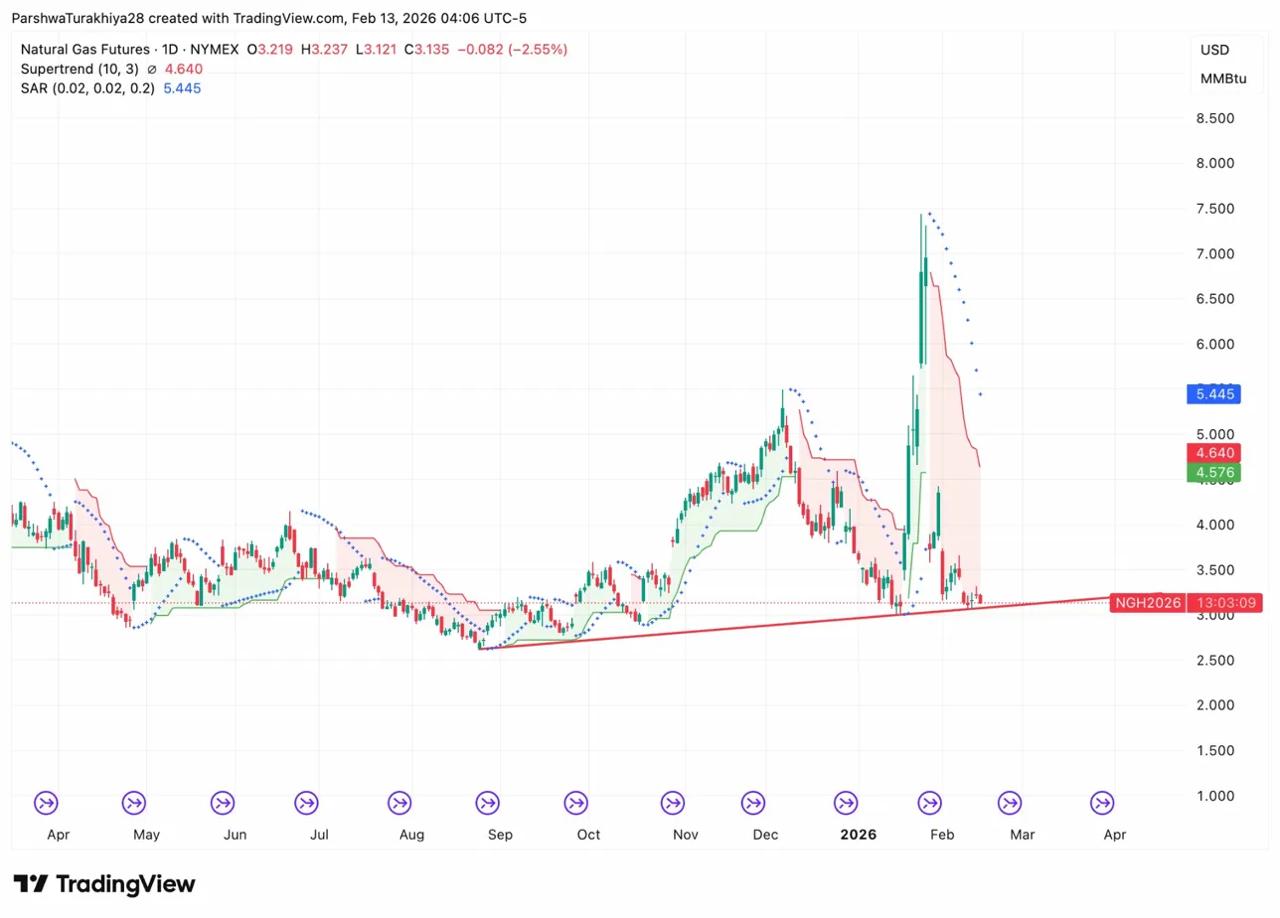
Natural gas price dynamics (Source: TradingView)
The breakdown of the $3.2–$3 zone shifts focus toward the $2.8–$3 region, levels not seen since 2024. Momentum remains negative, and the market has consistently rejected rallies above $5 throughout early 2025, establishing a pattern of lower highs. With no meaningful technical support until the upper $2.7 range, the path of least resistance remains lower unless a fundamental catalyst emerges.
The failure to hold the long-standing support band signals that speculative positioning tied to winter volatility has largely unwound, leaving sentiment fragile heading into the shoulder season.
International demand offers longer-term support
While domestic factors remain bearish, developments abroad may eventually provide a stabilizing influence. India’s Petronet LNG chief confirmed the country would purchase U.S. LNG at competitive prices, aligning with broader efforts to expand imports following recent tariff adjustments. India, currently the world’s fourth-largest LNG buyer, aims to raise natural gas’s share in its energy mix to 15% by 2030 from about 6%.The country operates roughly 27,000 megawatts of gas-fired power capacity at only 25% utilization, constrained by high fuel costs. Lower LNG prices could unlock significant latent demand across power generation, fertilizers, refining, and city gas networks. Petronet is also advancing expansion plans, including development of a new east coast terminal.
Separately, ConocoPhillips announced a $2.1 billion investment to restart production at Norway’s Greater Ekofisk fields by late 2028, targeting 90 to 120 million barrels of oil equivalent in gas and condensate. Such long-term capital commitments suggest confidence in structural gas demand despite current price weakness.
As previously discussed, natural gas has struggled to sustain gains following its winter spike, with elevated volatility and heavy speculative flows amplifying moves in both directions. The latest breakdown confirms technical weakness, but expanding LNG demand in Asia and Europe may form a longer-term floor once domestic oversupply stabilizes.





Latest Natural Gas News








-
 Afghanistan
-
 Albania
-
 Algeria
-
 Angola
-
 Argentina
-
 Armenia
-
 Australia
-
 Austria
-
 Azerbaijan
-
 Bahamas
-
 Bahrain
-
 Bangladesh
-
 Belarus
-
 Belgium
-
 Bolivia
-
 Botswana
-
 Brazil
-
 Brunei
-
 Bulgaria
-
 Cambodia
-
 Cameroon
-
 Canada
-
 Chile
Chile
-
 China
China
-
 Colombia
-
 Congo
Congo
-
 Costa Rica
-
 Cote d'Ivoire
-
 Croatia
-
 Cuba
Cuba
-
 Cyprus
-
 Czechia
-
 DR Congo
-
 Denmark
-
 Dominican Republic
-
 Ecuador
-
 Egypt
Egypt
-
 El Salvador
-
 Estonia
-
 Eswatini
-
 Ethiopia
-
 Finland
-
 France
-
 Georgia
-
 Germany
-
 Ghana
Ghana
-
 Greece
-
 Haiti
Haiti
-
 Hong Kong
-
 Hungary
-
 India
India
-
 Indonesia
-
 Iran, Islamic republic
-
 Iraq
Iraq
-
 Ireland
-
 Israel
-
 Italy
Italy
-
 Jamaica
-
 Japan
Japan
-
 Jordan
-
 Kazakhstan
-
 Kenya
Kenya
-
 Korea
Korea
-
 Kuwait
-
 Kyrgyzstan
-
 Laos
Laos
-
 Latvia
-
 Lebanon
-
 Lesotho
-
 Libya
Libya
-
 Lithuania
-
 Luxembourg
-
 Madagascar
-
 Malaysia
-
 Malta
Malta
-
 Mauritius
-
 Mexico
-
 Moldova
-
 Mongolia
-
 Montenegro
-
 Morocco
-
 Mozambique
-
 Myanmar
-
 Namibia
-
 Nepal
Nepal
-
 Netherlands
-
 New Zealand
-
 Nigeria
-
 North Macedonia
-
 Norway
-
 Oman
Oman
-
 Pakistan
-
 Palestine
-
 Panama
-
 Papua New Guinea
-
 Paraguay
-
 Peru
Peru
-
 Philippines
-
 Poland
-
 Portugal
-
 Puerto Rico
-
 Qatar
Qatar
-
 Reunion
-
 Romania
-
 Rwanda
-
 Saudi Arabia
-
 Serbia
-
 Singapore
-
 Slovakia
-
 Slovenia
-
 Somalia
-
 South Africa
-
 Spain
Spain
-
 Sri Lanka
-
 Sweden
-
 Switzerland
-
 Syria
Syria
-
 Taiwan
-
 Tajikistan
-
 Tanzania
-
 Thailand
-
 Trinidad and Tobago
-
 Tunisia
-
 Turkey
-
 UAE
UAE
-
 Uganda
-
 Ukraine
-
 United Kingdom
-
United States
-
 Uruguay
-
 Uzbekistan
-
 Venezuela
-
 Vietnam
-
 Yemen
Yemen
-
 Zambia
-
 Zimbabwe
- Forex
- Crypto












