
Natural gas price forecast: Gas steadies near $3 as Qatar outage keeps supply risk elevated
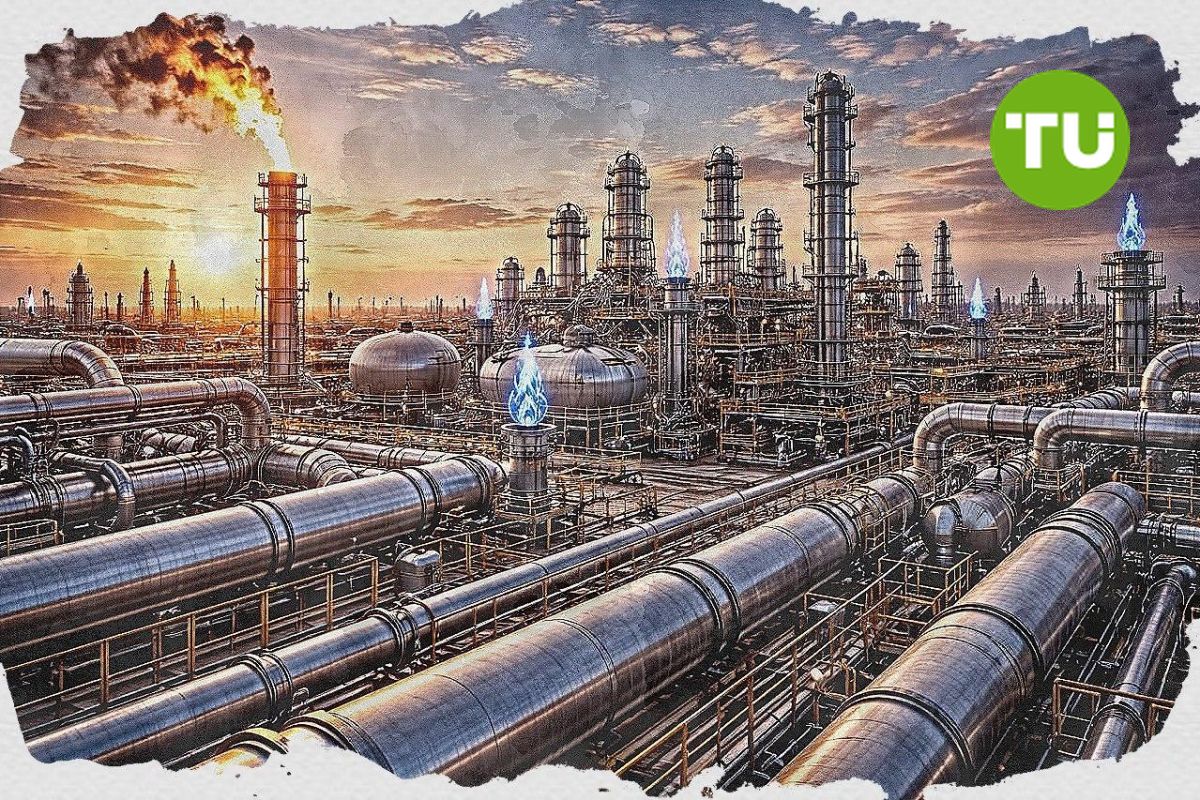
Natural gas futures are currently at ~$2.97 per MMBtu and remain stable just above a major long-term level of support following a steep drop from January's peak of above $7. The panic-driven high has eased in the market, with worries about supply disruptions connected with Qatar and the Strait of Hormuz preventing further drops.
Highlights
- Natural gas holds near $2.97 above a key trendline support around $2.9 to $3.
- Qatar’s LNG halt keeps global supply risk elevated across Europe and Asia.
- The $3.13 to $3.6 EMA band remains the main resistance zone for any rebound.
The market now sits at a clear turning point. The panic-driven premium seen earlier this year has mostly disappeared, yet geopolitical tensions continue to keep volatility elevated. Traders are closely watching the $2.9 level to see if it can hold long enough for prices to establish a base.
Support holds, but the chart remains fragile
Technically, natural gas remains in a corrective structure. Price is below the full EMAs band, with the 20-day EMA close to $3.13, the 50-day about $3.48, and the 100- and 200-day EMAs close to $3.63 and $3.59. That stacked resistance between $3.10 and $3.60 remains a cap on upside attempts.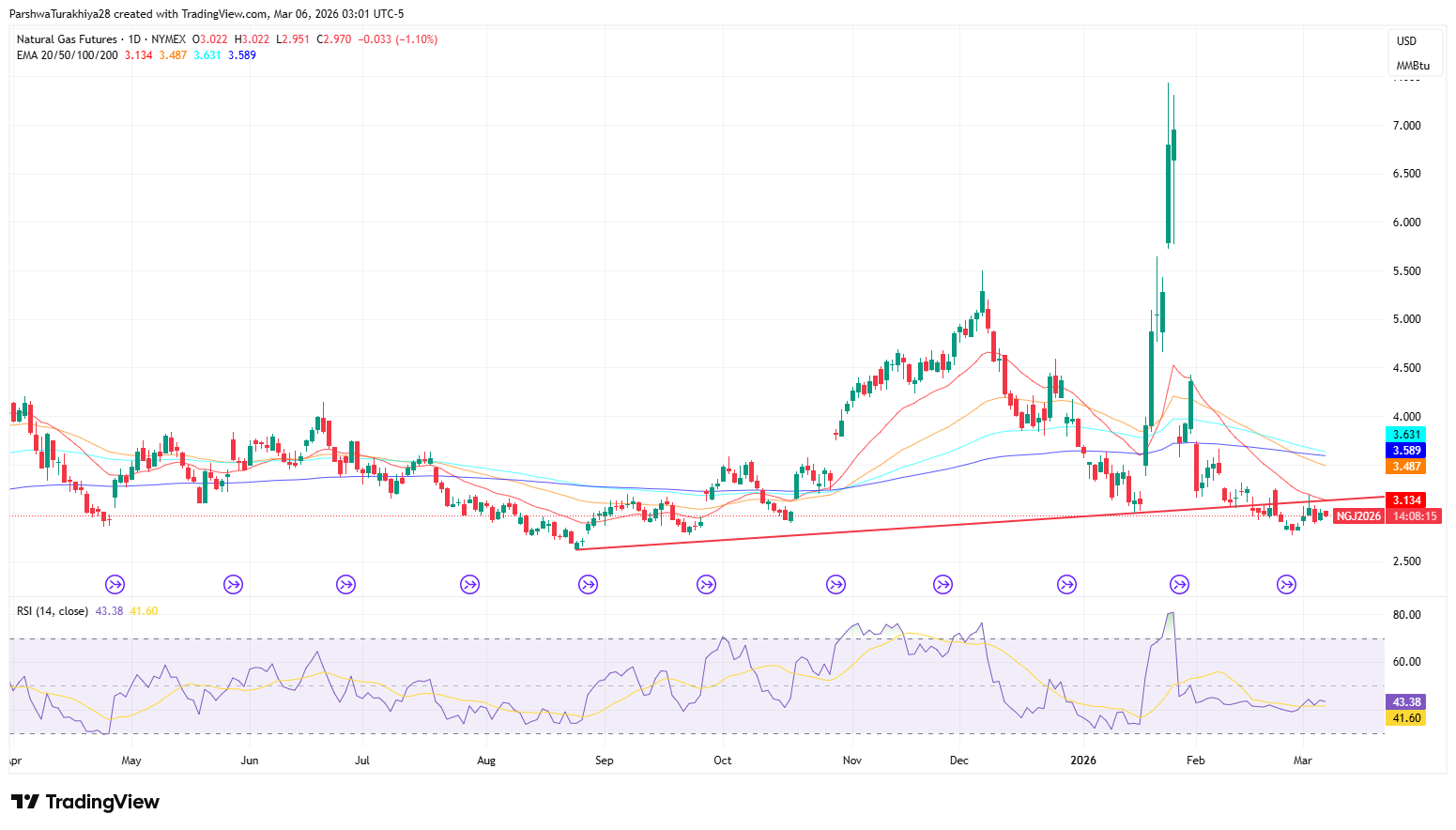
Natural gas price dynamics (Source: TradingView)
That trendline at $2.9-$3 is the critical technical level. So long as it holds, it remains in stabilization mode for the market. A clean break below it would reveal $2.7 and then $2.5, providing evidence that the geopolitical spike has now completely gone away. From the upside, first the bulls require a move above $3.13 before the pull to the higher $3.4 to $3.5 line. Only then would the chart begin to imply a broader recovery.
Qatar disruption keeps the fundamental floor in place
The main fundamental support comes from global LNG supply disruption. Qatar, responsible for about a fifth of world LNG exports, has halted production, while severe disruption to shipping through the Strait of Hormuz has tightened supply expectations across Asia and Europe.Assuming that the conflict ends quickly, restarting liquefaction operations won’t be simple to do immediately. LNG facilities need to be cooled down and restarted slowly, which means it may take weeks for export levels to return to normal.
That delay is key, in part because it maintains a premium on prices even after speculative trading slows down. Europe is already feeling the effects of this situation. Dutch TTF prices spiked earlier this week as traders anticipated the possibility of extended LNG disruptions, and lower storage levels could make it harder to replenish inventories before winter arrives.
Natural gas price outlook
Analyst Anton Kharitonov said, “The January spike proved how quickly gas can reprice when supply risk enters the equation. What matters now is that Qatar represents nearly one-fifth of global LNG exports. Even a short disruption forces traders to rethink the entire balance sheet. If flows through Hormuz stay uncertain, $3 stops being a floor built on charts and becomes a floor built on physics.”As previously discussed, natural gas has been trying to find equilibrium after a violent panic rally and collapse. The difference now is that physical supply risk has not fully disappeared. That leaves $2.90 as the line separating stabilization from another downside leg.





Latest Natural Gas News



-
 Afghanistan
-
 Albania
-
 Algeria
-
 Angola
-
 Argentina
-
 Armenia
-
 Australia
-
 Austria
-
 Azerbaijan
-
 Bahamas
-
 Bahrain
-
 Bangladesh
-
 Belarus
-
 Belgium
-
 Bolivia
-
 Botswana
-
 Brazil
-
 Brunei
-
 Bulgaria
-
 Cambodia
-
 Cameroon
-
 Canada
-
 Chile
Chile
-
 China
China
-
 Colombia
-
 Congo
Congo
-
 Costa Rica
-
 Cote d'Ivoire
-
 Croatia
-
 Cuba
Cuba
-
 Cyprus
-
 Czechia
-
 DR Congo
-
 Denmark
-
 Dominican Republic
-
 Ecuador
-
 Egypt
Egypt
-
 El Salvador
-
 Estonia
-
 Eswatini
-
 Ethiopia
-
 Finland
-
 France
-
 Georgia
-
 Germany
-
 Ghana
Ghana
-
 Greece
-
 Haiti
Haiti
-
 Hong Kong
-
 Hungary
-
 India
India
-
 Indonesia
-
 Iran, Islamic republic
-
 Iraq
Iraq
-
 Ireland
-
 Israel
-
 Italy
Italy
-
 Jamaica
-
 Japan
Japan
-
 Jordan
-
 Kazakhstan
-
 Kenya
Kenya
-
 Korea
Korea
-
 Kuwait
-
 Kyrgyzstan
-
 Laos
Laos
-
 Latvia
-
 Lebanon
-
 Lesotho
-
 Libya
Libya
-
 Lithuania
-
 Luxembourg
-
 Madagascar
-
 Malaysia
-
 Malta
Malta
-
 Mauritius
-
 Mexico
-
 Moldova
-
 Mongolia
-
 Montenegro
-
 Morocco
-
 Mozambique
-
 Myanmar
-
 Namibia
-
 Nepal
Nepal
-
 Netherlands
-
 New Zealand
-
 Nigeria
-
 North Macedonia
-
 Norway
-
 Oman
Oman
-
 Pakistan
-
 Palestine
-
 Panama
-
 Papua New Guinea
-
 Paraguay
-
 Peru
Peru
-
 Philippines
-
 Poland
-
 Portugal
-
 Puerto Rico
-
 Qatar
Qatar
-
 Reunion
-
 Romania
-
 Rwanda
-
 Saudi Arabia
-
 Serbia
-
 Singapore
-
 Slovakia
-
 Slovenia
-
 Somalia
-
 South Africa
-
 Spain
Spain
-
 Sri Lanka
-
 Sweden
-
 Switzerland
-
 Syria
Syria
-
 Taiwan
-
 Tajikistan
-
 Tanzania
-
 Thailand
-
 Trinidad and Tobago
-
 Tunisia
-
 Turkey
-
 UAE
UAE
-
 Uganda
-
 Ukraine
-
 United Kingdom
-
United States
-
 Uruguay
-
 Uzbekistan
-
 Venezuela
-
 Vietnam
-
 Yemen
Yemen
-
 Zambia
-
 Zimbabwe
- Forex
- Crypto












