
+1.09% for Microsoft stock as Tokyo partnership highlights regional energy and security fears

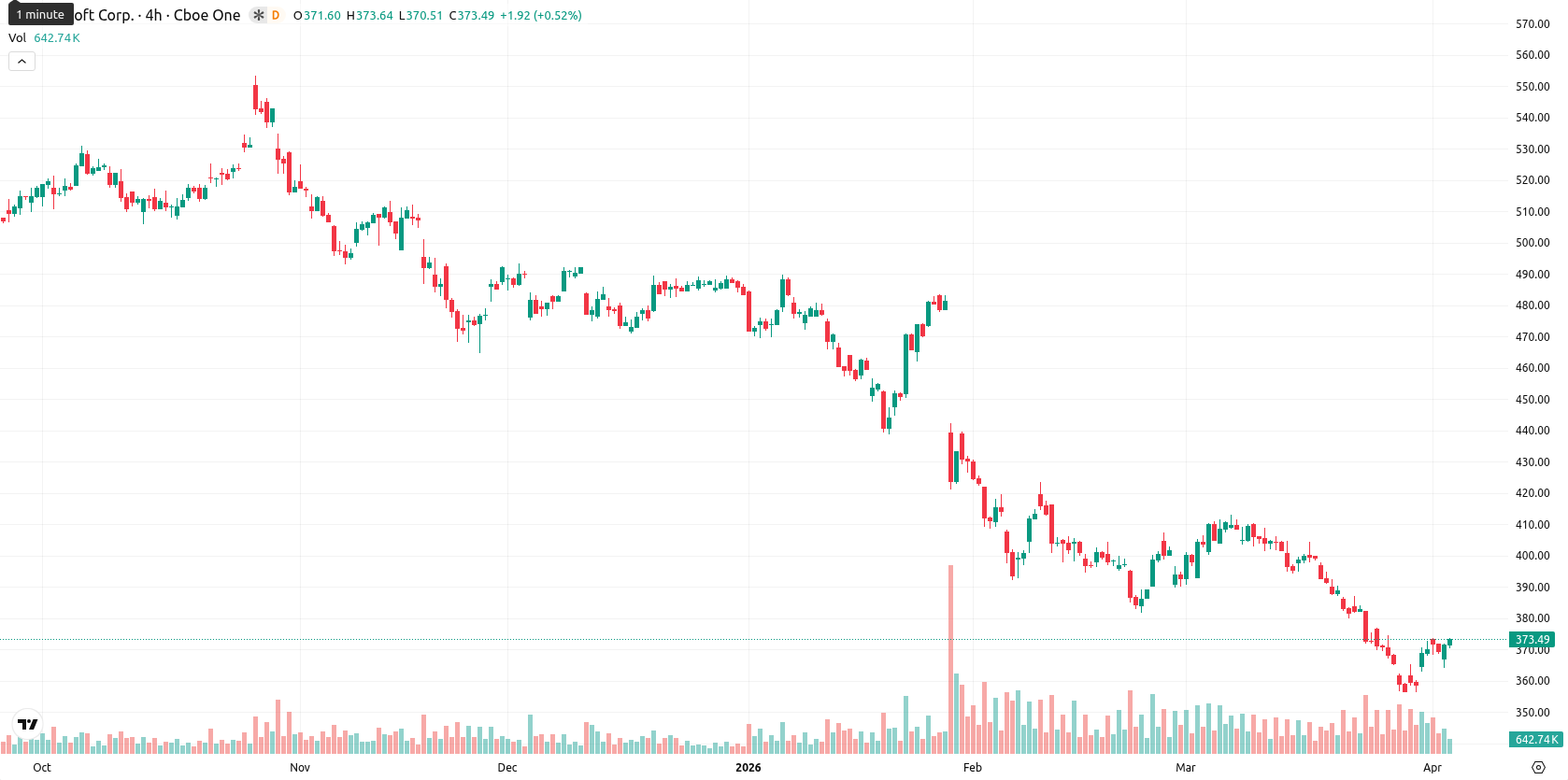
Microsoft Corporation (MSFT) is trading at $373.39, up $4.02 or 1.09% on the day. The stock remains below its SMA-20 ($385.47), SMA-50 ($403.60), and SMA-200 ($476.90), underscoring ongoing downside risk relative to key moving averages.
 411.86
440.39
411.86
440.39
Highlights
- Microsoft will invest $10 billion in Japan from 2026–2029 to boost AI infrastructure and cybersecurity collaboration amid rising regional risks.
- Escalating geopolitical threats, including Iranian cyber-attacks on US-linked AI firms, and Japanese energy supply concerns pose risks to project execution and data center resilience.
- MSFT trades below key moving averages, with weak momentum and a bearish outlook suggesting a likely range of $370–$380 in the near term.
Infrastructure expansion faces geopolitical and energy-driven operational risks
Microsoft has committed to a $10 billion investment in Japan between 2026 and 2029 to expand artificial intelligence infrastructure and enhance cybersecurity cooperation with Japanese authorities. The company is addressing acute energy and data sovereignty constraints, a response to rising geopolitical tensions in the Asia-Pacific and Middle East regions. Recent operational risks have escalated as Iranian threats have targeted US-linked AI firms and regional data centers, leading to service disruptions affecting global cloud providers such as Microsoft. Japanese energy supply concerns add further uncertainty to the timeline and resilience of Microsoft's infrastructure expansion efforts.
Seller dominance persists as multi-indicator momentum remains weak
With MSFT trading below all major MAs and the Ichimoku Kijun ($384.64) now acting as immediate resistance, the technical landscape continues to favor selling pressure across timeframes. MACD and ADX remain on Sell, signaling weak or negative momentum, while RSI at 39.32 and CCI at –70.42 indicate the stock sits in a lower trading range but is not yet oversold; meanwhile, Stoch RSI's overbought reading points to fading rally strength and a divergence with classic oscillators. BBP at –2.13 highlights intraday seller dominance, although today's close at the session high suggests buyers reclaimed control late in the day despite mixed momentum signals.
Limited upside expected as technical and volatility signals weigh
Over the next five sessions, MSFT is expected to fluctuate within a typical volatility band of $370 to $380. The likelihood of further gains is low (below 20%), and trend and momentum signals favor more downside or a neutral sideways range just under resistance. A sustained move above the Kijun level ($384.64) would be needed to shift the short-term outlook to bullish, while a break below $370 may invite additional selling toward lower support zones.
Earlier, analysts noted that Microsoft faced persistent bearish momentum driven by technical weakness and external risks, maintaining a cautious outlook for the stock. The latest developments reinforce this cautious stance as heightened geopolitical tensions and operational disruptions add new headwinds, signaling that downside risk remains prevalent and that renewed volatility around the $370 level warrants close monitoring.





Latest Microsoft News










-
 Afghanistan
-
 Albania
-
 Algeria
-
 Angola
-
 Argentina
-
 Armenia
-
 Australia
-
 Austria
-
 Azerbaijan
-
 Bahamas
-
 Bahrain
-
 Bangladesh
-
 Belarus
-
 Belgium
-
 Bolivia
-
 Botswana
-
 Brazil
-
 Brunei
-
 Bulgaria
-
 Cambodia
-
 Cameroon
-
 Canada
-
 Chile
Chile
-
 China
China
-
 Colombia
-
 Congo
Congo
-
 Costa Rica
-
 Cote d'Ivoire
-
 Croatia
-
 Cuba
Cuba
-
 Cyprus
-
 Czechia
-
 DR Congo
-
 Denmark
-
 Dominican Republic
-
 Ecuador
-
 Egypt
Egypt
-
 El Salvador
-
 Estonia
-
 Eswatini
-
 Ethiopia
-
 Finland
-
 France
-
 Georgia
-
 Germany
-
 Ghana
Ghana
-
 Greece
-
 Haiti
Haiti
-
 Hong Kong
-
 Hungary
-
 India
India
-
 Indonesia
-
 Iran, Islamic republic
-
 Iraq
Iraq
-
 Ireland
-
 Israel
-
 Italy
Italy
-
 Jamaica
-
 Japan
Japan
-
 Jordan
-
 Kazakhstan
-
 Kenya
Kenya
-
 Korea
Korea
-
 Kuwait
-
 Kyrgyzstan
-
 Laos
Laos
-
 Latvia
-
 Lebanon
-
 Lesotho
-
 Libya
Libya
-
 Lithuania
-
 Luxembourg
-
 Madagascar
-
 Malaysia
-
 Malta
Malta
-
 Mauritius
-
 Mexico
-
 Moldova
-
 Mongolia
-
 Montenegro
-
 Morocco
-
 Mozambique
-
 Myanmar
-
 Namibia
-
 Nepal
Nepal
-
 Netherlands
-
 New Zealand
-
 Nigeria
-
 North Macedonia
-
 Norway
-
 Oman
Oman
-
 Pakistan
-
 Palestine
-
 Panama
-
 Papua New Guinea
-
 Paraguay
-
 Peru
Peru
-
 Philippines
-
 Poland
-
 Portugal
-
 Puerto Rico
-
 Qatar
Qatar
-
 Reunion
-
 Romania
-
 Rwanda
-
 Saudi Arabia
-
 Serbia
-
 Singapore
-
 Slovakia
-
 Slovenia
-
 Somalia
-
 South Africa
-
 Spain
Spain
-
 Sri Lanka
-
 Sweden
-
 Switzerland
-
 Syria
Syria
-
 Taiwan
-
 Tajikistan
-
 Tanzania
-
 Thailand
-
 Trinidad and Tobago
-
 Tunisia
-
 Turkey
-
 UAE
UAE
-
 Uganda
-
 Ukraine
-
 United Kingdom
-
United States
-
 Uruguay
-
 Uzbekistan
-
 Venezuela
-
 Vietnam
-
 Yemen
Yemen
-
 Zambia
-
 Zimbabwe
- Forex
- Crypto












