
Nvidia stock falls as US-Israel-Iran tensions disrupt semiconductor trade

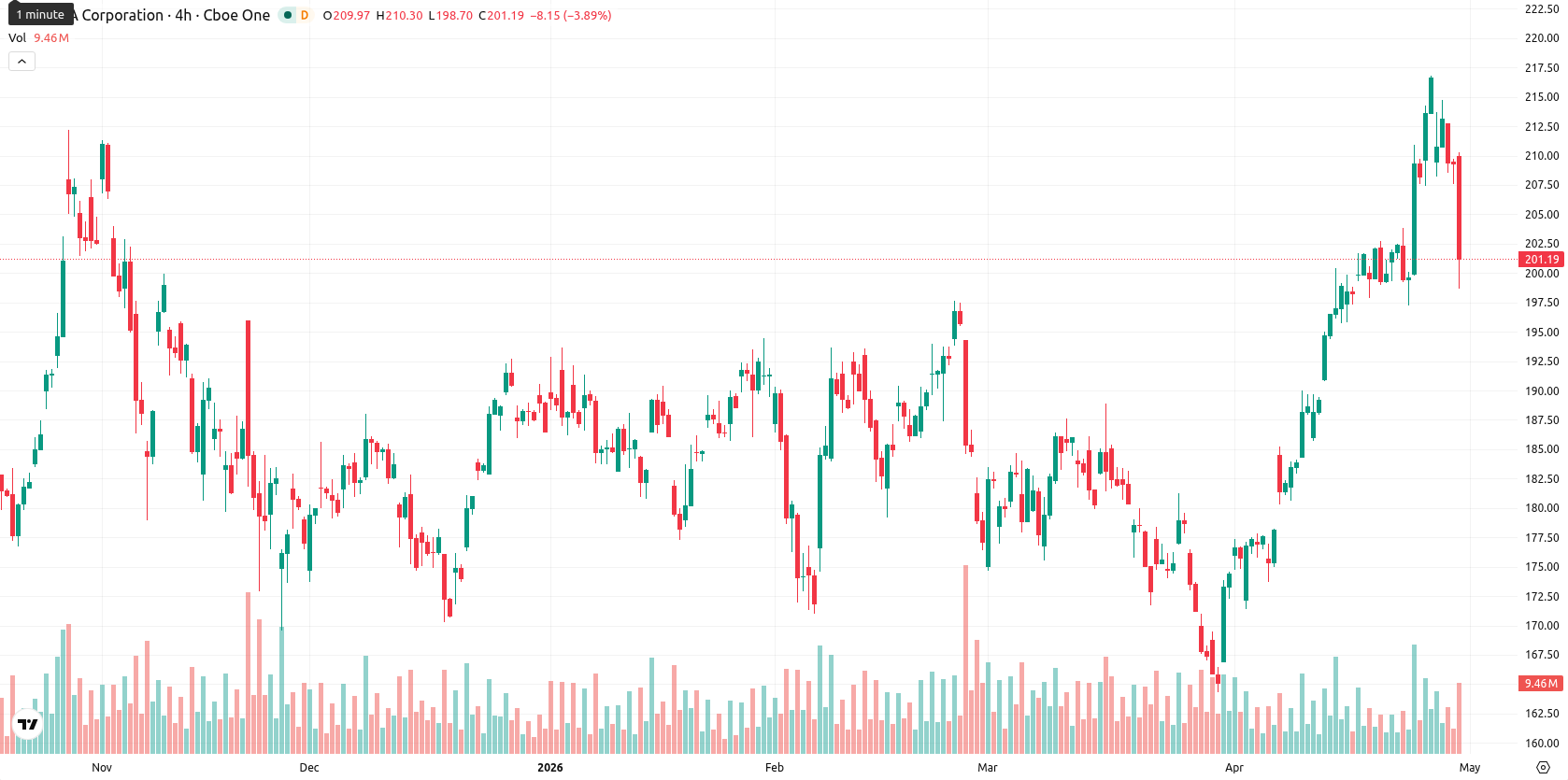
NVIDIA Corporation (NVDA) is trading at $200.43, marking a daily decline of 3.88%. The price sits above its key moving averages.
 205.66
213.84
205.66
213.84
Highlights
- Rising tensions between the US, Israel, and Iran are heightening risks of supply chain disruptions and sanctions for semiconductors.
- Slowing artificial intelligence infrastructure spending by major US hyperscalers and strict US-China export controls are clouding Nvidia's demand outlook and inflating B300 chip prices in China.
- NVDA trades near $200 with a bullish technical structure, but intraday volatility and seller pressure suggest consolidation between $197 and $206 over the next week.
Sector uncertainty grows on geopolitical tensions and supply risks
Escalating geopolitical risks between the United States, Israel, and Iran have increased the threat of trade disruptions and potential sanctions, creating uncertainty across the semiconductor sector's supply chains and demand visibility. Reports of weakened artificial intelligence infrastructure spending among major U.S. hyperscalers, driven by revenue and user shortfalls at leading AI firms, have further undermined confidence in sustained market growth. Persistent U.S.-China export restrictions have pushed the price of Nvidia's China-focused B300 chips to nearly 7 million yuan, signaling ongoing regulatory barriers and constrained supply. Heightened volatility in the Middle East, especially surrounding the US-Israel conflict, continues to threaten global technology supply chains.
Mixed momentum as bullish bias meets weak intraday trend
Technical analysis shows the price remains above the MA-20 ($194.92), MA-50 ($186.69), and MA-200 ($183.57), with immediate support given by the Ichimoku Kijun level at $190.55. Momentum indicators present a mixed picture: MACD on the daily chart reflects ongoing buying interest, while the ADX at 18.22 signals a weak overall trend. The RSI sits near 64, which is slightly elevated but below overbought territory; meanwhile, Stoch RSI and CCI register neutral to oversold readings on intraday intervals, hinting at short-term exhaustion. The Bull/Bear Power (BBP) indicator on D1 shows an overbought condition, and the Awesome Oscillator is in line with the prevailing bullish trend. Intraday price action has featured a slide toward the day's lower range ($198.76–$208.55), amid elevated volatility and increased selling pressure after the open, diverging from previous momentum signals and possibly indicating an upcoming pause or correction.
Consolidation likely as signals favor a neutral-to-bullish bias
Looking forward over the next five trading days, NVDA is projected to fluctuate within a typical weekly volatility band between $197.00 and $206.00. There is a high probability, exceeding 80%, for price consolidation or upward attempts as three of four key weekly signals remain in "Buy" territory, with only the ADX on neutral. The base scenario involves the price consolidating in a lateral channel centered near $200. A breakout above $206 would open upside toward fresh highs, whereas a decline below $197 may expose the stock to further downside risk.
Earlier, analysts noted that Nvidia maintained a bullish technical structure despite heightened geopolitical and supply chain risks, though they cautioned that persistent external pressures could threaten momentum. Recent increases in Middle East volatility and signs of weaker AI infrastructure spending add new layers of uncertainty, making it critical for traders to monitor the $197 support as a warning of potential downside should consolidation fail.




Latest NVDA News








-
 Afghanistan
-
 Albania
-
 Algeria
-
 Angola
-
 Argentina
-
 Armenia
-
 Australia
-
 Austria
-
 Azerbaijan
-
 Bahamas
-
 Bahrain
-
 Bangladesh
-
 Belarus
-
 Belgium
-
 Bolivia
-
 Botswana
-
 Brazil
-
 Brunei
-
 Bulgaria
-
 Cambodia
-
 Cameroon
-
 Canada
-
 Chile
Chile
-
 China
China
-
 Colombia
-
 Congo
Congo
-
 Costa Rica
-
 Cote d'Ivoire
-
 Croatia
-
 Cuba
Cuba
-
 Cyprus
-
 Czechia
-
 DR Congo
-
 Denmark
-
 Dominican Republic
-
 Ecuador
-
 Egypt
Egypt
-
 El Salvador
-
 Estonia
-
 Eswatini
-
 Ethiopia
-
 Finland
-
 France
-
 Georgia
-
 Germany
-
 Ghana
Ghana
-
 Greece
-
 Haiti
Haiti
-
 Hong Kong
-
 Hungary
-
 India
India
-
 Indonesia
-
 Iran, Islamic republic
-
 Iraq
Iraq
-
 Ireland
-
 Israel
-
 Italy
Italy
-
 Jamaica
-
 Japan
Japan
-
 Jordan
-
 Kazakhstan
-
 Kenya
Kenya
-
 Korea
Korea
-
 Kuwait
-
 Kyrgyzstan
-
 Laos
Laos
-
 Latvia
-
 Lebanon
-
 Lesotho
-
 Libya
Libya
-
 Lithuania
-
 Luxembourg
-
 Madagascar
-
 Malaysia
-
 Malta
Malta
-
 Mauritius
-
 Mexico
-
 Moldova
-
 Mongolia
-
 Montenegro
-
 Morocco
-
 Mozambique
-
 Myanmar
-
 Namibia
-
 Nepal
Nepal
-
 Netherlands
-
 New Zealand
-
 Nigeria
-
 North Macedonia
-
 Norway
-
 Oman
Oman
-
 Pakistan
-
 Palestine
-
 Panama
-
 Papua New Guinea
-
 Paraguay
-
 Peru
Peru
-
 Philippines
-
 Poland
-
 Portugal
-
 Puerto Rico
-
 Qatar
Qatar
-
 Reunion
-
 Romania
-
 Rwanda
-
 Saudi Arabia
-
 Serbia
-
 Singapore
-
 Slovakia
-
 Slovenia
-
 Somalia
-
 South Africa
-
 Spain
Spain
-
 Sri Lanka
-
 Sweden
-
 Switzerland
-
 Syria
Syria
-
 Taiwan
-
 Tajikistan
-
 Tanzania
-
 Thailand
-
 Trinidad and Tobago
-
 Tunisia
-
 Turkey
-
 UAE
UAE
-
 Uganda
-
 Ukraine
-
 United Kingdom
-
United States
-
 Uruguay
-
 Uzbekistan
-
 Venezuela
-
 Vietnam
-
 Yemen
Yemen
-
 Zambia
-
 Zimbabwe
- Forex
- Crypto












