
Tesla stock edges up to $254 as investors digest price cuts and policy shifts

As of April 16, 2025, Tesla Inc. (NASDAQ: TSLA) is trading at $254.11, marking a partial recovery from its March low but still reflecting a sharp 40% decline from its December 2024 peak near $500.
From a technical perspective, Tesla’s chart remains bearish, dominated by the recent formation of a "death cross" — a condition in which the 50-day simple moving average (SMA) crosses below the 200-day SMA. This pattern typically indicates weakening momentum and signals the potential for sustained downside. Currently, Tesla’s 50-day SMA is around $288.76 while the 200-day SMA is hovering at $290.60, leaving the stock well below both key moving averages.
The last time Tesla experienced a death cross was in May 2022, which was followed by a steep decline of more than 50%. While past performance is not always indicative of future outcomes, the reappearance of this technical pattern adds weight to the current negative sentiment. The Relative Strength Index (RSI) remains below the neutral 50 level, confirming a lack of bullish momentum. Meanwhile, the MACD (Moving Average Convergence Divergence) is still in negative territory, with no signs of convergence, further suggesting that any rebounds are likely to be short-lived.
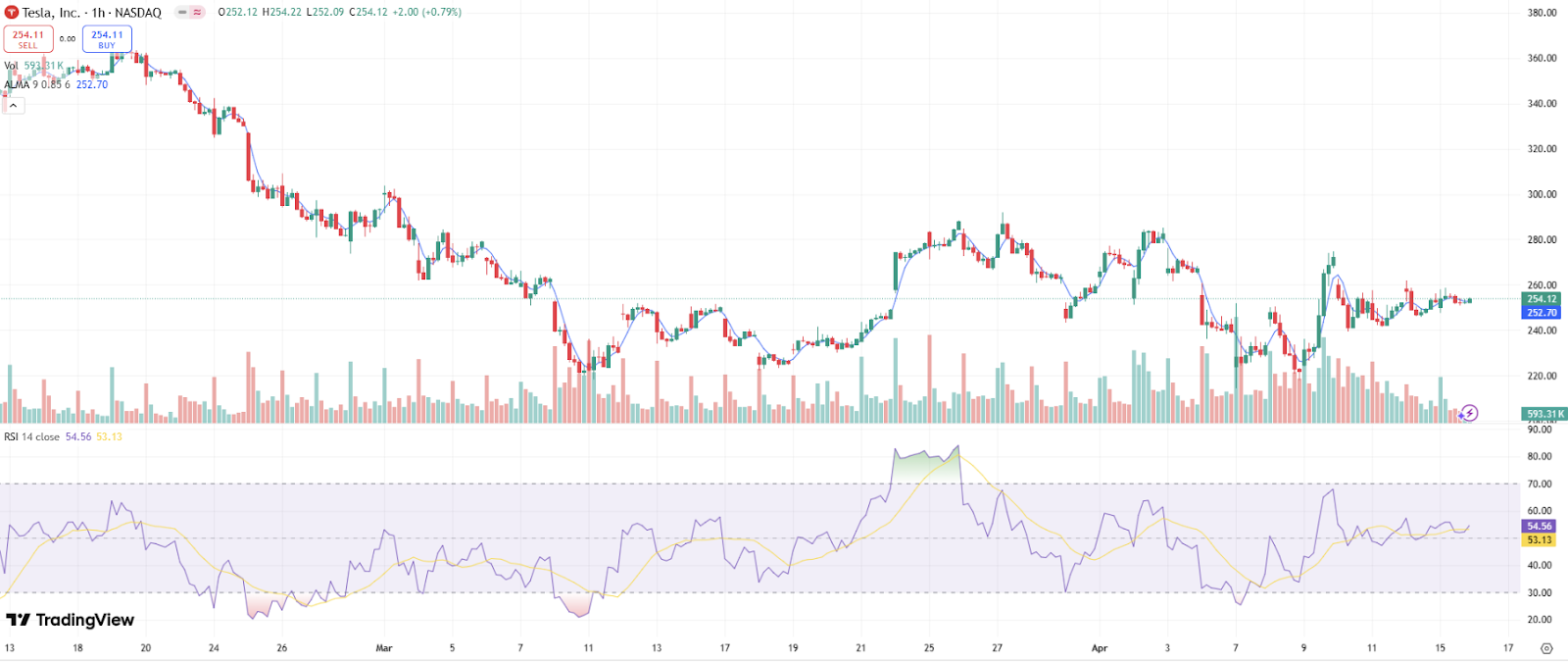
TSLA stock price dynamics (February 2025 - April 2025). Source: TradingView.
In terms of key technical levels, support is now seen at $240, which aligns with recent swing lows. A breakdown below this level could lead to a rapid test of the $220 mark, a psychologically and technically significant threshold. On the upside, Tesla faces strong resistance around $270 and again near the $290 area — the level where the 200-day moving average lies. These resistance zones will need to be reclaimed for any meaningful bullish reversal to take shape in the near term.
Tariffs, delivery forecasts, and brand headwinds
Beyond technicals, Tesla is also contending with a set of fundamental challenges. One of the most pressing issues is the imposition of a 145% tariff on Chinese goods — including critical EV components and battery materials — by the Trump administration. This policy move is expected to raise Tesla’s average vehicle production cost, resulting in approximately $5,000 in added expense per unit sold. In turn, analysts estimate that U.S. demand for Tesla vehicles may fall by as much as 9%, affecting already fragile delivery volumes.
Several major investment banks have revised their outlooks accordingly. UBS has slashed its price target for Tesla to $190, citing an expected 11% year-over-year drop in vehicle deliveries for 2025. Mizuho likewise cut its price target to $375, down from previous highs, reflecting the likelihood that higher prices will depress consumer appetite. The consensus Wall Street target remains around $327, but this includes a wide range of outcomes, indicating considerable uncertainty. These factors are layered atop concerns over brand erosion, as CEO Elon Musk’s public behavior has prompted consumer backlash in key global markets, notably in parts of Europe and the U.S.
Adding to these pressures is the increasingly competitive landscape in the global EV sector. Chinese automakers like BYD and Nio, along with legacy players such as Volkswagen and Ford, are aggressively expanding their EV offerings, often at lower price points. Tesla’s ability to maintain its market share is being challenged not only on pricing but also on innovation cycles and localization strategies.
Range-bound movement likely in the short term
Looking ahead to the rest of Q2 2025, Tesla’s price action is likely to remain range-bound, with downside risk outweighing upside potential unless market conditions improve meaningfully. A break below $240 would open the door for a decline toward $220, and potentially the $200 psychological level if delivery figures disappoint or macroeconomic pressures intensify. On the other hand, should the stock regain traction and push through resistance at $270, followed by a retest of $290, sentiment could begin to shift toward a neutral-to-bullish tone.
In the short term, however, the path of least resistance remains to the downside. The presence of the death cross, negative revisions in delivery expectations, and geopolitical trade risks form a trio of headwinds that are likely to cap any sustained recovery. Traders and investors should watch technical levels closely while remaining alert to fundamental developments — including upcoming earnings and regulatory updates — that may act as catalysts in either direction.
Tesla’s Q1 2025 deliveries fell to 337,000 units, down 13% year-over-year and about 40,000 below expectations — the sharpest miss since 2020. Analysts cite production shifts, weakening demand, and intensifying global EV competition as key drivers of the shortfall.















-
 Afghanistan
-
 Albania
-
 Algeria
-
 Angola
-
 Argentina
-
 Armenia
-
 Australia
-
 Austria
-
 Azerbaijan
-
 Bahamas
-
 Bahrain
-
 Bangladesh
-
 Belarus
-
 Belgium
-
 Bolivia
-
 Botswana
-
 Brazil
-
 Brunei
-
 Bulgaria
-
 Cambodia
-
 Cameroon
-
 Canada
-
 Chile
Chile
-
 China
China
-
 Colombia
-
 Congo
Congo
-
 Costa Rica
-
 Cote d'Ivoire
-
 Croatia
-
 Cuba
Cuba
-
 Cyprus
-
 Czechia
-
 DR Congo
-
 Denmark
-
 Dominican Republic
-
 Ecuador
-
 Egypt
Egypt
-
 El Salvador
-
 Estonia
-
 Eswatini
-
 Ethiopia
-
 Finland
-
 France
-
 Georgia
-
 Germany
-
 Ghana
Ghana
-
 Greece
-
 Haiti
Haiti
-
 Hong Kong
-
 Hungary
-
 India
India
-
 Indonesia
-
 Iran, Islamic republic
-
 Iraq
Iraq
-
 Ireland
-
 Israel
-
 Italy
Italy
-
 Jamaica
-
 Japan
Japan
-
 Jordan
-
 Kazakhstan
-
 Kenya
Kenya
-
 Korea
Korea
-
 Kuwait
-
 Kyrgyzstan
-
 Laos
Laos
-
 Latvia
-
 Lebanon
-
 Lesotho
-
 Libya
Libya
-
 Lithuania
-
 Luxembourg
-
 Madagascar
-
 Malaysia
-
 Malta
Malta
-
 Mauritius
-
 Mexico
-
 Moldova
-
 Mongolia
-
 Montenegro
-
 Morocco
-
 Mozambique
-
 Myanmar
-
 Namibia
-
 Nepal
Nepal
-
 Netherlands
-
 New Zealand
-
 Nigeria
-
 North Macedonia
-
 Norway
-
 Oman
Oman
-
 Pakistan
-
 Palestine
-
 Panama
-
 Papua New Guinea
-
 Paraguay
-
 Peru
Peru
-
 Philippines
-
 Poland
-
 Portugal
-
 Puerto Rico
-
 Qatar
Qatar
-
 Reunion
-
 Romania
-
 Rwanda
-
 Saudi Arabia
-
 Serbia
-
 Singapore
-
 Slovakia
-
 Slovenia
-
 Somalia
-
 South Africa
-
 Spain
Spain
-
 Sri Lanka
-
 Sweden
-
 Switzerland
-
 Syria
Syria
-
 Taiwan
-
 Tajikistan
-
 Tanzania
-
 Thailand
-
 Trinidad and Tobago
-
 Tunisia
-
 Turkey
-
 UAE
UAE
-
 Uganda
-
 Ukraine
-
 United Kingdom
-
United States
-
 Uruguay
-
 Uzbekistan
-
 Venezuela
-
 Vietnam
-
 Yemen
Yemen
-
 Zambia
-
 Zimbabwe
- Forex
- Crypto












