
Apple stock drops after global Mac and iPad price hikes amid chip costs

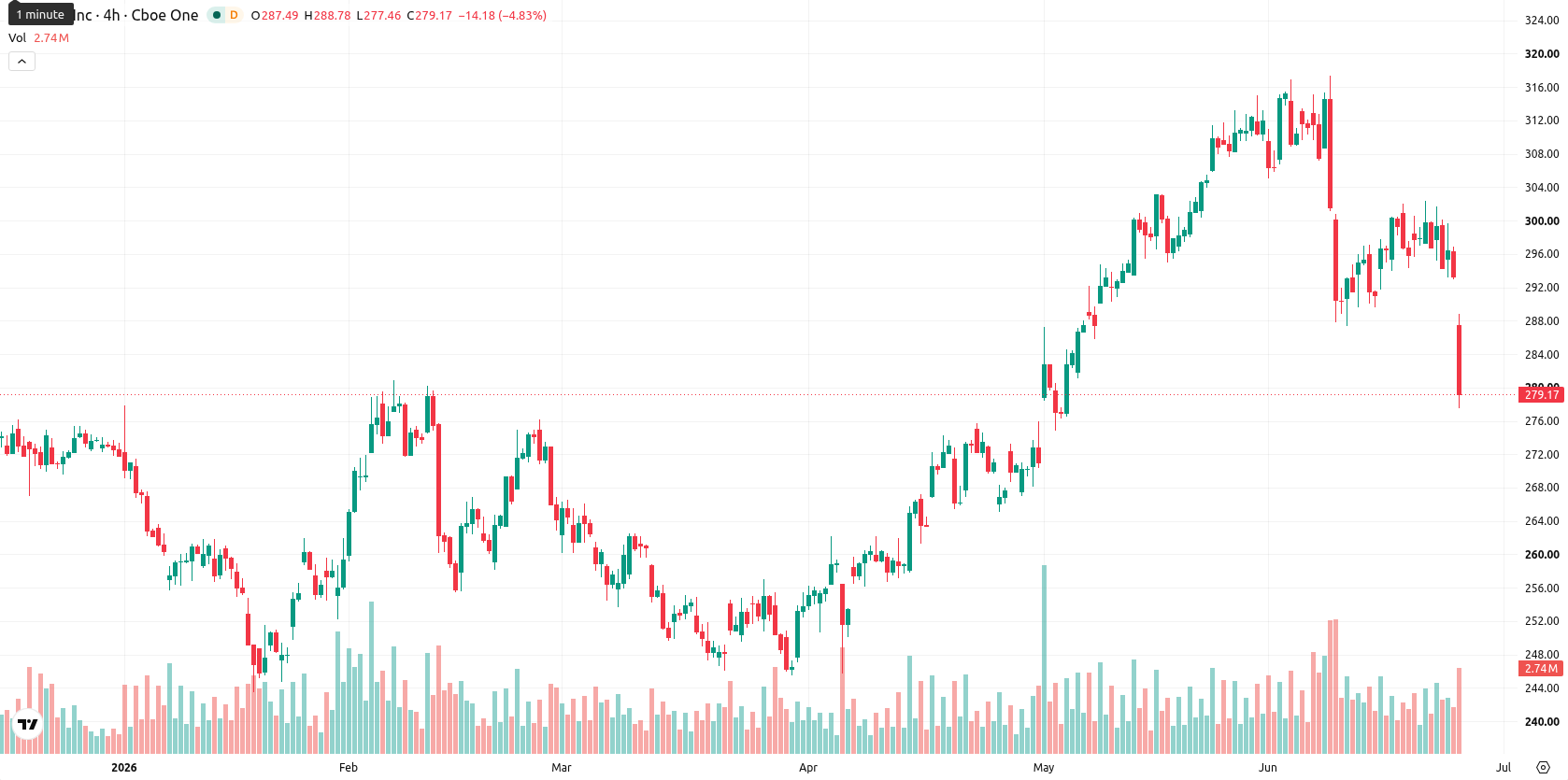
Apple Inc. (AAPL) stock is trading at $277.73, marking a daily decline of 5.53%. Shares currently sit below key moving averages, suggesting downside momentum relative to recent price trends.
 286.10
302.42
286.10
302.42
Highlights
- Apple faces heightened regulatory risk and possible operational disruptions in Russia after removing key local apps from its App Store.
- A global price hike of up to $300 on Macs and iPads driven by rising memory chip costs threatens hardware demand.
- Apple shares show short- and medium-term downside pressure with strong bearish momentum and a projected trading range of $259.49 to $282.47.
Regulatory threats and higher device prices weigh on Apple’s outlook
On June 25, Apple removed several popular Russian applications, including VK and Dzen, from its App Store, an action that has drawn immediate criticism and a formal demand for explanation from Russian authorities, according to English Pravda and Tradingview. This move restricts critical digital access for local users and exposes Apple to escalating regulatory scrutiny and potential operational hurdles within the Russian market. Separately, the company has implemented a global price increase of up to USD 300 on Mac and iPad devices due to surging memory chip costs, introducing uncertainty for consumers and impacting the accessibility of Apple’s core hardware lineup as reported by News Futunn. The combination of regulatory headwinds in Russia and higher worldwide price points has contributed to a more challenging operating environment for Apple.
Bearish momentum persists amid oversold signals and mixed oscillators
On the technical front, AAPL is trading below both the 20-period ($296.07) and 50-period ($302.71) moving averages on the 4-hour chart, while still above the 200-period ($269.03) moving average on the daily timeframe. Immediate resistance can be seen at the Ichimoku Kijun level of $302.39, with the 200-period moving average acting as longer-term support. The Moving Average Convergence Divergence (MACD) indicator is signaling a strong sell, and the Average Directional Index (ADX) is neutral, reflecting unclear trend strength. The Relative Strength Index (RSI) stands at 43.7, suggesting a bearish bias, while the Stochastic RSI and Bull/Bear Power show oversold conditions. The Commodity Channel Index (CCI) and Awesome Oscillator both remain neutral, indicating mixed signals from oscillators. Volatility is elevated with price trading near the session’s low and a recent gap of 8.57, highlighting increased intraday selling pressure.
Downside risk prevails with narrow chance of reversal in coming days
Over the next two to three trading days, AAPL is expected to fluctuate within a volatility band of $259.49 to $282.47. The probability of an upward move is estimated at 30%, with downside risk dominating at 70%, suggesting a continued decline is more likely in the short term. The base case scenario is for the price to oscillate within this projected range; a bullish reversal would require a break above immediate resistance, while a bearish outcome would be confirmed if the price falls below the lower support boundary.
Previously it was reported that Apple faced sustained downside momentum, with technical conditions indicating oversold signals and limited short-term upside. The latest escalation of regulatory pressures and higher device prices adds to the challenges, suggesting that traders should closely monitor for further weakness if shares decisively breach the lower support region in the coming sessions.





Latest Apple News










-
 Afghanistan
-
 Albania
-
 Algeria
-
 Angola
-
 Argentina
-
 Armenia
-
 Australia
-
 Austria
-
 Azerbaijan
-
 Bahamas
-
 Bahrain
-
 Bangladesh
-
 Belarus
-
 Belgium
-
 Bolivia
-
 Botswana
-
 Brazil
-
 Brunei
-
 Bulgaria
-
 Cambodia
-
 Cameroon
-
 Canada
-
 Chile
Chile
-
 China
China
-
 Colombia
-
 Congo
Congo
-
 Costa Rica
-
 Cote d'Ivoire
-
 Croatia
-
 Cuba
Cuba
-
 Cyprus
-
 Czechia
-
 DR Congo
-
 Denmark
-
 Dominican Republic
-
 Ecuador
-
 Egypt
Egypt
-
 El Salvador
-
 Estonia
-
 Eswatini
-
 Ethiopia
-
 Finland
-
 France
-
 Georgia
-
 Germany
-
 Ghana
Ghana
-
 Greece
-
 Haiti
Haiti
-
 Hong Kong
-
 Hungary
-
 India
India
-
 Indonesia
-
 Iran, Islamic republic
-
 Iraq
Iraq
-
 Ireland
-
 Israel
-
 Italy
Italy
-
 Jamaica
-
 Japan
Japan
-
 Jordan
-
 Kazakhstan
-
 Kenya
Kenya
-
 Korea
Korea
-
 Kuwait
-
 Kyrgyzstan
-
 Laos
Laos
-
 Latvia
-
 Lebanon
-
 Lesotho
-
 Libya
Libya
-
 Lithuania
-
 Luxembourg
-
 Madagascar
-
 Malaysia
-
 Malta
Malta
-
 Mauritius
-
 Mexico
-
 Moldova
-
 Mongolia
-
 Montenegro
-
 Morocco
-
 Mozambique
-
 Myanmar
-
 Namibia
-
 Nepal
Nepal
-
 Netherlands
-
 New Zealand
-
 Nigeria
-
 North Macedonia
-
 Norway
-
 Oman
Oman
-
 Pakistan
-
 Palestine
-
 Panama
-
 Papua New Guinea
-
 Paraguay
-
 Peru
Peru
-
 Philippines
-
 Poland
-
 Portugal
-
 Puerto Rico
-
 Qatar
Qatar
-
 Reunion
-
 Romania
-
 Rwanda
-
 Saudi Arabia
-
 Serbia
-
 Singapore
-
 Slovakia
-
 Slovenia
-
 Somalia
-
 South Africa
-
 Spain
Spain
-
 Sri Lanka
-
 Sweden
-
 Switzerland
-
 Syria
Syria
-
 Taiwan
-
 Tajikistan
-
 Tanzania
-
 Thailand
-
 Trinidad and Tobago
-
 Tunisia
-
 Turkey
-
 UAE
UAE
-
 Uganda
-
 Ukraine
-
 United Kingdom
-
United States
-
 Uruguay
-
 Uzbekistan
-
 Venezuela
-
 Vietnam
-
 Yemen
Yemen
-
 Zambia
-
 Zimbabwe
- Forex
- Crypto











