
LVMH stock falls 1.7% as luxury demand weakens in China and U.S.

As of August 21, LVMH stock is trading at €485.10, down 1.7% in the past 24 hours. This marks a pullback after a modest two-day rally earlier in the week. The stock remains under pressure, hovering close to the lower end of its 52-week range.
Highlights
- LVMH stock is trading near the lower end of its 52-week range, with technical resistance at €517 and support around €470.
- Sector-wide luxury demand is weakening, especially in China and the U.S., putting pressure on sales and margins.
- Despite a “Strong Buy” technical signal, any rebound is likely to be short-lived unless fundamental conditions improve.
From a technical standpoint, the trend is decisively bearish on the medium-term chart. The 50-day moving average sits above the current price level, acting as resistance near €517, while the 200-day moving average, currently around €572, reinforces the longer-term downtrend. The stock has failed to breach either of these key levels since May, indicating a lack of upward momentum. Relative Strength Index (RSI) has slipped back toward the 42 level, not yet in oversold territory but well below the 70 mark typical of bull phases.
Nevertheless, several technical indicators tracked by Investing.com suggest a potential near-term rebound. The overall technical rating is flagged as “Strong Buy” due to bullish signals from oscillators and short-term moving averages, which point to potential support around €470. Volume has also increased modestly, indicating some accumulation at current levels. Still, the price action remains fragile and vulnerable to macroeconomic data and sector-wide sentiment shifts.
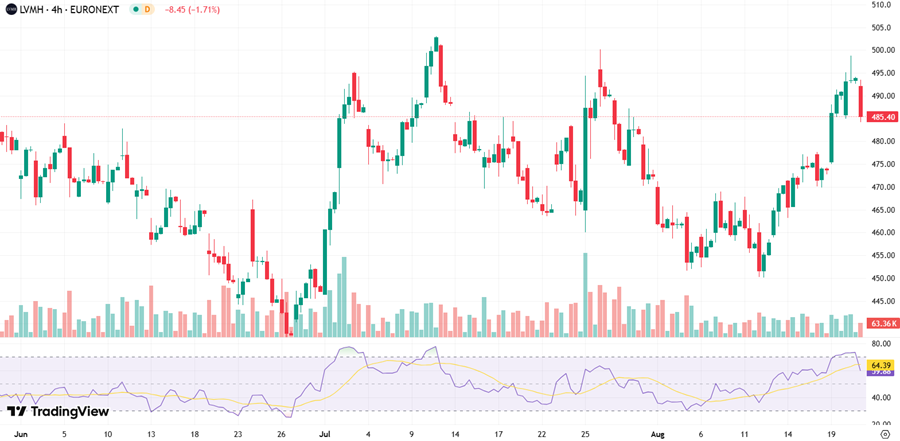
LVMH stock price dynamics (June 2025 - August 2025). Source: TradingView
Adding to the technical picture, Bollinger Bands have recently begun to narrow, indicating declining volatility and the potential for an imminent breakout. The price is currently hugging the lower band, which often suggests that the stock is oversold in the short term. Furthermore, the Moving Average Convergence Divergence (MACD) is showing early signs of a bullish crossover, with the signal line flattening and the histogram moving closer to the zero line. While these signals are not yet fully confirmed, they align with the possibility of a short-term corrective bounce.
Luxury faces demand erosion
The current drawdown in LVMH's share price is not occurring in isolation. The broader luxury sector is facing a multi-front challenge, with falling demand across key regions, particularly in Asia and North America. Global luxury brands including Dior, Gucci, and Cartier are all seeing sharp contractions in sales, driven by reduced discretionary spending, high inflation, and a weakening post-COVID rebound in China.The situation is especially acute in the Wines & Spirits segment of LVMH. Moët Hennessy burned through €1.5 billion in 2024 due to overexpansion, rapid acquisitions, and weak pricing discipline. Management has so far failed to articulate a clear recovery plan, and the division is dragging down group-wide profitability. This is a significant concern, as Wines & Spirits historically provided both margin stability and brand prestige.
Despite these pressures, LVMH posted solid full-year 2024 results: €84.7 billion in revenue and €18.9 billion in operating income. However, forward guidance was notably conservative. Geographic diversification is another stabilizing factor: 27.5% of revenue originates in Asia (excluding Japan), 25.4% in North America, and 17.2% in Europe (excluding France), with the remainder split across Japan, France, and emerging markets. This breadth offers some resilience, but also complicates strategic pivots in response to regional downturns.
Price outlook and scenarios
Looking ahead, the short-term outlook for LVMH is neutral to slightly bearish. The base case scenario sees the stock consolidating within a narrow range of €470 to €500 over the next 2–4 weeks. This assumes continued headwinds from consumer demand, ongoing weakness in Wines & Spirits, and limited upside catalysts from upcoming earnings revisions.
In the bear case, renewed weakness in Chinese luxury consumption or worsening operational losses in Moët Hennessy could drag the share price down to the €440–€460 range. Additional risks include foreign exchange volatility and interest rate concerns, especially in the eurozone and the U.S., which may impact investor appetite for cyclical discretionary names.
The luxury sector has struggled in 2024 and 2025 due to sluggish sales in major markets like China and the U.S. Iconic brands such as Gucci, Dior, and Louis Vuitton have resorted to rare discounting and promotional tactics to retain customers.














-
 Afghanistan
-
 Albania
-
 Algeria
-
 Angola
-
 Argentina
-
 Armenia
-
 Australia
-
 Austria
-
 Azerbaijan
-
 Bahamas
-
 Bahrain
-
 Bangladesh
-
 Belarus
-
 Belgium
-
 Bolivia
-
 Botswana
-
 Brazil
-
 Brunei
-
 Bulgaria
-
 Cambodia
-
 Cameroon
-
 Canada
-
 Chile
Chile
-
 China
China
-
 Colombia
-
 Congo
Congo
-
 Costa Rica
-
 Cote d'Ivoire
-
 Croatia
-
 Cuba
Cuba
-
 Cyprus
-
 Czechia
-
 DR Congo
-
 Denmark
-
 Dominican Republic
-
 Ecuador
-
 Egypt
Egypt
-
 El Salvador
-
 Estonia
-
 Eswatini
-
 Ethiopia
-
 Finland
-
 France
-
 Georgia
-
 Germany
-
 Ghana
Ghana
-
 Greece
-
 Haiti
Haiti
-
 Hong Kong
-
 Hungary
-
 India
India
-
 Indonesia
-
 Iran, Islamic republic
-
 Iraq
Iraq
-
 Ireland
-
 Israel
-
 Italy
Italy
-
 Jamaica
-
 Japan
Japan
-
 Jordan
-
 Kazakhstan
-
 Kenya
Kenya
-
 Korea
Korea
-
 Kuwait
-
 Kyrgyzstan
-
 Laos
Laos
-
 Latvia
-
 Lebanon
-
 Lesotho
-
 Libya
Libya
-
 Lithuania
-
 Luxembourg
-
 Madagascar
-
 Malaysia
-
 Malta
Malta
-
 Mauritius
-
 Mexico
-
 Moldova
-
 Mongolia
-
 Montenegro
-
 Morocco
-
 Mozambique
-
 Myanmar
-
 Namibia
-
 Nepal
Nepal
-
 Netherlands
-
 New Zealand
-
 Nigeria
-
 North Macedonia
-
 Norway
-
 Oman
Oman
-
 Pakistan
-
 Palestine
-
 Panama
-
 Papua New Guinea
-
 Paraguay
-
 Peru
Peru
-
 Philippines
-
 Poland
-
 Portugal
-
 Puerto Rico
-
 Qatar
Qatar
-
 Reunion
-
 Romania
-
 Rwanda
-
 Saudi Arabia
-
 Serbia
-
 Singapore
-
 Slovakia
-
 Slovenia
-
 Somalia
-
 South Africa
-
 Spain
Spain
-
 Sri Lanka
-
 Sweden
-
 Switzerland
-
 Syria
Syria
-
 Taiwan
-
 Tajikistan
-
 Tanzania
-
 Thailand
-
 Trinidad and Tobago
-
 Tunisia
-
 Turkey
-
 UAE
UAE
-
 Uganda
-
 Ukraine
-
 United Kingdom
-
United States
-
 Uruguay
-
 Uzbekistan
-
 Venezuela
-
 Vietnam
-
 Yemen
Yemen
-
 Zambia
-
 Zimbabwe
- Forex
- Crypto












