
LVMH stock gains 1.6% as Thomas Mulliez named Veuve Clicquot CEO
As of September 18, LVMH stock is trading at €519.7, up 1.6% over the past 24 hours. The price action comes amid an ongoing recovery from recent 2025 lows, though the stock remains significantly off its all-time highs.
Highlights
- LVMH appointed Thomas Mulliez as the new CEO of Veuve Clicquot, replacing Jean-Marc Gallot in a strategic move to revitalize its Wines & Spirits division.
- The leadership change is part of a broader effort to address declining volumes and profitability in the champagne and cognac segments.
- Shares rose 1.6%, indicating modest investor confidence in the potential for operational improvement.
Over the past 12 months, LVMH has lost approximately 25% of its market capitalization, reflecting margin compression, demand softening in Asia, and general investor de-risking from premium luxury equities. Technically, €500 remains a key support level that has held multiple times since June. The stock is now approaching short-term resistance near €525–530, where the 50-day moving average intersects with the descending trendline from the April high. A breakout above this zone could trigger a move toward the 200-day moving average around €558.
From a valuation standpoint, LVMH trades at a trailing P/E of 22.3x and a forward P/E closer to 20x, indicating moderate expectations for future earnings growth. Revenue for 2024 was €84.7 billion, essentially flat year-over-year, while net income came in at €12.6 billion, slightly down from 2023. The Fashion & Leather Goods division continues to drive profitability, while Wines & Spirits has weighed on overall margins. Free cash flow has held steady but shows some deterioration in capital efficiency within the spirits and cosmetics segments.
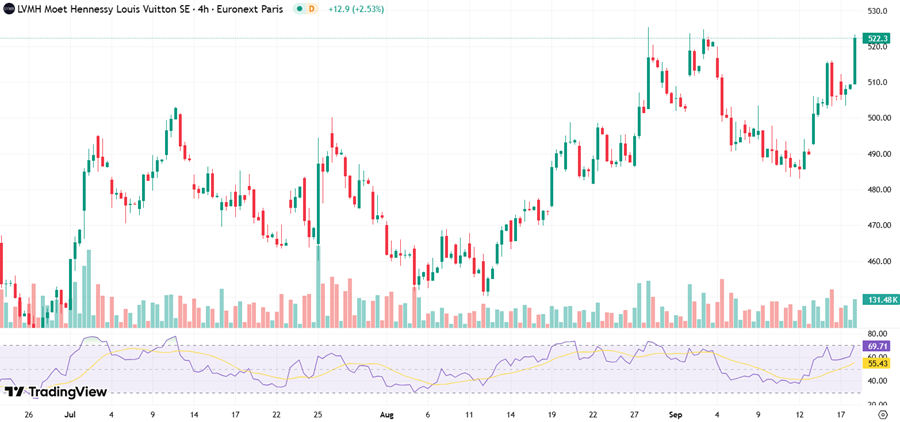
LVMH stock price dynamics (July 2025 - September 2025). Source: TradingView
Segment-wise, the crown jewels—Louis Vuitton, Dior, and Celine—continue to outperform competitors on brand equity and pricing power, though not immune to macro cycles. The Wines & Spirits unit (Moët Hennessy), on the other hand, reported revenue declines in recent quarters and saw downward revisions in guidance due to declining volumes, particularly in the U.S. and China. Negative FX effects and inflationary pressure on raw materials have also eroded margins.
Strategic moves amid headwinds: new CEO for Veuve Clicquot
In a notable strategic development, LVMH has appointed Thomas Mulliez as the new President and CEO of its champagne house, Veuve Clicquot Ponsardin. Mulliez succeeds Jean-Marc Gallot, who is leaving the group after several years at the helm. The move is part of a broader restructuring aimed at restoring momentum within the underperforming Wines & Spirits division. The leadership change signals LVMH’s attempt to inject fresh direction into a unit that has lagged both operationally and in market visibility, particularly amid declining volumes and margin compression in key export markets.
This follows earlier internal reshuffling: Jean-Jacques Guiony, previously Group CFO, was named CEO of Moët Hennessy in February 2025, with Alexandre Arnault stepping in as Deputy CEO. The group has also initiated cost-cutting measures, including a reported 12% workforce reduction in its spirits operations, and a reassessment of its portfolio strategy, particularly in mature champagne and cognac markets.The timing of these leadership changes suggests that LVMH is not waiting for macro conditions to improve but is proactively repositioning the division to regain competitiveness. This strategic pivot is especially critical given that Hermès has recently overtaken LVMH as the most valuable luxury brand by market cap—driven largely by steadier margins and better resilience in Asia-Pacific.
Recovery hinges on spirits turnaround and China rebound
With LVMH trading near €520, the next phase will be determined by three interrelated factors: margin stabilization, spirits division recovery, and Chinese consumer sentiment. In the base case, if cost discipline holds and the new leadership team succeeds in arresting the decline in Wines & Spirits, the stock could see a 10–15% rebound, targeting €570–590 over the next six months. This would likely require positive signals from Q3 earnings, particularly around inventory normalization and pricing strategy in champagne and cognac.
The bear case involves continued volume pressure in spirits, weak Chinese demand, and limited operating leverage in Fashion & Leather Goods. Under that scenario, the stock risks falling back to the €480–490 zone, particularly if macro conditions worsen or geopolitical risks escalate in key regions. In the bull case, a strong recovery in Asia coupled with successful repositioning of Moët Hennessy and easing FX pressures could push shares toward €620, regaining lost ground from early 2024 levels.
Giorgio Armani’s will names LVMH, L’Oréal, and EssilorLuxottica as preferred future acquirers of the brand, outlining a phased sale of up to 54.9% over five years. LVMH welcomed the move, with CEO Bernard Arnault expressing interest in a deal that would honor Armani’s legacy while strengthening its global footprint.












-
 Afghanistan
-
 Albania
-
 Algeria
-
 Angola
-
 Argentina
-
 Armenia
-
 Australia
-
 Austria
-
 Azerbaijan
-
 Bahamas
-
 Bahrain
-
 Bangladesh
-
 Belarus
-
 Belgium
-
 Bolivia
-
 Botswana
-
 Brazil
-
 Brunei
-
 Bulgaria
-
 Cambodia
-
 Cameroon
-
 Canada
-
 Chile
Chile
-
 China
China
-
 Colombia
-
 Congo
Congo
-
 Costa Rica
-
 Cote d'Ivoire
-
 Croatia
-
 Cuba
Cuba
-
 Cyprus
-
 Czechia
-
 DR Congo
-
 Denmark
-
 Dominican Republic
-
 Ecuador
-
 Egypt
Egypt
-
 El Salvador
-
 Estonia
-
 Eswatini
-
 Ethiopia
-
 Finland
-
 France
-
 Georgia
-
 Germany
-
 Ghana
Ghana
-
 Greece
-
 Haiti
Haiti
-
 Hong Kong
-
 Hungary
-
 India
India
-
 Indonesia
-
 Iran, Islamic republic
-
 Iraq
Iraq
-
 Ireland
-
 Israel
-
 Italy
Italy
-
 Jamaica
-
 Japan
Japan
-
 Jordan
-
 Kazakhstan
-
 Kenya
Kenya
-
 Korea
Korea
-
 Kuwait
-
 Kyrgyzstan
-
 Laos
Laos
-
 Latvia
-
 Lebanon
-
 Lesotho
-
 Libya
Libya
-
 Lithuania
-
 Luxembourg
-
 Madagascar
-
 Malaysia
-
 Malta
Malta
-
 Mauritius
-
 Mexico
-
 Moldova
-
 Mongolia
-
 Montenegro
-
 Morocco
-
 Mozambique
-
 Myanmar
-
 Namibia
-
 Nepal
Nepal
-
 Netherlands
-
 New Zealand
-
 Nigeria
-
 North Macedonia
-
 Norway
-
 Oman
Oman
-
 Pakistan
-
 Palestine
-
 Panama
-
 Papua New Guinea
-
 Paraguay
-
 Peru
Peru
-
 Philippines
-
 Poland
-
 Portugal
-
 Puerto Rico
-
 Qatar
Qatar
-
 Reunion
-
 Romania
-
 Rwanda
-
 Saudi Arabia
-
 Serbia
-
 Singapore
-
 Slovakia
-
 Slovenia
-
 Somalia
-
 South Africa
-
 Spain
Spain
-
 Sri Lanka
-
 Sweden
-
 Switzerland
-
 Syria
Syria
-
 Taiwan
-
 Tajikistan
-
 Tanzania
-
 Thailand
-
 Trinidad and Tobago
-
 Tunisia
-
 Turkey
-
 UAE
UAE
-
 Uganda
-
 Ukraine
-
 United Kingdom
-
United States
-
 Uruguay
-
 Uzbekistan
-
 Venezuela
-
 Vietnam
-
 Yemen
Yemen
-
 Zambia
-
 Zimbabwe
- Forex
- Crypto












