
Gold steadies above $4,100 as traders eye inflation data and Fed outlook

Gold prices edged lower on Wednesday, hovering near $4,106 after briefly touching $4,150 earlier in the European session. The pullback reflected a balancing act between expectations of a Federal Reserve rate cut next week and easing U.S.–China trade tensions that tempered safe-haven demand.
Highlights
- Gold trades around $4,100 as Fed rate cut bets offset easing trade risks.
- Investors await U.S. CPI data for clues on the Fed’s policy path.
- Support seen near $4,000 with resistance around $4,380.
Despite the dip, the metal remains close to record highs, signaling that underlying bullish sentiment is still intact.
Technical setup points to short-term consolidation
On the charts, gold has retreated from its recent peak near $4,380, where the Parabolic SAR signaled temporary overextension. The metal is consolidating around $4,106, with the Supertrend indicator maintaining a bullish bias as long as prices stay above $4,027. The immediate resistance zone remains at $4,380, while initial support is forming near $4,000—a key psychological and technical level tied to the previous breakout region. A deeper correction could drag gold toward $3,435, the upper edge of its summer consolidation phase, but such a move would require a clear loss of momentum.
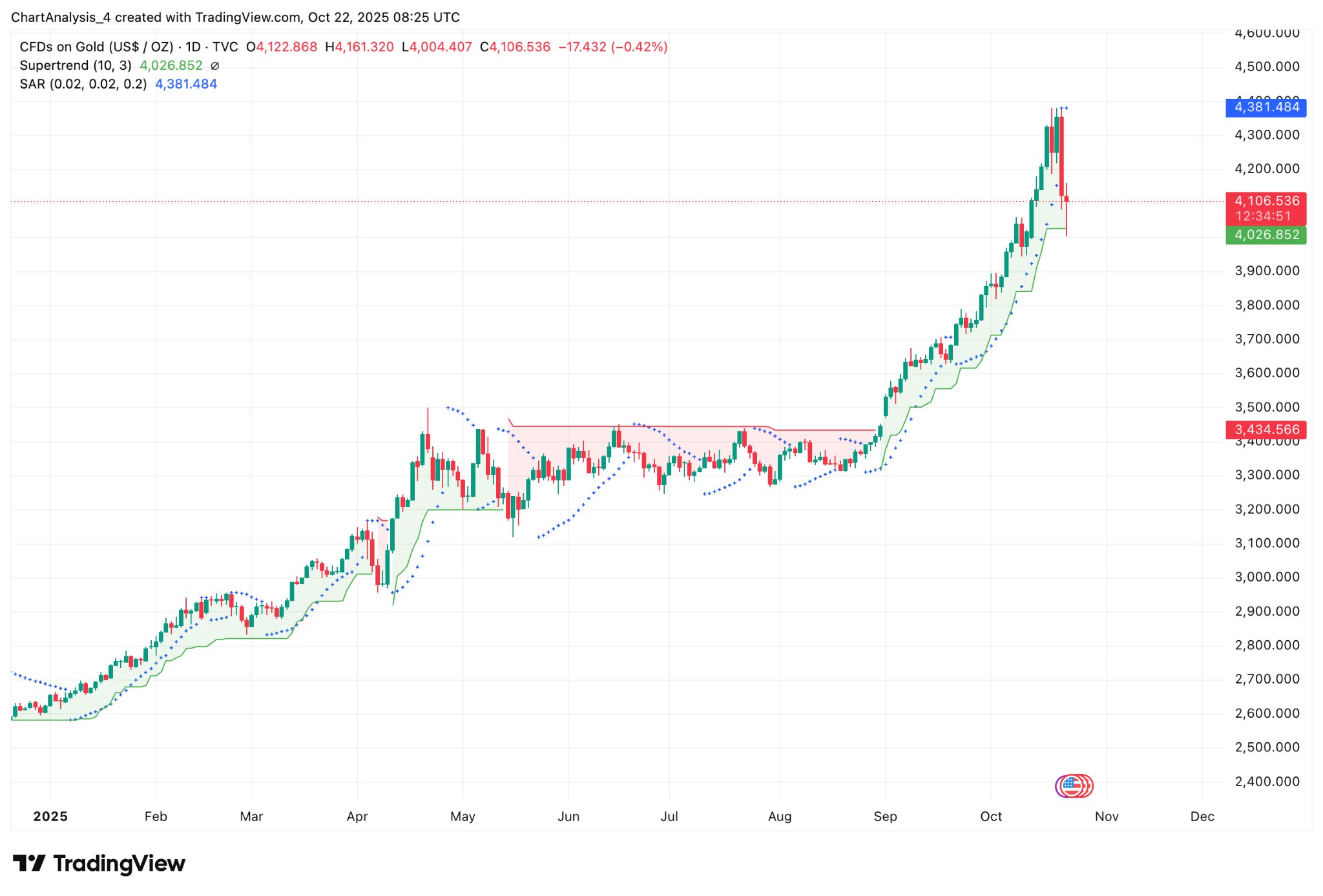
Gold price dynamics (Source: TradingView)
The broader uptrend remains firmly established after gold broke out of its multi-month range between $3,400 and $3,600 in late September. That breakout marked a shift in investor positioning, as expectations for U.S. monetary easing and elevated geopolitical risk drove a wave of demand for hedging assets. The rally has since lifted gold to record highs, making it one of 2025’s strongest-performing assets.
Macro catalysts guide sentiment
Markets are nearly fully pricing in a 25-basis-point rate cut at next week’s Fed policy meeting, with another reduction expected by December. Lower interest rates tend to support non-yielding assets like gold by reducing the opportunity cost of holding them. Meanwhile, the prolonged U.S. government shutdown has injected uncertainty into markets, enhancing gold’s safe-haven appeal.
At the same time, a thaw in U.S.–China trade relations has limited upside momentum. Officials from both sides are moving toward a deal ahead of the November 1 tariff deadline, with President Trump signaling flexibility after earlier threatening 100% tariffs. Improved trade sentiment could weigh on gold if risk appetite strengthens, particularly if combined with higher U.S. inflation readings.
The next key test comes with Friday’s U.S. September CPI report, expected to show headline and core inflation at 3.1% year-over-year. A stronger print could lift the dollar and prompt short-term selling in gold, while a softer reading would reinforce the Fed’s dovish stance and likely revive buying momentum toward $4,380 and potentially $4,500.
Outlook
As covered in prior analyses, gold’s longer-term structure remains bullish despite near-term consolidation. The $4,000–$4,027 range now acts as a key floor for buyers, while resistance between $4,375 and $4,400 defines the ceiling for the next breakout attempt.
Unless the price breaks decisively below $4,000, corrections are likely to be treated as pauses within a broader uptrend fueled by dovish policy expectations and persistent geopolitical uncertainty.




Latest XAU/USD News










-
 Afghanistan
-
 Albania
-
 Algeria
-
 Angola
-
 Argentina
-
 Armenia
-
 Australia
-
 Austria
-
 Azerbaijan
-
 Bahamas
-
 Bahrain
-
 Bangladesh
-
 Belarus
-
 Belgium
-
 Bolivia
-
 Botswana
-
 Brazil
-
 Brunei
-
 Bulgaria
-
 Cambodia
-
 Cameroon
-
 Canada
-
 Chile
Chile
-
 China
China
-
 Colombia
-
 Congo
Congo
-
 Costa Rica
-
 Cote d'Ivoire
-
 Croatia
-
 Cuba
Cuba
-
 Cyprus
-
 Czechia
-
 DR Congo
-
 Denmark
-
 Dominican Republic
-
 Ecuador
-
 Egypt
Egypt
-
 El Salvador
-
 Estonia
-
 Eswatini
-
 Ethiopia
-
 Finland
-
 France
-
 Georgia
-
 Germany
-
 Ghana
Ghana
-
 Greece
-
 Haiti
Haiti
-
 Hong Kong
-
 Hungary
-
 India
India
-
 Indonesia
-
 Iran, Islamic republic
-
 Iraq
Iraq
-
 Ireland
-
 Israel
-
 Italy
Italy
-
 Jamaica
-
 Japan
Japan
-
 Jordan
-
 Kazakhstan
-
 Kenya
Kenya
-
 Korea
Korea
-
 Kuwait
-
 Kyrgyzstan
-
 Laos
Laos
-
 Latvia
-
 Lebanon
-
 Lesotho
-
 Libya
Libya
-
 Lithuania
-
 Luxembourg
-
 Madagascar
-
 Malaysia
-
 Malta
Malta
-
 Mauritius
-
 Mexico
-
 Moldova
-
 Mongolia
-
 Montenegro
-
 Morocco
-
 Mozambique
-
 Myanmar
-
 Namibia
-
 Nepal
Nepal
-
 Netherlands
-
 New Zealand
-
 Nigeria
-
 North Macedonia
-
 Norway
-
 Oman
Oman
-
 Pakistan
-
 Palestine
-
 Panama
-
 Papua New Guinea
-
 Paraguay
-
 Peru
Peru
-
 Philippines
-
 Poland
-
 Portugal
-
 Puerto Rico
-
 Qatar
Qatar
-
 Reunion
-
 Romania
-
 Rwanda
-
 Saudi Arabia
-
 Serbia
-
 Singapore
-
 Slovakia
-
 Slovenia
-
 Somalia
-
 South Africa
-
 Spain
Spain
-
 Sri Lanka
-
 Sweden
-
 Switzerland
-
 Syria
Syria
-
 Taiwan
-
 Tajikistan
-
 Tanzania
-
 Thailand
-
 Trinidad and Tobago
-
 Tunisia
-
 Turkey
-
 UAE
UAE
-
 Uganda
-
 Ukraine
-
 United Kingdom
-
United States
-
 Uruguay
-
 Uzbekistan
-
 Venezuela
-
 Vietnam
-
 Yemen
Yemen
-
 Zambia
-
 Zimbabwe
- Forex
- Crypto












