
Nikkei 225 jumps as global easing bets clash with BOJ policy risk
The Nikkei 225 surged 1.14% to 49,865 on Wednesday, reversing early-week weakness as global equity markets rallied on renewed expectations that the U.S. Federal Reserve will continue cutting rates into 2026.
Highlights
- Nikkei 225 closes at 49,865, breaking out of a month-long compression pattern.
- Tech leaders drive gains as markets price aggressive Fed easing into 2026.
- BOJ tightening risk clouds outlook, keeping domestic investors cautious.
The rebound aligned with risk-on flows across Wall Street, but Japan’s benchmark index is locked in a more nuanced battle, navigating a month-long technical compression even as domestic policy uncertainty tempers momentum.
Market attempts breakout as global easing narrative strengthens
The index has spent the past month inside a contracting triangle pattern that formed after the late-October peak above 51,500. That high coincided with momentum exhaustion across Japan’s heavy-weight sectors, triggering a corrective phase defined by lower highs but anchored by a long-term ascending trendline.
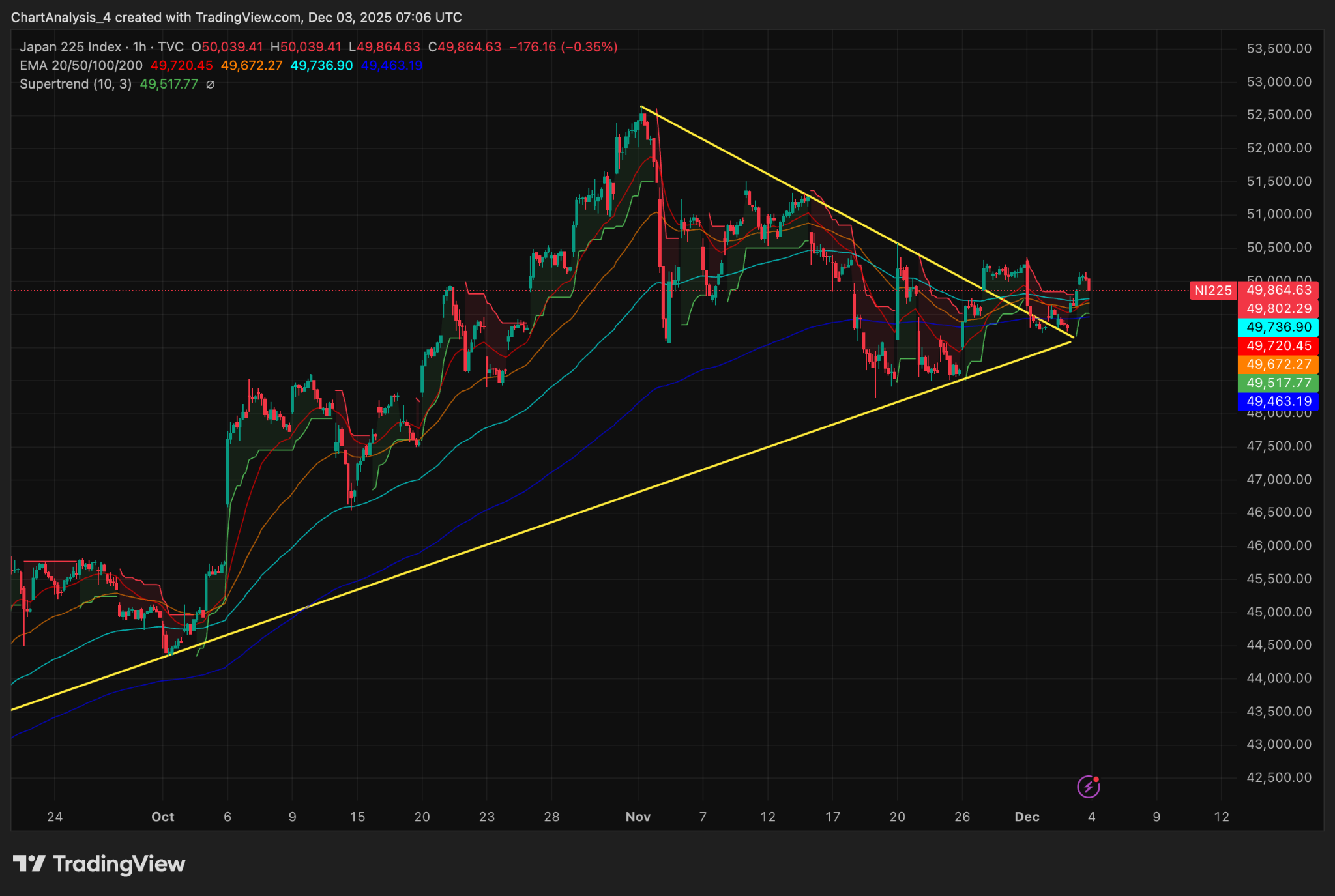
Nikkei 225 index price dynamics (Source: TradingView)
That trendline, which began in early October, was tested repeatedly near 49,000 and held firm last week, producing a clean rebound. Wednesday’s advance marks the index’s first meaningful attempt to clear the upper wedge boundary, shifting the technical tone from defensive stabilization to early-stage breakout.
Short-term moving averages are beginning to realign to the upside. The 20, 50, and 100-period EMAs have flattened and are starting to curl higher, while the 200-period EMA near 49,470 remains a strong structural anchor. The Supertrend indicator flipped positive this week, reinforcing the shift in momentum as price reclaimed territory lost during November’s decline.
Sector divergence reveals cross-currents in domestic risk appetite
Beneath the surface, Wednesday’s rally was far from uniform. Technology names powered the advance, with outsized gains from SoftBank Group, Advantest, Tokyo Electron, Lasertec, and related semiconductor suppliers. These companies tend to outperform when global liquidity expectations rise, and the latest shift in Fed policy assumptions has strengthened demand for high-duration assets.
In contrast, financials and consumer stocks lagged. Shares of Mitsubishi UFJ and Sumitomo Mitsui weakened, reflecting the tension between a global easing cycle and the possibility that the Bank of Japan may raise rates sooner than expected. Banks benefit from stable rate environments and wider domestic spreads; a scenario where the Fed cuts while the BOJ tightens is structurally unfavorable for the sector.
This divergence reflects a broader theme: foreign investors are driving the index higher on global macro optimism, but domestic investors remain cautious, unwilling to fully re-risk portfolios until BOJ direction becomes clearer.
BOJ uncertainty tempers sentiment despite global tailwinds
BOJ Governor Kazuo Ueda reiterated this week that any policy shift will be data-dependent, but markets remain acutely aware that a December rate hike is still feasible. After years of ultra-loose policy, even minor adjustments carry significant signaling power. That tension kept Wednesday’s rally measured rather than euphoric, as investors balanced global easing expectations against potential domestic tightening.
For bulls, this tension may present an opportunity. If the BOJ refrains from hiking this month, the Nikkei could see a powerful catch-up rally as domestic investors re-enter risk assets. Conversely, a rate increase introduced into a global easing cycle could create a rare dual headwind for Japanese equities: falling duration demand and tightening domestic liquidity.
Technical roadmap points to decisive levels ahead
The first significant resistance sits near 50,300, followed by a heavy supply band between 50,800 and 51,200 — a region that capped rallies throughout November. A clean breakout above this area would confirm trend continuation and open the path toward 52,000 to 52,400, where momentum buyers historically accelerate positioning.
Downside support begins at 49,600, with secondary support near 49,200. The long-term ascending trendline around 48,800 remains the critical level; a break below it would invalidate the bullish structure and likely force de-risking across leveraged accounts.
For now, the chart suggests a market preparing for trend resumption, but macro uncertainty continues to restrain conviction.In earlier analysis, we highlighted the Nikkei’s sensitivity to BOJ policy and global liquidity signals. This week’s breakout attempt aligns with that framework: technical momentum turns higher when global easing expectations strengthen, but trend sustainability hinges on BOJ decisions that remain unresolved.





Latest Nikkei 225 News









-
 Afghanistan
-
 Albania
-
 Algeria
-
 Angola
-
 Argentina
-
 Armenia
-
 Australia
-
 Austria
-
 Azerbaijan
-
 Bahamas
-
 Bahrain
-
 Bangladesh
-
 Belarus
-
 Belgium
-
 Bolivia
-
 Botswana
-
 Brazil
-
 Brunei
-
 Bulgaria
-
 Cambodia
-
 Cameroon
-
 Canada
-
 Chile
Chile
-
 China
China
-
 Colombia
-
 Congo
Congo
-
 Costa Rica
-
 Cote d'Ivoire
-
 Croatia
-
 Cuba
Cuba
-
 Cyprus
-
 Czechia
-
 DR Congo
-
 Denmark
-
 Dominican Republic
-
 Ecuador
-
 Egypt
Egypt
-
 El Salvador
-
 Estonia
-
 Eswatini
-
 Ethiopia
-
 Finland
-
 France
-
 Georgia
-
 Germany
-
 Ghana
Ghana
-
 Greece
-
 Haiti
Haiti
-
 Hong Kong
-
 Hungary
-
 India
India
-
 Indonesia
-
 Iran, Islamic republic
-
 Iraq
Iraq
-
 Ireland
-
 Israel
-
 Italy
Italy
-
 Jamaica
-
 Japan
Japan
-
 Jordan
-
 Kazakhstan
-
 Kenya
Kenya
-
 Korea
Korea
-
 Kuwait
-
 Kyrgyzstan
-
 Laos
Laos
-
 Latvia
-
 Lebanon
-
 Lesotho
-
 Libya
Libya
-
 Lithuania
-
 Luxembourg
-
 Madagascar
-
 Malaysia
-
 Malta
Malta
-
 Mauritius
-
 Mexico
-
 Moldova
-
 Mongolia
-
 Montenegro
-
 Morocco
-
 Mozambique
-
 Myanmar
-
 Namibia
-
 Nepal
Nepal
-
 Netherlands
-
 New Zealand
-
 Nigeria
-
 North Macedonia
-
 Norway
-
 Oman
Oman
-
 Pakistan
-
 Palestine
-
 Panama
-
 Papua New Guinea
-
 Paraguay
-
 Peru
Peru
-
 Philippines
-
 Poland
-
 Portugal
-
 Puerto Rico
-
 Qatar
Qatar
-
 Reunion
-
 Romania
-
 Rwanda
-
 Saudi Arabia
-
 Serbia
-
 Singapore
-
 Slovakia
-
 Slovenia
-
 Somalia
-
 South Africa
-
 Spain
Spain
-
 Sri Lanka
-
 Sweden
-
 Switzerland
-
 Syria
Syria
-
 Taiwan
-
 Tajikistan
-
 Tanzania
-
 Thailand
-
 Trinidad and Tobago
-
 Tunisia
-
 Turkey
-
 UAE
UAE
-
 Uganda
-
 Ukraine
-
 United Kingdom
-
United States
-
 Uruguay
-
 Uzbekistan
-
 Venezuela
-
 Vietnam
-
 Yemen
Yemen
-
 Zambia
-
 Zimbabwe
- Forex
- Crypto












